• Email Us: [email protected]
  • Contact Us: +1 718 874 1545
  • Skip to main content
  • Skip to primary sidebar

Medical Market Report

  • Home
  • All Reports
  • About Us
  • Contact Us

New Volcano Has Been Found Flinging Debris From Earth’s Insides

May 16, 2023 by Deborah Bloomfield

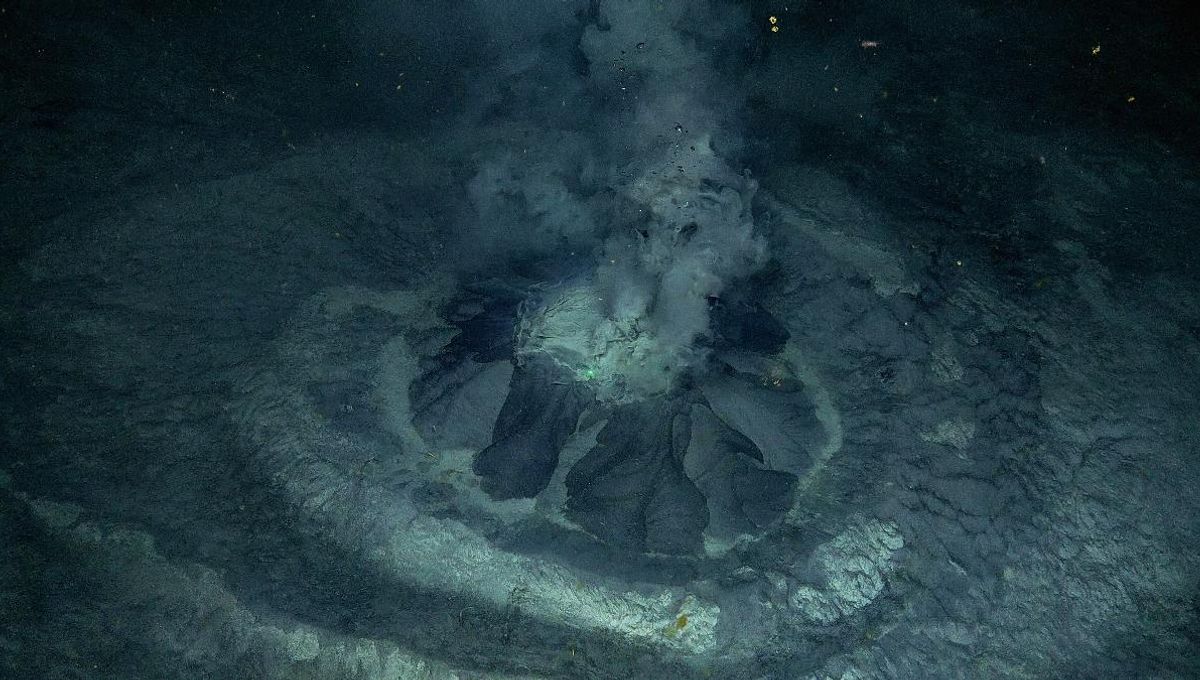
A new volcano has been discovered deep in the icy waters of the Barents Sea in the Norwegian Arctic. Remarkably, it’s active and can still be seen oozing a flurry of mud, liquid, and gas. By studying this newly found volcano and its spewed contents, scientists believe they might be able to catch some insights into the mysteries of Earth’s interior.

Named Borealis Mud Volcano, researchers from the University of Tromsø (UiT) – The Arctic University of Norway identified the volcano earlier this month at a depth of 400 meters (1,312 feet) in the Barents Sea, located above the northern coast of Norway.

Advertisement

In collaboration with REV Ocean, it was discovered with the help of a remote-controlled underwater vessel, named ROV Aurora, which was launched from the icebreaking polar research vessel RV Kronprins Haakon. 

It’s just the second time a mud volcano has been discovered in the waters of Norway – and scientists are pretty excited.

“Seeing an underwater eruption in real time reminds me how ‘alive’ our planet is,” Professor Giuliana Panieri, expedition leader and principal researcher for the UiT project, said in a statement. 

“We do not rule out the possibility of discovering other mud volcanoes in the Barents Sea. It is only thanks to good cooperation and advanced technology that we can make such discoveries,” continued Panieri.

Advertisement

The volcano is just 7 meters (22 feet) in diameter and 2.5 meters (8 feet) in height, located within a crater that is approximately 300 meters (984 feet) wide and 25 meters (82 feet) deep.  It’s thought this crater was the result of a blast of methane that erupted shortly after the last Ice Age 18,000 years ago.

It may be small, but it’s a mighty one. The volcano spews out a cocktail of water, gas, and fine sediments that likely originate several hundred meters to a few kilometers beneath the seabed. As such, the researchers say the composition of this slurry could offer a “direct window” into the depths of Earth’s interior.

The submarine volcano is home to a unique ecosystem that includes sea anemones, sponges, carnivorous sponges, starfish, corals, sea spiders, and crustaceans, not to mention a host of bacteria. 

“Exploring the seabed and discovering new methane insights is like finding hidden treasures. It is full of surprises. We have found thousands of such insights. Nevertheless, every time we go down to the seabed, we get the feeling that we have just begun to understand the great and incredible diversity of such insight systems,” explained Professor Stefan Buenz, who worked on the project. 

Deborah Bloomfield
Deborah Bloomfield

Related posts:

  1. UK PM Johnson to address lawmakers about Afghanistan on Monday
  2. Pandemic-hit Qantas weighs new pay structure to keep key executives
  3. Air New Zealand reels from Auckland curbs, Australia bubble loss
  4. Google’s Rival To ChatGPT Makes Embarrassing JWST Error That Wipes $100 Billion Off Shares

Source Link: New Volcano Has Been Found Flinging Debris From Earth's Insides

Filed Under: News

Primary Sidebar

  • US Just Killed NASA’s Mars Sample Return Mission – So What Happens Now?
  • Art Sleuths May Have Recovered Traces Of Da Vinci’s DNA From One Of His Drawings
  • Countries With The Most Narcissists Identified By 45,000-Person Study, And The Results Might Surprise You
  • World’s Oldest Poison Arrows Were Used By Hunters 60,000 Years Ago
  • The Real Reason You Shouldn’t Eat (Most) Raw Cookie Dough
  • Antarctic Scientists Have Just Moved The South Pole – Literally
  • “What We Have Is A Very Good Candidate”: Has The Ancestor Of Homo Sapiens Finally Been Found In Africa?
  • Europe’s Missing Ceratopsian Dinosaurs Have Been Found And They’re Quite Diverse
  • Why Don’t Snorers Wake Themselves Up?
  • Endangered “Northern Native Cat” Captured On Camera For The First Time In 80 Years At Australian Sanctuary
  • Watch 25 Years Of A Supernova Expanding Into Space Squeezed Into This 40-Second NASA Video
  • “Diet Stacking” Trend Could Be Seriously Bad For Your Health
  • Meet The Psychedelic Earth Tiger, A Funky Addition To “10 Species To Watch” In 2026
  • The Weird Mystery Of The “Einstein Desert” In The Hunt For Rogue Planets
  • NASA Astronaut Charles Duke Left A Touching Photograph And Message On The Moon In 1972
  • How Multilingual Are You? This New Language Calculator Lets You Find Out In A Minute
  • Europa’s Seabed Might Be Too Quiet For Life: “The Energy Just Doesn’t Seem To Be There”
  • Amoebae: The Microscopic Health Threat Lurking In Our Water Supplies. Are We Taking Them Seriously?
  • The Last Dogs In Antarctica Were Kicked Out In April 1994 By An International Treaty
  • Interstellar Comet 3I/ATLAS Snapped By NASA’s Europa Mission: “We’re Still Scratching Our Heads About Some Of The Things We’re Seeing”
  • Business
  • Health
  • News
  • Science
  • Technology
  • +1 718 874 1545
  • +91 78878 22626
  • [email protected]
Office Address
Prudour Pvt. Ltd. 420 Lexington Avenue Suite 300 New York City, NY 10170.

Powered by Prudour Network

Copyrights © 2026 · Medical Market Report. All Rights Reserved.

Go to mobile version