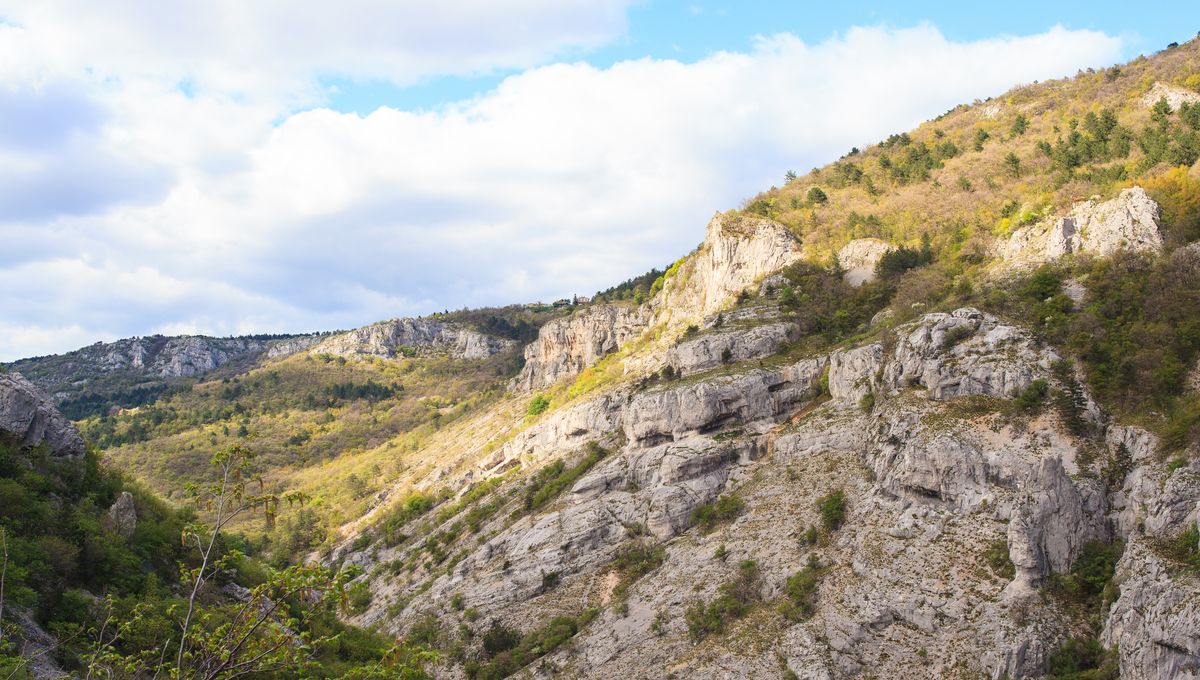
Airborne lasers have revealed four long, low dry-stone structures on the Karst Plateau in Italy and Slovenia. The team that discovered them believes the walls were used to herd wild animals for easier hunting. Although they have not been dated with precision, these walls speak to the level of coordination in societies previously thought to lack these capacities.
Large mammals had millions of years evolving to survive predators faster and with much sharper teeth than us, so early humans needed some other advantage. Many learned the migration patterns of prey and put them to use. Native Americans, for example, seem to have burned territory they wanted to lure bison into so that it would sprout particularly tasty shoots six months later. These locations were chosen as places where the shape of the land allowed the hunters to herd bison towards “buffalo jumps”, cliffs high enough to kill animals who went over them.
Where the landscape did not naturally provide such natural funnels, people sometimes built them instead. At least this is the favored explanation for so-called “desert kites” found in North Africa and western Asia, where long stone structures are visible from the air and satellite photos, although alternative explanations exist.
Such structures are rarer in Europe, although candidates have been found from Spain to Scandinavia. Now four have been found within 25 kilometers (16 miles) of each other on highlands near the Gulf of Trieste.
“The Karst is a geologically complex limestone terrain shaped by dolines, escarpments, and dry valleys, offering ideal conditions for integrating architecture with topography,” Dr Dimitrij Mlekuž Vrhovnik of the University of Ljubljana and Dr Tomaž Fabec of the Institute for the Protection of the Cultural Heritage of Slovenia write. “The identified structures share a common design: low dry-stone walls that converge into a deep enclosure, almost always situated beneath a natural drop, such as a rock ledge at the edge of a doline. The length of the walls ranges from several hundred meters to several kilometers.”
The shape and location would have made these structures suited for driving herds of prey to the point where they could not go sideways because of the walls, while going back would bring them too close to the hunters. The walls follow sloping ground, coming to an apex at the lowest point, forcing any animal seeking to escape past the humans to battle uphill.
The authors consider the finds the strongest evidence for large-scale structures with this purpose in Europe.
The absence of such structures in more fertile areas may reflect different hunting strategies and the lack of migrations, but also might be because wetter climates allow plants to hide the evidence. Fine sediments that might build up elsewhere get removed on the Karst Plateau, leaving banks and walls visible.
The walls are formed from large, weathered limestone blocks fitted together without mortar using smaller stones and rubble (dry-stone building).
Limestone is locally abundant, and neither the walls’ height nor the width is particularly impressive – generally 50 centimeters (1.6 feet) and 1-1.5 meters (3-5 feet) respectively, and the authors think they were probably not much higher when built. Gaps in the walls align with stony crags where animals would have had little prospect for escape.
However, where the walls meet, there is a deep enclosure beneath a natural crag 8-10 meters (26-33 feet across). These are bordered by one rock face and three thick stone walls, much thicker and higher than the guiding walls, and showing signs of being built with more care. The drops into these enclosures are so sharp that animals would likely not have known what was coming until 20 meters (66 feet away), when there would be little chance to reverse course.
The depths of these enclosures rule out the possibility that the walls were for corralling domesticated animals, as has been proposed for desert kites. The authors think the prey were probably mostly red deer, which would have been hunted annually during the rut, making methods to preserve and store the meat essential.
The locations of the walls and pits indicate great familiarity with the landscape and planning. However, the most revealing feature is that their length and the enclosures’ size mean the largest structure, known as KO1, would have taken at least 5,000 person-hours of labor to make, according to the authors’ calculations. “They were not the work of small, transient groups,” they write. If 40 people worked continuously to build them, it would take two months, an impossible task without a large store of food. Even once built, they would have required regular maintenance to maintain their effectiveness.
The authors cannot confidently date when the walls were built, but soil started to fill the enclosures by the Late Bronze Age, indicating they had been abandoned by then.
What is now the Adriatic Sea was a great plain during the Ice Age, and its flooding drove foragers into the surrounding uplands. There may not have been enough food for such an influx without developing new technologies, which the walls may have provided. If so, the walls could date to the early Holocene, much earlier than the pyramids in Egypt.
Overall, the discovery indicates greater complexity and coordination in pre-agricultural societies in the area than has previously been recognized. “Rather than isolated anomalies, the Karst traps may represent a missing chapter in the prehistory of European landscape modification, one that warrants further comparative, chronological, and regional exploration,” the authors write.
The study is published in Proceedings of the National Academy of Sciences.
[H/T: Phys.org]

Source Link: Newly Discovered Hunting Megastructures Suggest Pre-Bronze Age Societies More Sophisticated Than Previously Thought
