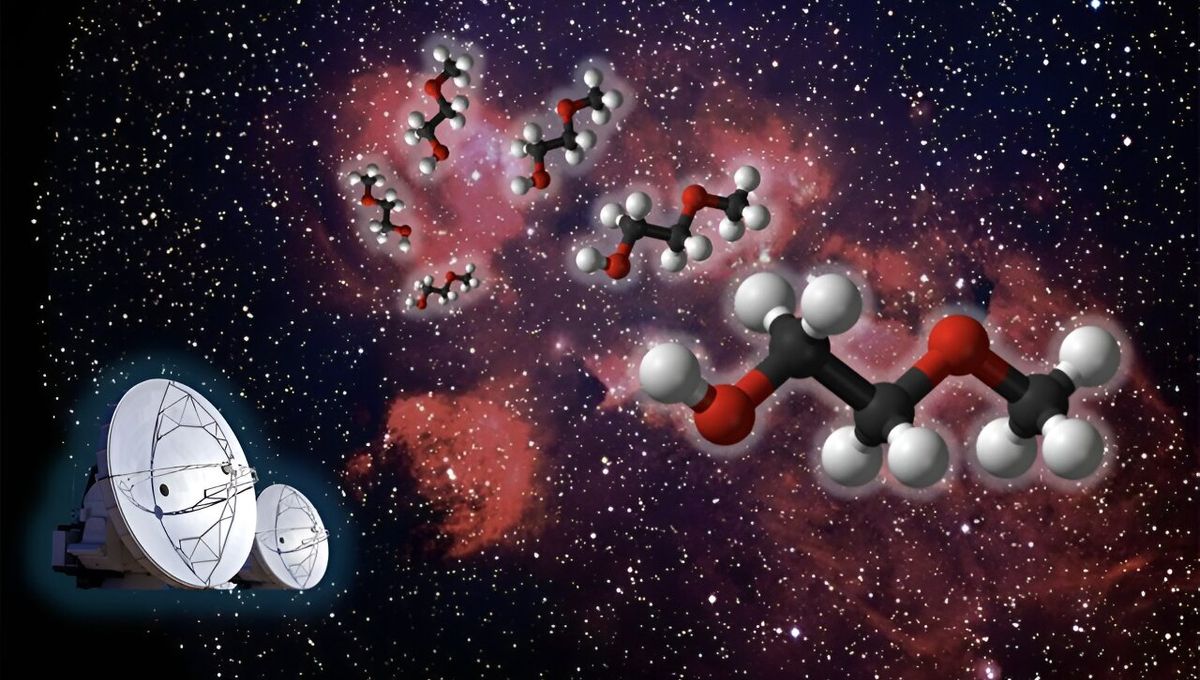
Astronomers have discovered a complex molecule in a star-forming region known as the Cat’s Paw Nebula. The molecule in question is 2-methoxyethanol which on Earth is a pretty toxic chemical solvent, dangerous to health even in small doses. But in space, it might be crucial to the formation of stars and planets.
It is among the largest molecules ever discovered in interstellar space. It has 13 atoms – three carbon, eight hydrogen, and two oxygen. Only six other chemical species detected outside the solar system have more atoms than that. Many different molecules have been found in this nebula, suggesting that the complex chemistry at play might be important in the birth of new stars.
Finding the molecule was far from easy. Researchers can observe the signs of molecules by studying the light of gas clouds. Molecules in space absorb some stray starlight and they begin to rotate thanks to the energy they get from the light. So molecules have a spectral signature, like a barcode, that allows them to be recognized – but only if you have studied them in the lab first.
Researchers used a machine learning model to work out what would be a good molecule to hunt for, and 2-methoxyethanol came out as a good target. The international team studied what this molecule’s signature would be like in the lab and then used the Atacama Large Millimeter Array (ALMA) to look at two star-forming regions. They found that signature in a protocluster in the Cat’s Paw Nebula, NGC 6334I. The number of lines found allowed them to feel confident that this was truly a detection.
“Ultimately, we observed 25 rotational lines of 2-methoxyethanol that lined up with the molecular signal observed toward NGC 6334I (the barcode matched!), thus resulting in a secure detection of 2-methoxyethanol in this source,” lead author Zachary T.P. Fried, a graduate researcher from MIT, said in a statement. “This allowed us to then derive physical parameters of the molecule toward NGC 6334I, such as its abundance and excitation temperature. It also enabled an investigation of the possible chemical formation pathways from known interstellar precursors.”
“There are a number of ‘methoxy’ molecules in space, like dimethyl ether, methoxymethanol, ethyl methyl ether, and methyl formate, but 2-methoxyethanol would be the largest and most complex ever seen,” added Fried.
The team proposed different mechanisms for how this molecule might form in deep space. Interstellar space has some intriguing molecules, some of which are important precursors to the chemistry of life. Even toxic substances like 2-methoxyethanol can provide insights into how we came to be.
“Continued observations of large molecules and subsequent derivations of their abundances allows us to advance our knowledge of how efficiently large molecules can form and by which specific reactions they may be produced,” added Fried.
“Additionally, since we detected this molecule in NGC 6334I but not in IRAS 16293-2422B, we were presented with a unique opportunity to look into how the differing physical conditions of these two sources may be affecting the chemistry that can occur.”
A paper describing the discovery is published in The Astrophysical Journal Letters.

Source Link: Newly Spotted Complex Molecule Is Among The Largest Ever Discovered Outside The Solar System
