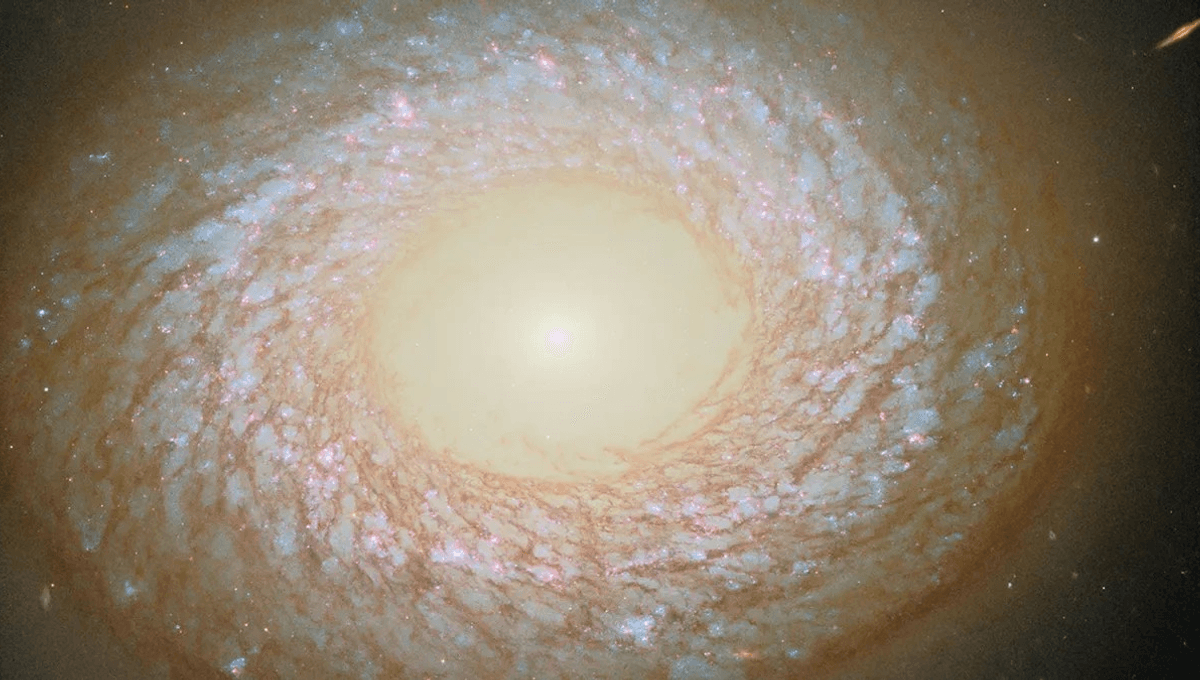
Human classification, from celestial bodies to living organisms, often starts with their morphology. Depending on how something looks, it gets a certain label. This is all well and good until you find the exceptions, so you expand the category. But what happens when you find an exception to the exception? Well, you get something like galaxy NGC 2775.
The rest of this article is behind a paywall. Please sign in or subscribe to access the full content.
There are four main categories of galaxy. The most common are spiral and elliptical, with the occasional lenticular, as well as the presence of “other” box, which are the irregular galaxies. Spirals are known for their lovely arms as well as their richness in dust, gas, and new stars. The spiral galaxies are mostly flat like a pancake, with a more dense distribution of stars at their core.
Elliptical galaxies instead tend to be older, more massive, and with stars distributed not in a nice little disk, but in a spherical distribution. Elliptical galaxies, being the product of galactic merging events, are often lacking in major features.
So why is NGC 2775 special? Well, its outer area looks just like a spiral galaxy with a disk of gas and dust, while its central area has the hallmarks of an elliptical galaxy. We can’t really tell if the distribution of stars in the core and beyond is more spherical than flat, as we are seeing it from a single angle, so our classification is a bit stuck.
Many researchers give priority to the external portion of the galaxy and classify it as a type of spiral galaxy. Others prefer the transitional classification of a lenticular galaxy. These kinds of galaxies are an in-between, where the galaxy has no spiral arm but a large disk; they tend to be older and less active, unlike spirals, but with features such as concentric rings of dust, unlike ellipticals.
It is not clear how lenticular galaxies come to be. They could be a peculiar end product of merging spiral galaxies or a more passive evolution of certain elliptical galaxies. If NGC 2775 is to become a more classical lenticular galaxy, it will probably be the former scenario. While invisible on this Hubble image, there is evidence of a faint tail of hydrogen around the galaxy, suggesting a past interaction with another galaxy.
If it is a spiral, it’s in the flocculent subclass. These galaxies have poorly defined arms that look feathery or tufty: “flocculent” means “flaky”.
Hubble observed this galaxy in 2020 and again this year, as part of the Physics at High Angular resolution in Nearby GalaxieS (PHANGS) – HST Image Products, a program to better understand star-formation in spiral galaxies.
An earlier version of this article was published in September 2025.

Source Link: NGC 2775: This Galaxy Breaks The Rules Of “Galactic Evolution” And Baffles Astronomers
