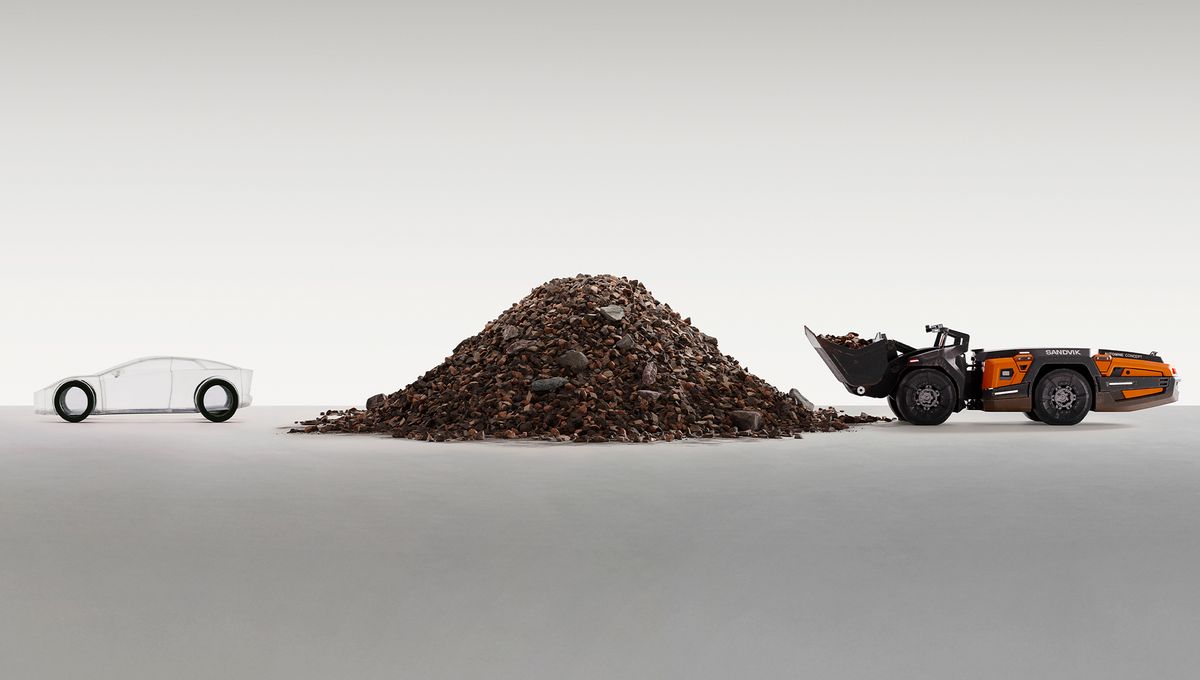
There’s no denying it: We need to radically transform our relationship to resources and consumption if we want to combat climate change. One way to do that is to develop new low-carbon technologies, but there’s still a challenge here that’s often overlooked. Take electric cars, for example. They’re the quintessential representation of efforts to transition towards a more sustainable form of technology, but what would an electric car look like if it did not contain scarce minerals and metals?
The answer is eNimon, the no mine car from Sandvik – what is essentially just an empty shell. eNimon is a powerful reminder that, without mined materials, there can be no transition to green technologies.
Although a move towards electric technology is important, innovations like electric vehicles require six times more mineral resources than conventional ones. This may be a daunting thought, but it demonstrates just how important mining will be for the green transition
Mining is often seen as a contributor to the ongoing environmental crisis, as it can produce air pollution and destroy habitats, while also using and excavating the fossil fuels (coal and oil) that drive climate change. It may therefore seem paradoxical to say that mining may play an important role in addressing the current challenges we face as a species, but it’s true. This is because the rapidly advancing clean energy technologies we are increasingly developing – such as wind turbines, solar panels, and electric vehicles – require minerals such as copper, lithium, nickel, and cobalt for their construction.
It’s clear that to achieve net zero – the state of balance where any greenhouse gas emissions produced are offset by the amount being removed from the atmosphere – we will need to increase mining activities across the world. The International Energy Agency (IEA), believes the demand for critical minerals will become three times higher by 2030 and four times higher by 2040, as we become more reliant on green technologies.
If we do not scale up mining practices, there will soon be a material shortage that could easily undermine national and international climate targets.
At the same time, increasingly few students and young people are interested in mining studies at a time when the existing workforce is preparing to retire. For instance, more than half of the US mining workforce (roughly 221,000 people) is due to retire by 2029. This will leave a huge knowledge gap if companies do not find a way to attract new talent.
Put plainly, as the demand for mined minerals continues to rise, there is an increasing mismatch with the number of people wanting to work in the sector, which ultimately threatens our chances of reaching our net-zero goals.
So, what does this mean for the mines of the future? Well, you can forget about pickaxes or simple trucks. The mines of tomorrow are far more sophisticated. They’re automated, digitized, and, above all, eco-efficient. They are also here already.
An engineering challenge of a lifetime
Sandvik, the Swedish multinational engineering company responsible for eNimon, is a leader in the automation and electrification of mining. For decades, they have been working at the forefront of the mining sector and have helped develop innovative equipment, tools, and services, as well as providing digital solutions for machining, mining, rock excavation, and rock processing.
In a new report and roundtable discussion among industry experts, Sandvik demonstrates not only that they are helping facilitate the global green transition, but that mining more generally is an exciting and rewarding industry for STEM (Science, Technology, Engineering, and Mathematics) researchers, recent graduates, and professionals wanting to work in sustainable technology.
One of their key goals is to achieve net zero in their “value chain” – the full set of activities a business conducts to create a product or service, from its initial design to its final delivery to an end customer. This is achieved by reducing both the emissions needed to produce a product and the carbon that product consumes when operated. This approach not only lowers Sandvik emissions, it also helps customers on their own journey to net zero.
Electrification is a significant part of this process. By electrifying mining – by way of battery-electric and cable-electric vehicles – and rock-processing equipment, Sandvik and other companies can help make mines across the world more sustainable.
Then there’s the digitization process. By relying on new digital technologies, such as automation, real-time intelligence, and predictive decision-making, mines are transformed from potentially hazardous and low-tech sites to data-driven, safer, and significantly more efficient operations with much lighter environmental footprints. Digital tools basically take the lid off a mine by creating 3D models, allowing engineers to identify deposits, understand ore bodies, and minimize otherwise expensive drilling. Digital and autonomous tools also make it possible to operate equipment in deeper and potentially more dangerous environments without putting humans at risk.
What is clear from these developments is that mining has moved far beyond pickaxes, dirt, and danger.
“We are a purpose driven company. We are advancing the world through engineering – that’s our purpose”, Björn added. “For electrification, we enable the green transition through our customers. For instance, we help our customers become CO2 neutral through this approach, which electrifies the mines. When it comes to automation, focusing on self-driving vehicles also makes mining safer while allowing us to mine deeper with automated equipment. And lastly, digitalization of mining helps to control the mine from a remote location – you might run the mine from a more urban environment, which can help attract talent that’s searching for these opportunities.”
As the technology of mining has evolved, so too has the need for more diverse perspectives. In addition to traditional disciplines such as engineering and geology, the modern mining industry also needs expertise in data science, social sciences, and environmental and social governance. This is another key area where Sandvik is trying to make a difference.
“Despite offering exciting international opportunities and competitive salaries, the mining industry still suffers from an outdated image,” Edvard Bergström, VP Communications at Sandvik, explains. “Our goal is to show what mining really looks like today – and where it’s headed.”
“We have the tools, the technology, and the know-how to make mining more productive and sustainable,” said Bergström. “This is about transforming how people view Sandvik and how they view the entire mining industry.”
You can learn more about Sandvik and the green transition here.

Source Link: No Mining, No Machines – How The Future Of Technology Depends On Greener Mines
