• Email Us: [email protected]
  • Contact Us: +1 718 874 1545
  • Skip to main content
  • Skip to primary sidebar

Medical Market Report

  • Home
  • All Reports
  • About Us
  • Contact Us

Nobel Prize In Chemistry Awarded For New Material Breakthrough

October 8, 2025 by Deborah Bloomfield

The winners of the 2025 Nobel Prize in Chemistry are Susumu Kitagawa, Richard Robson, and Omar Yaghi, “for the development of metal-organic frameworks”. The prize is worth 11 million Swedish kronor (around $1,170,000 USD at the time of publishing), which will be shared equally between the winners. 

The rest of this article is behind a paywall. Please sign in or subscribe to access the full content.

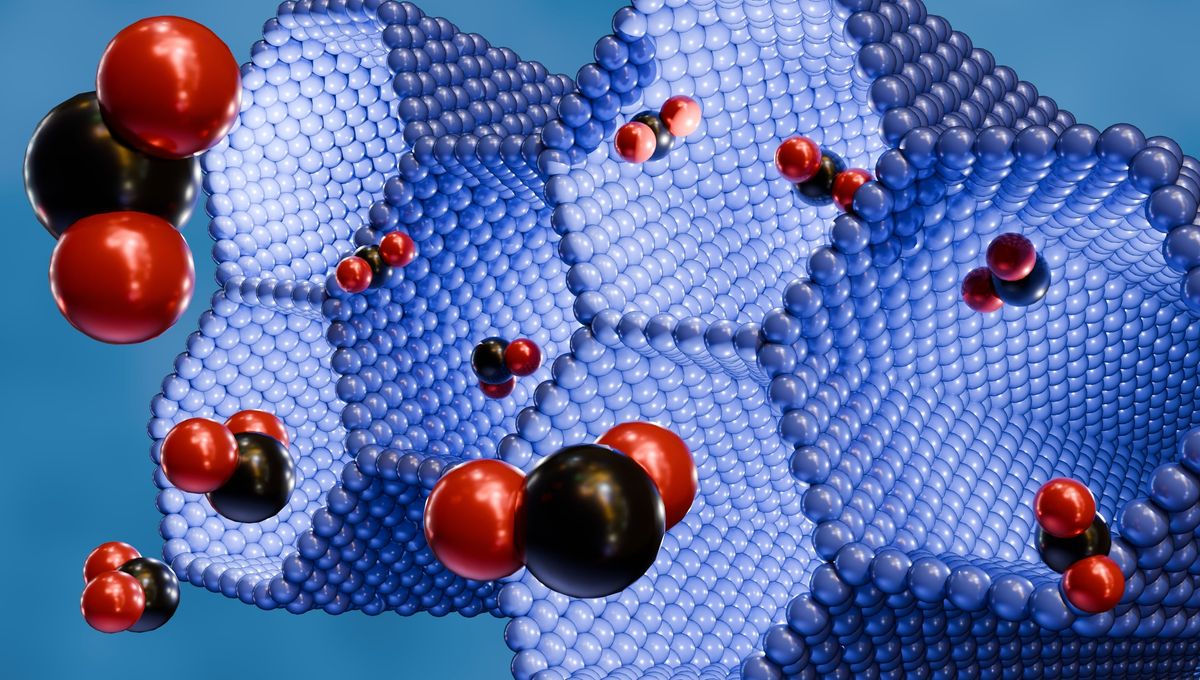
Metal-organic frameworks are a completely new class of material that have extraordinary properties and very exciting potential applications, from cleaning water to trapping carbon dioxide and pollutants in the air.

“Metal-organic frameworks have enormous potential, bringing previously unforeseen opportunities for custom-made materials with new functions,” Heiner Linke, Chair of the Nobel Committee for Chemistry, said in a statement.

The interest in metal-organic frameworks is because they have a sponge-like structure. This means that they have a much larger internal surface area for a very small volume, and this interior space can be used to capture, store, and make molecules interact within the lattice. Metal-organic frameworks can be built to match a target molecule, which makes them a bespoke approach to filtering or keeping gases of interest.

The history of metal-organic frameworks started over 35 years ago. Back in 1989, Richard Robson was working on a spacious crystal made of copper – he created one similar to a diamond with innumerable cavities. The applications were immediately obvious, despite the molecular construction being unstable. It was Kitagawa and Yaghi who showed that there was a class of these crystals that could be created with higher stability.

Across the 1990s and early 2000s, independently with their teams, the new Nobel laureates have shown how to develop better metal-organic frameworks. Kitagawa has shown that fluid can flow through these structures, leading them to be built for the most exciting applications.


There are new metal-organic frameworks that are being developed and built every day. Demonstrations over the last decade have shown frameworks that can capture water from air, such as in the desert, that can remove carbon dioxide from industrial fumes, store liquid hydrogen, mine rare-earth metals from waste, break down oil contamination, and even extract forever chemicals such as PFAS from water.

The field is relatively young, but it has enormous potential to greatly benefit humanity.  

Deborah Bloomfield
Deborah Bloomfield

Related posts:

  1. Tallest teen, fastest hair skipping among 2022 Guinness World Records
  2. Soccer-Women’s leagues join UEFA opposition to biennial World Cup
  3. Largest Ever Analysis Of Ancient African DNA Reveals Origin Myth Was True All Along
  4. 2024 “Effectively Certain” To Be The Hottest Year On Record

Source Link: Nobel Prize In Chemistry Awarded For New Material Breakthrough

Filed Under: News

Primary Sidebar

  • US Just Killed NASA’s Mars Sample Return Mission – So What Happens Now?
  • Art Sleuths May Have Recovered Traces Of Da Vinci’s DNA From One Of His Drawings
  • Countries With The Most Narcissists Identified By 45,000-Person Study, And The Results Might Surprise You
  • World’s Oldest Poison Arrows Were Used By Hunters 60,000 Years Ago
  • The Real Reason You Shouldn’t Eat (Most) Raw Cookie Dough
  • Antarctic Scientists Have Just Moved The South Pole – Literally
  • “What We Have Is A Very Good Candidate”: Has The Ancestor Of Homo Sapiens Finally Been Found In Africa?
  • Europe’s Missing Ceratopsian Dinosaurs Have Been Found And They’re Quite Diverse
  • Why Don’t Snorers Wake Themselves Up?
  • Endangered “Northern Native Cat” Captured On Camera For The First Time In 80 Years At Australian Sanctuary
  • Watch 25 Years Of A Supernova Expanding Into Space Squeezed Into This 40-Second NASA Video
  • “Diet Stacking” Trend Could Be Seriously Bad For Your Health
  • Meet The Psychedelic Earth Tiger, A Funky Addition To “10 Species To Watch” In 2026
  • The Weird Mystery Of The “Einstein Desert” In The Hunt For Rogue Planets
  • NASA Astronaut Charles Duke Left A Touching Photograph And Message On The Moon In 1972
  • How Multilingual Are You? This New Language Calculator Lets You Find Out In A Minute
  • Europa’s Seabed Might Be Too Quiet For Life: “The Energy Just Doesn’t Seem To Be There”
  • Amoebae: The Microscopic Health Threat Lurking In Our Water Supplies. Are We Taking Them Seriously?
  • The Last Dogs In Antarctica Were Kicked Out In April 1994 By An International Treaty
  • Interstellar Comet 3I/ATLAS Snapped By NASA’s Europa Mission: “We’re Still Scratching Our Heads About Some Of The Things We’re Seeing”
  • Business
  • Health
  • News
  • Science
  • Technology
  • +1 718 874 1545
  • +91 78878 22626
  • [email protected]
Office Address
Prudour Pvt. Ltd. 420 Lexington Avenue Suite 300 New York City, NY 10170.

Powered by Prudour Network

Copyrights © 2026 · Medical Market Report. All Rights Reserved.

Go to mobile version