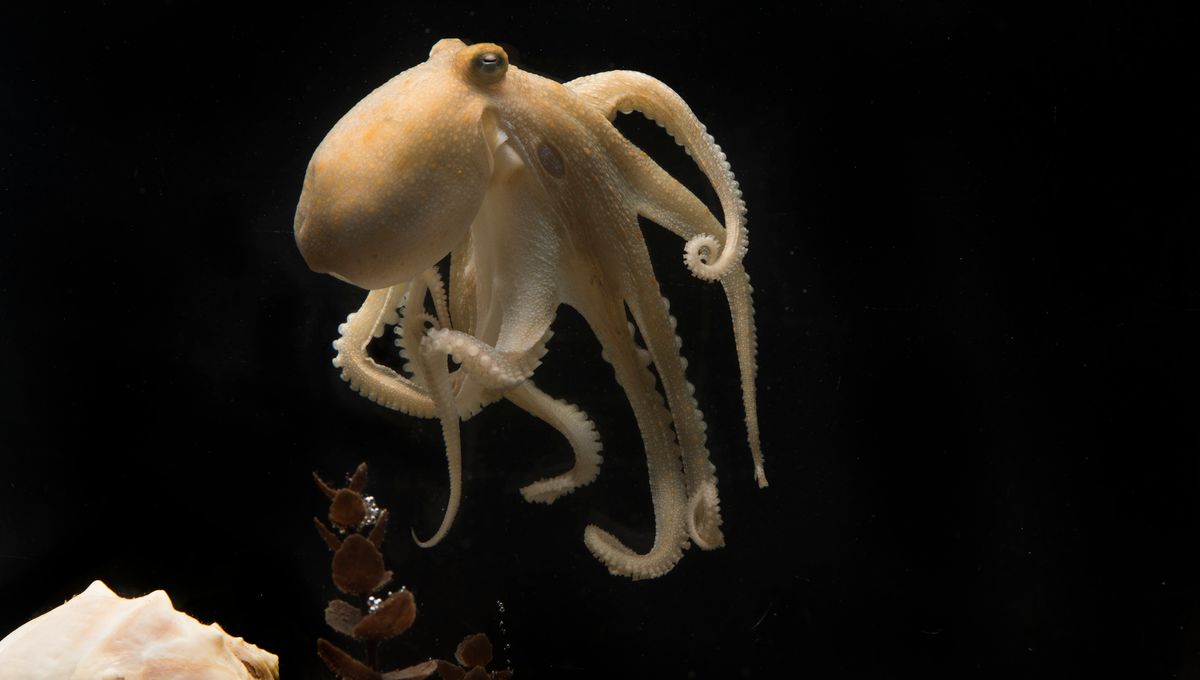
It’s hard not to love octopuses – they’re bizarre-looking, hugely intelligent, and get up to plenty of shenanigans. That makes what happens to them all the more tragic; after the females of some octopus species lay their eggs, they stop eating, slowly withering away until they die. The trigger of this process, known as the death spiral, has long puzzled researchers, but it seems the answer has now been uncovered.
Scientists back in the 1970s had linked the death spiral to the octopus optic gland, after surgically removing it led to octopuses continuing to live even after laying eggs. Dr Jerome Wodinsky, who carried out the research, told the Washington Post at the time that he believed that the process was controlled by a hormone secreted by the optic gland.
Fast forward to 2022, and it turns out Wodinksy was at least partially right. Researchers with the University of Chicago set to analyzing the chemicals secreted by the maternal octopus optic gland, focusing in on cholesterol and sterol hormones. Previous studies by the team suggested these molecules could play a role.
The researchers discovered that the optic gland in maternal octopuses experiences a significant shift in cholesterol metabolism, leading to equally drastic changes in steroid hormone production. This occurs via three different pathways, all of which involve cholesterol in some way and appear to lead to the death spiral behavior.
“What’s striking is that they go through this progression of changes where they seem to go crazy right before they die,” said study author Clifton Ragsdale in a statement. “Maybe that’s two processes, maybe it’s three or four. Now, we have at least three apparently independent pathways to steroid hormones that could account for the multiplicity of effects that these animals show.”
One of these pathways results in increased levels of 7-dehydrocholesterol (7-DHC), a precursor molecule to cholesterol. In humans, a mutation in the enzyme that’s involved in this conversion leads to a genetic disorder that can involve repetitive self-injury. That makes this finding particularly pertinent, as some octopuses display self-mutilation behaviors during their death spiral.
While the study provides long-awaited insight into how the death spiral is controlled, it remains that this tragic process doesn’t happen in every octopus species. Lead study author Z. Yan Wang is now looking to the optic gland of one such species, the lesser Pacific striped octopus, to discover why it doesn’t self-destruct after reproduction.
“The optic gland exists in all other soft-bodied cephalopods, and they have such divergent reproductive strategies,” said Wang. “It’s such a tiny gland and it’s underappreciated, and I think it’s going to be exciting to explore how it contributes to such a great diversity of life history trajectories in cephalopods.”
The study is published in Current Biology.

Source Link: Octopus Moms End Life In A Tragic Death Spiral, And We May Now Understand Why
