We live in an age where things like “the Earth orbits the sun” and “Kepler’s third law” are well known, and yet the majesty of a solar eclipse is still something that can make even the most powerful man in the world stop and stare. How much more awe-inspiring must this cosmological phenomenon have appeared, then, to our ancestors many millennia ago?
Well, thanks to a new study of an ancient text, we do actually have some idea.
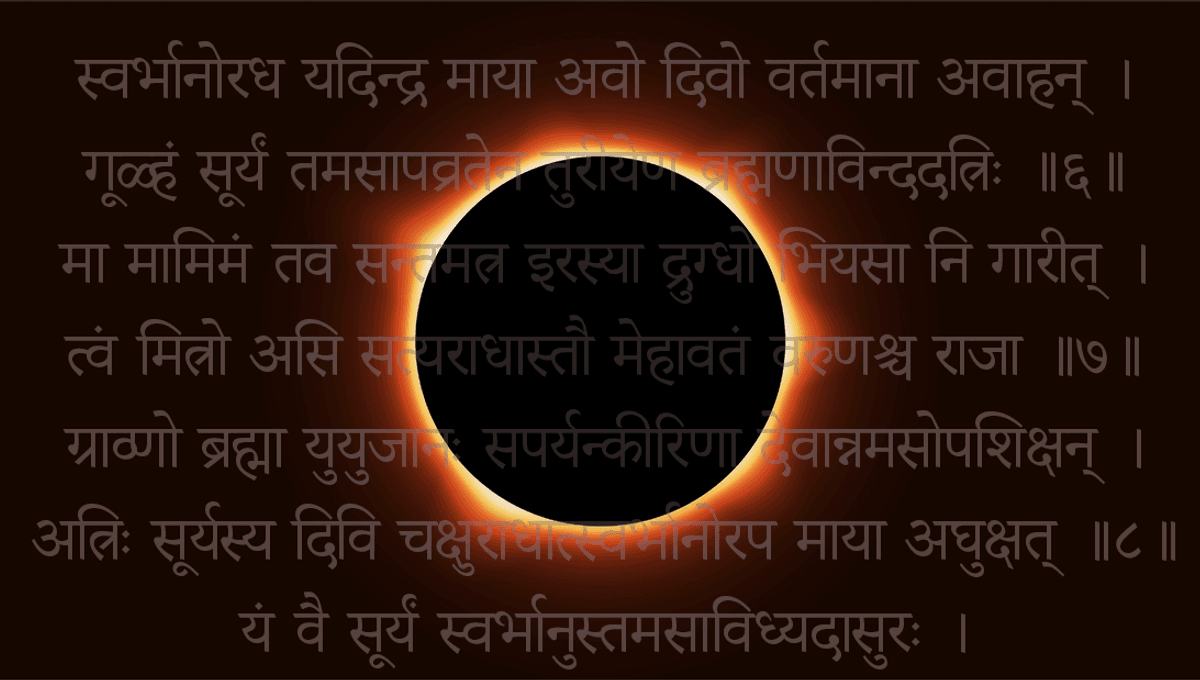
“O Surya, when the Asura’s descendant Svarbhanu, pierced thee through and through with darkness, All creatures looked like one who is bewildered, who knoweth not the place where he is standing.
“What time thou smotest down Svarbhanu’s magic that spread itself beneath the sky, O Indra, By his fourth sacred prayer Atri discovered Surya concealed in the gloom that stayed his function.
“Let not the oppressor with this dread, through anger swallow me up, for I am thine, O Atri. Mitra art thou, the sender of true blessings: thou and King Varuna be both my helpers.
“The Brahman Atri, as he set the press stones, serving the Gods with praise and adoration, Established in the heaven the eye of Surya, and caused Svarbhanu’s magic arts to vanish.
“The Atris found the Sun again, him whom Svarbhanu of the brood Of Asuras had pierced with gloom. This none besides had the power to do.”
That’s an excerpt from the Rig Veda, an ancient collection of Vedic Sanskrit hymns, one of the four sacred canonical texts in Hinduism, and one of the oldest known documents in the world.
If you search for the date it was created, you’ll most likely get an estimate of around 1500 BCE, but the truth is much more complex: “[T]here is a significant amount of evidence that it incorporates memories of events that were much further back in time,” explains the new paper.
“For example, it discusses events when the Vernal Equinox was in Orion, which occurred around 4500 BC,” the authors explain, “while the final reference to the Vernal Equinox in the Rig Veda relates to its being in the Pleiades, which happened in 2230 BC.”
And the above excerpt is an example of precisely this, study authors Mayank Vahia, formerly of the Tata Institute of Fundamental Research in Mumbai, and Mitsuru Sôma, a researcher at the National Astronomical Observatory of Japan, believe.
The passages describe an ancient solar eclipse – albeit using what the pair readily admit is “highly poetic and abstract” language – but not one witnessed by whomever it was that recorded it in the Veda. Using astronomical, geographical, and literary clues, the researchers instead place the referenced event some 2,500 years earlier than the Rig Veda itself.
“[We have in the Rig Veda] four details of the eclipse,” the pair write. “1. It occurred when the Vernal Equinox was in Orion; 2. It was a total solar eclipse; 3. It occurred three days prior to the Autumnal equinox; and 4. It was total wherever the Rig Vedic people were living at that time.”
From there, it was just a simple matter of, uh, scouring 400 years’ worth of potential eclipses to find one that fit those criteria. Luckily, only two candidates presented themselves: 22 October, 4202 BCE, and 9 October, 3811 BCE – both far earlier than the previously oldest-known references to solar eclipses.
Now, that’s already a headline-worthy discovery – but could the pair narrow it down any further? In fact, they could: using a little bit of math based on the fact that the Earth rotates faster now than it did thousands of years ago, the researchers deduced that one date – the one in 4202 BCE – had slightly more evidence in its favor than the other.
That said, when dealing with events from this long ago, nothing is set in stone (ironically) – and the pair therefore don’t go so far as to say the eclipse was definitely in 4202 BCE rather than 3811 BCE. Either way, though, it’s still a remarkable discovery: not only a concrete date for an ancient cosmological marvel, but a fantastic insight into how the people of the time understood and processed the event – through the creation of myths and legends that have survived for more than 6,000 years.
The study is published in the Journal of Astronomical History and Heritage.

Source Link: Oldest Ever Record Of A Solar Eclipse Discovered Pretty Much In Front Of Our Faces
