• Email Us: [email protected]
  • Contact Us: +1 718 874 1545
  • Skip to main content
  • Skip to primary sidebar

Medical Market Report

  • Home
  • All Reports
  • About Us
  • Contact Us

Oldest Evidence Of Earthquakes Might Lie In 3.3-Billion-Year-Old Rocks

March 29, 2024 by Deborah Bloomfield

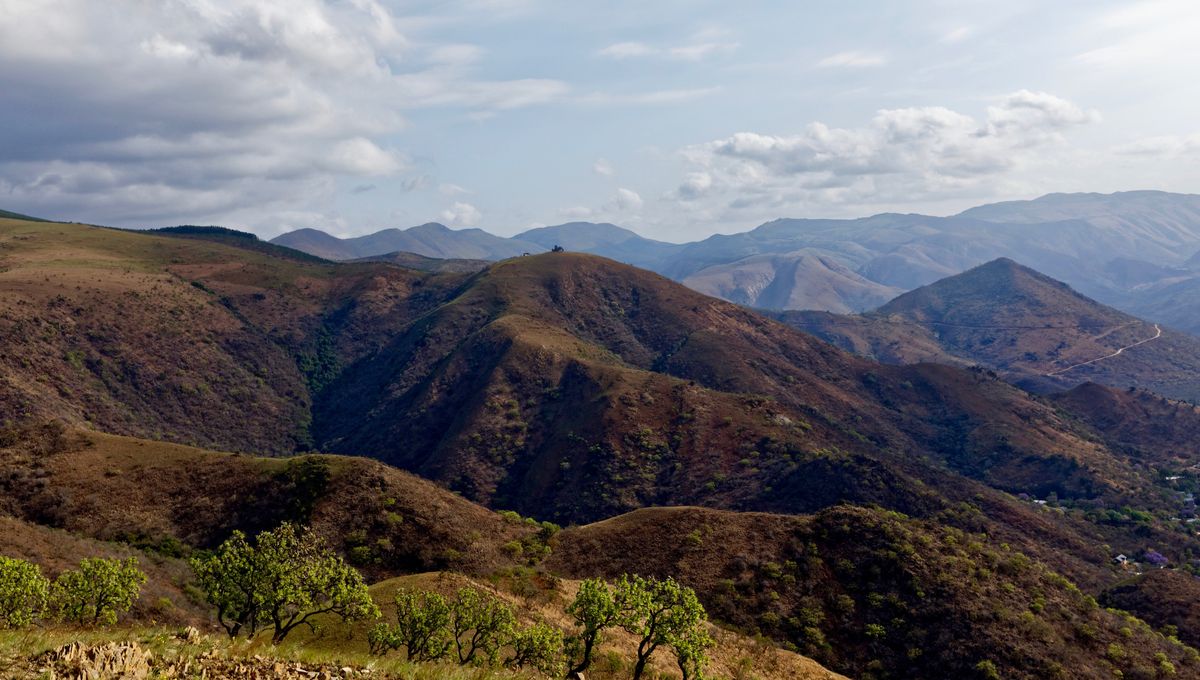
The Barberton Greenstone Belt in South Africa contains some of the oldest exposed rocks on Earth, some over 3.6 billion years old. It also contains some layers, a bit younger than that, which have perplexed geologists as they looked like a jumble of different rocks put together. Researchers now have a proposal: That portion is evidence of an ancient submarine landslide caused by an ancient quake.

If their theory is correct, this is the oldest evidence of an earthquake. The rocks are portions of an ancient and deep seafloor aged about 3.3 billion years. But among them, there are sedimentary rocks that could not have formed on the ocean floor. Those are rocks that formed either on land or in shallow water, such as barite crystals that formed as evaporites – rocks produced by the evaporation of water. Definitely not something that happens at the bottom of the sea.

Advertisement

So, the question is: how did those very different types of rock get together? Researchers Simon Lamb and Cornel de Ronde realized that the mix of rocks resembled the structures seen off the coast of New Zealand, where powerful earthquakes produce the sort of marine landslide that brings material from land and shallow water onto the deep ocean floor.

“We realised this map looked remarkably similar to a geological map (by Simon Lamb) made of the aftermath of much more recent submarine landslides. These were triggered by great earthquakes along New Zealand’s largest fault, the megathrust in the Hikurangi subduction zone,” the authors wrote in The Conversation.

“The importance of this lies in the fact that New Zealand’s geological record is uniquely created by the profound effects of large earthquakes in a subduction zone. This is still happening today, most recently in November 2016, when the magnitude 7.8 Kaikoura earthquake set off vast submarine landslides and debris avalanches that flowed down into deep water,” the authors continued. “We found the oldest record of these earthquakes, hidden in the highveld of southern Africa.”

This hypothesis is consistent with evidence from other regions of the world that plate tectonics and quakes from the motion of the plates started around that time. But there’s more. The Barberton Greenstone Belt shows evidence of underwater volcanism similar to the dramatic Hunga Tonga-Hunga Ha’apai volcanic eruption.

Advertisement

It is believed that the turmoil of our planet played an important role in the formation of life on Earth – although life might have predated the formation of tectonic plates.

A paper on this work is published in the journal Geology.

[H/T: The Conversation]

Deborah Bloomfield
Deborah Bloomfield

Related posts:

  1. U.S. banking lobby groups oppose proposed tax reporting law
  2. Video Shows Albert Einstein Explaining His Most Famous Equation
  3. Venus’s Thin And “Squishy” Crust May Be Answer To Heat-Loss Mystery
  4. Secret Service Agent At JFK Assassination Casts Doubt On Single Bullet Theory

Source Link: Oldest Evidence Of Earthquakes Might Lie In 3.3-Billion-Year-Old Rocks

Filed Under: News

Primary Sidebar

  • “Orbital House Of Cards”: One Solar Storm And 2.8 Days Could End In Disaster For Earth And Its Satellites
  • Astronomical Winter Vs. Meteorological Winter: What’s The Difference?
  • Do Any Animal Species Actively Hunt Humans As Prey?
  • “What The Heck Is This?”: JWST Reveals Bizarre Exoplanet With Inexplicable Composition
  • The Animal With The Strongest Bite Chomps Down With A Force Of Over 16,000 Newtons
  • The Eschatian Hypothesis: Why Our First Contact From Aliens May Be Particularly Bleak, And Nothing Like The Movies
  • The Great Mountain Meltdown Is Coming: We Could Reach “Peak Glacier Extinction” By 2041
  • Comet 3I/ATLAS Is Experiencing A Non-Gravitational Acceleration – What Does That Mean?
  • The First Human Ancestor To Leave Africa Wasn’t Who We Thought It Was
  • Why Do Warm Hugs Make Us Feel So Good? Here’s The Science
  • “Unidentified Human Relative”: Little Foot, One Of Most Complete Early Hominin Fossils, May Be New Species
  • Thought Arctic Foxes Only Came In White? Think Again – They Come In Beautiful Blue Too
  • COVID Shots In Pregnancy Are Safe And Effective, Cutting Risk Of Hospitalization By 60 Percent
  • Ramanujan’s Unexpected Formulas Are Still Unraveling The Mysteries Of The Universe
  • First-Ever Footage of A Squid Disguising Itself On Seafloor 4,100 Meters Below Surface
  • Your Daily Coffee Might Be Keeping You Young – Especially If You Have Poor Mental Health
  • Why Do Cats And Dogs Eat Grass?
  • What Did Carl Sagan Actually Mean When He Said “We Are All Made Of Star Stuff”?
  • Lonesome George: The Giant Tortoise Who Was The Very Last Of His Kind
  • Bermuda Sits On A Strange, 20-Kilometer-Thick Structure That’s Like No Other In The World
  • Business
  • Health
  • News
  • Science
  • Technology
  • +1 718 874 1545
  • +91 78878 22626
  • [email protected]
Office Address
Prudour Pvt. Ltd. 420 Lexington Avenue Suite 300 New York City, NY 10170.

Powered by Prudour Network

Copyrights © 2025 · Medical Market Report. All Rights Reserved.

Go to mobile version