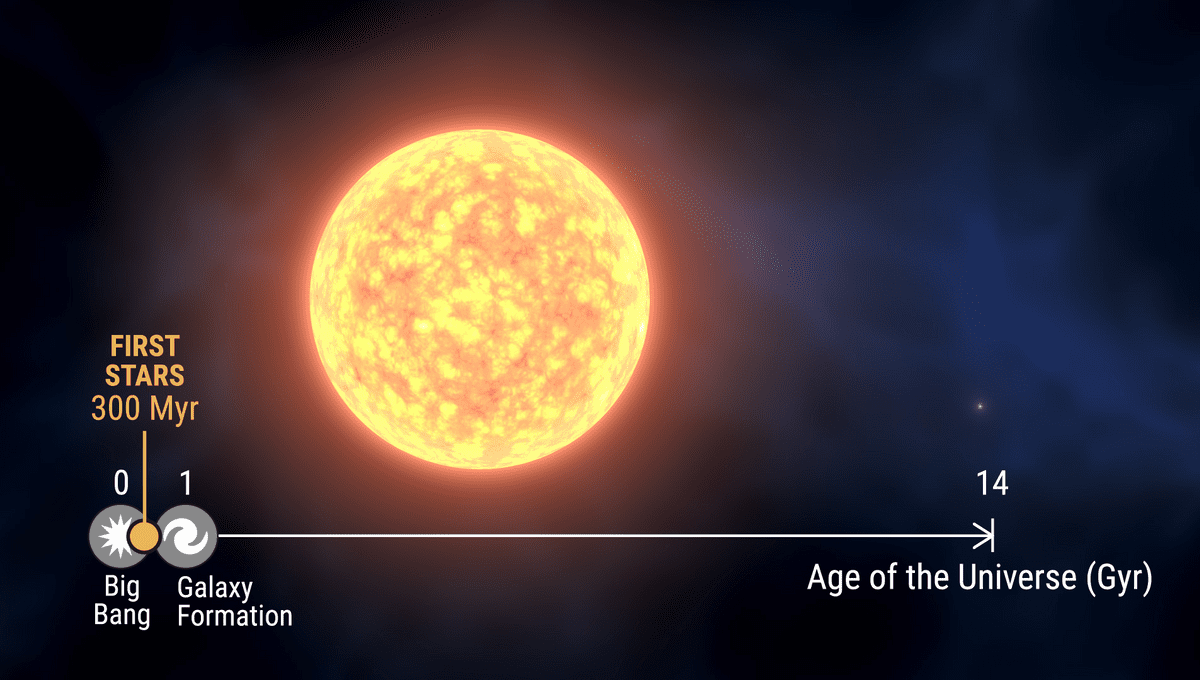
Most of our galaxy’s stars were formed from the ashes of not one but two previous generations, making the rare survivors from the galaxy’s earliest days precious sources of insights into our origins. One of the Milky Way’s oldest known stars is named SMSS1605-1443. A new analysis of its light using the world’s largest optical telescope shows we really are seeing it in close to its original state, despite the discovery of an unexpected companion.
The processes that led to the formation of the galaxy’s first stars out of primordial hydrogen and helium tended to make them very massive. Since high-mass stars burn their fuel faster, these all ended their lives very quickly in supernova bursts, scattering elements across the galaxy that were then taken up by the next stellar generation.
These so-called extreme Population II are mostly gone as well – but a few smaller ones survive, and are highly prized by astronomers. SMSS1605-1443, first discovered in 2018, is one of just eight of these that fall into the CEMP-no category. A paper to be published in Astronomy and Astrophysics describes its in-depth exploration using the ESPRESSO high-precision spectrograph on the European Southern Observatory’s Very Large Telescope.
Old stars are identified by their low abundance of metals, particularly iron. Although SMS1605-1433 (full name SMSS J160540.18−144323.1) has more carbon than some other old stars, it has the lowest iron-to-hydrogen ratio of any star we have found.
“It was surprising to find […] that this object is really a double star (a binary),” said first author Dr David Aguado of the University of Florence in a statement.
That’s unexpected because binaries are thought to be rare among these early stars – after all, even if born in pairs, one of them will often have expired in the billions of years since. However, the star HE 0107−5240 (also part of the CEMP-no class and initially thought to be solitary) was found after twenty years to have a companion. The rarity of companions may have been overstated.
Unfortunately, we don’t know anything about the companion star, including whether it formed together with SMS1605-1433, or if they passed each other later and became associated.
ESPRESSO also revealed that the ratio of carbon-12 to carbon-13 in SMSS1605-1443’s atmosphere is greater than 60 to one. This matches what we would expect in carbon isotopes produced by the supernovas that produced the galaxy’s first carbon, and from which the star was born.
Companion stars, among other things, can pollute stars’ atmospheres, which in this case would undermine the use of SMS1605-1433 as a window into the early galaxy. The carbon ratio suggests this has not happened, and we have an intact time capsule from the early galaxy just after the explosion of the first stars.
The paper is published open access in the journal Astronomy and Astrophysics

Source Link: One Of Our Galaxy’s Oldest Stars Has An Unexpected Companion
