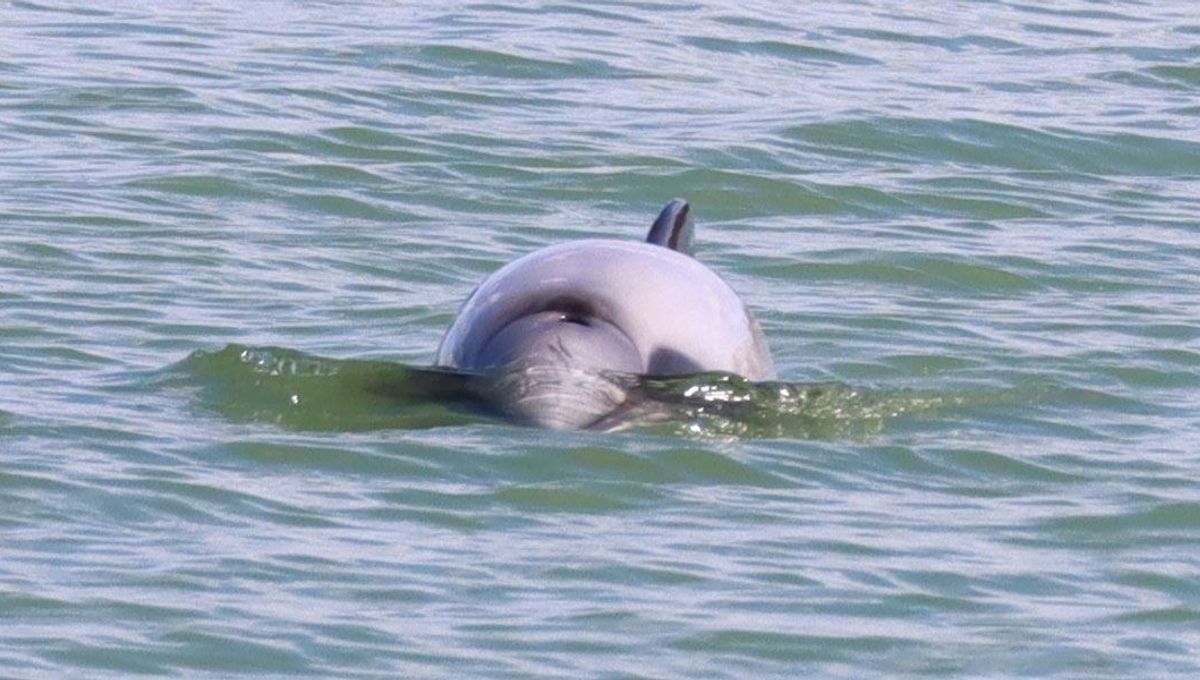
The subtropical waters of New Zealand’s Northland region may have had a rare treat recently, after reported sightings of what could be the rarest subspecies of the world’s smallest marine dolphin.
The species in question is Hector’s dolphin (Cephalorhynchus hectori), which is split into two subspecies: the South Island Hector’s dolphin (C. h. hectori) and the Māui dolphin (C. h. maui).
Both are endemic to New Zealand, and both look pretty much identical. They’re characteristically short and stocky compared to other dolphins at around 1.2 to 1.5 meters (4 to 5 feet) long, have grey and white bodies with black markings, and a rounded, flat black dorsal fin that looks like one of Mickey Mouse’s ears.
Jochen Zaeschmar, a dolphin researcher from the Far Out Ocean Research Collective, spotted a lone individual that could be either one of the subspecies in the Bay of Islands last week, which was later seen again in the English Bay.
The New Zealand Department of Conservation (DOC) is now asking locals in the area to keep an eye out for the dolphin so that Zaeschmar can take a DNA sample from it.
This is critical to finding out whether or not it’s a Hector’s or Māui dolphin that’s been seen; while there are some physical differences between the two (Māuis have a longer, wider snout, for example), it’s incredibly difficult to separate them at a glance. DNA makes distinguishing between the two much simpler, as there are clear genetic differences.
South Island Hector’s dolphins are the most numerous of the two subspecies, with a population of around 15,000 adults. As you might’ve guessed from the name, they’re found primarily around New Zealand’s South Island. To see one so far north would be a rare spot, even if it’s the more common subspecies.
“This would be just the second confirmed sighting of a Hector’s in Northland in 100 years,” explained DOC Marine Species Senior Advisor Kristina Hillock in a statement.
Māui dolphins, on the other hand, are limited to the west coast of the North Island, more likely to be seen between Manukau Harbour and Port Waikato. They’re also the rarer of the two, with only an estimated 54 adults remaining.
Identifying which of the subspecies the recently spotted individual is isn’t just for the sake of wanting to know; it’s an important part of conservation monitoring. The overall species is considered endangered by the IUCN, while within New Zealand, the South Island subspecies has a conservation status of nationally vulnerable, and the Māui dolphin nationally critical.
Both subspecies are vulnerable to further decline as they have relatively short lifespans compared to other cetaceans, as well as reaching maturity late and having a low reproduction rate. Such factors make it slower and more difficult to build a population back up.
Keeping an eye on them is key. If you happen to be in the area and spot something, the DOC has a message: If the dolphin has a rounded fin, call it in. You can find out more information on how to do so here.

Source Link: One Of The World’s Rarest, Smallest Dolphins May Have Just Been Spotted Off New Zealand’s Coast
