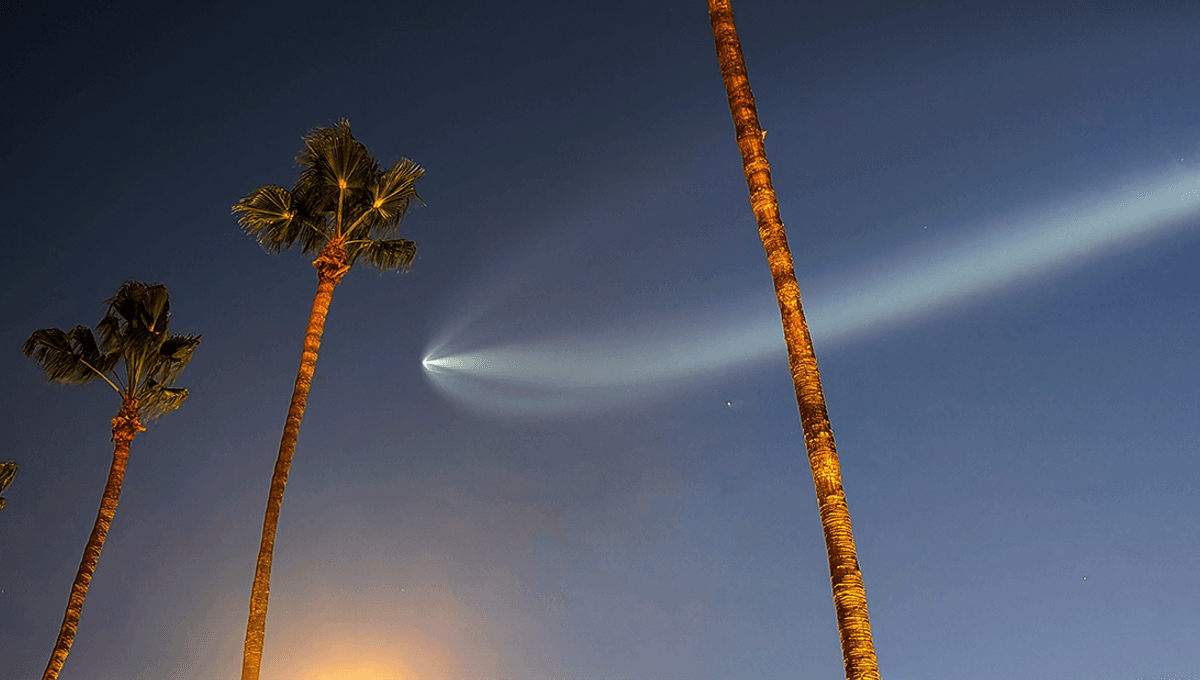
A new paper has taken a look at the orbits of megaconstellations around Earth, and found that we may be tiptoeing dangerously close to the catastrophic “Kessler syndrome” first hypothesized in 1978.
Simply put, the Kessler effect, or Kessler-Cour-Pallais syndrome (KCPS), is where a single event (such as the explosion of a satellite) in low-Earth orbit creates a chain reaction, as debris destroys other satellites in orbit. Should this happen, the debris could keep colliding with other satellites or other debris, potentially causing communication problems and leaving areas of space inaccessible to spacecraft.
Essentially, it could end up like the film Gravity, but with less Sandra Bullock and more “hey, what happened to the concept of GPS?” At worst, some scientists have speculated it could essentially trap us here on Earth, unable to even explore our own Solar System.
Back in 1978, when NASA space debris expert Don Kessler first proposed it, that may have seemed a tad dramatic, or at least a far-off problem humanity filed under “to be dealt with later”. Well, according to the new preprint paper, “later” may have crept up on us. By 2024, there were over 14,000 satellites in orbit around the Earth. Megaconstellations, like SpaceX’s Starlink, make up the bulk of this number, with Elon Musk’s firm having 8,811 in orbit as of October 2025.
These have posed real threats to other satellites, with the European Space Agency having to take evasive action back in 2019 to avoid a collision after “the Starlink team informed ESA that they had no plan to take action”. Concerns about these satellites (not limited to the topic of space debris) have grown in recent years, as geomagnetic storms have knocked them out of orbit.
In the new paper, which is yet to be peer-reviewed, the team attempted to quantify the danger posed by collisions, and how long satellite operators would have to correct courses and prevent catastrophe in the event of avoidance maneuver systems becoming broken, or solar storms causing a loss of situational awareness.
“There is substantial potential for current or planned actions in orbit to cause serious degradation of the orbital environment or lead to catastrophic outcomes, highlighting the urgent need to find better ways to quantify stress on the orbital environment,” the team writes in their paper.
“Here we propose a new metric, the [Collision Realization And Significant Harm] CRASH Clock, that measures such stress in terms of the time it takes for a catastrophic collision to occur if there are no collision avoidance manoeuvres or there is a severe loss in situational awareness.”
As with Kessler syndrome, the team stresses the dangers of chain reactions caused by one collision.
“Although spherical shells around Earth represent extremely large volumes and the instantaneous volume occupied by satellites is small, LEO [Low Earth Orbit] satellites orbit the Earth in approximately 90 minutes depending on the altitude,” the paper explains.
“As a result, these satellites quickly explore their mutual interaction possibilities. Collision avoidance manoeuvres are essential in dense satellite shells and successful repeated execution of these manoeuvres is the only reason why there has not been a recent major satellite-satellite collision as orbital densities continue to increase.”
Should we lose such capabilities, with solar storms being the main cause of such problems, things could get messy quite quickly. In 2019, the potential collision between Starlink and ESA’s satellite may not have posed much of a risk to other satellites, but according to the new paper, it certainly would today.
“Our calculations show the CRASH Clock is currently 2.8 days, which suggests there is now little time to recover from a wide-spread disruptive event, such as a solar storm. This is in stark contrast to the pre-megaconstellation era: in 2018, the CRASH Clock was 121 days,” the team writes.
“Said differently, if collision avoidance manoeuvres were to suddenly stop, and with our assumptions of collision cross-sections, within 24 hours there is a 30% chance of a collision between two catalogued RSOs and a 26% chance of a collision involving a Starlink satellite,” they added. “Such collisions would be catastrophic, causing a major debris-generating event with high likelihood of secondary and tertiary collisions due to high orbital densities and local collision areas.”
The team’s simulations did not take into account the effects of atmospheric drag, which could complicate the problems further, leaving very little time to correct orbits to prevent disaster. Full Kessler syndrome would take decades or even centuries to develop, which is part of the reason why the team suggests the CRASH Clock would be a more useful metric for measuring risk. However, such a disaster, perhaps caused by a strong solar storm, would still have some nasty consequences for satellites, and the humans below who rely on them.
“We emphasize that the CRASH Clock does not measure the onset of KCPS, nor should it be interpreted as indicating a runaway condition. However, it does measure the degree to which we are reliant on errorless operations,” the team writes in their discussion.
“In the short term, a major collision is more akin to the Exxon Valdez oil spill disaster than a Hollywood-style immediate end of operations in orbit. Indeed, satellite operations could continue after a major collision, but would have different operating parameters, including a higher risk of collision damage.”
The paper is posted to the preprint server arXiv.

Source Link: "Orbital House Of Cards": One Solar Storm And 2.8 Days Could End In Disaster For Earth And Its Satellites
