• Email Us: [email protected]
  • Contact Us: +1 718 874 1545
  • Skip to main content
  • Skip to primary sidebar

Medical Market Report

  • Home
  • All Reports
  • About Us
  • Contact Us

Oriental Hornbills Show Off Cognitive Skills That Rival Those Of Apes

February 19, 2024 by Deborah Bloomfield

Forget the term bird brain, many bird species are actually famous for their intelligence. And while parrots and corvids get all the credit, another group of birds is joining the ranks. The Oriental pied hornbill (Anthracoceros albirostris) is fascinating not just for its extraordinary mating and reproductive behaviors, but it’s also impressed scientists with its ability to understand object permanence.

Object permanence is the idea that an object still exists even when you can’t see it. In human children, there are six developmental stages that can test their understanding. Previously, other non parrot or corvid bird species have made it to stage four, but hornbills are the only other birds that have made it to stage six.

Advertisement

The idea that the birds would have a good understanding of object permanence occurs because, during the hornbills’ breeding stage, the female will seal herself inside the hollow cavity of a tree to lay her eggs. The male will bring food to her and their chicks even though he has never seen them as they remain sealed inside the tree with the female.


To test this, six oriental pied hornbills underwent a series of seven standard Piagetian tasks involving visible and invisible displacements. Jean Piaget was a Swiss psychologist who developed this scale and worked extensively on cognitive development in children. Stages one and two are about recognizing objects, so the tests with the hornbills began at stage three. 

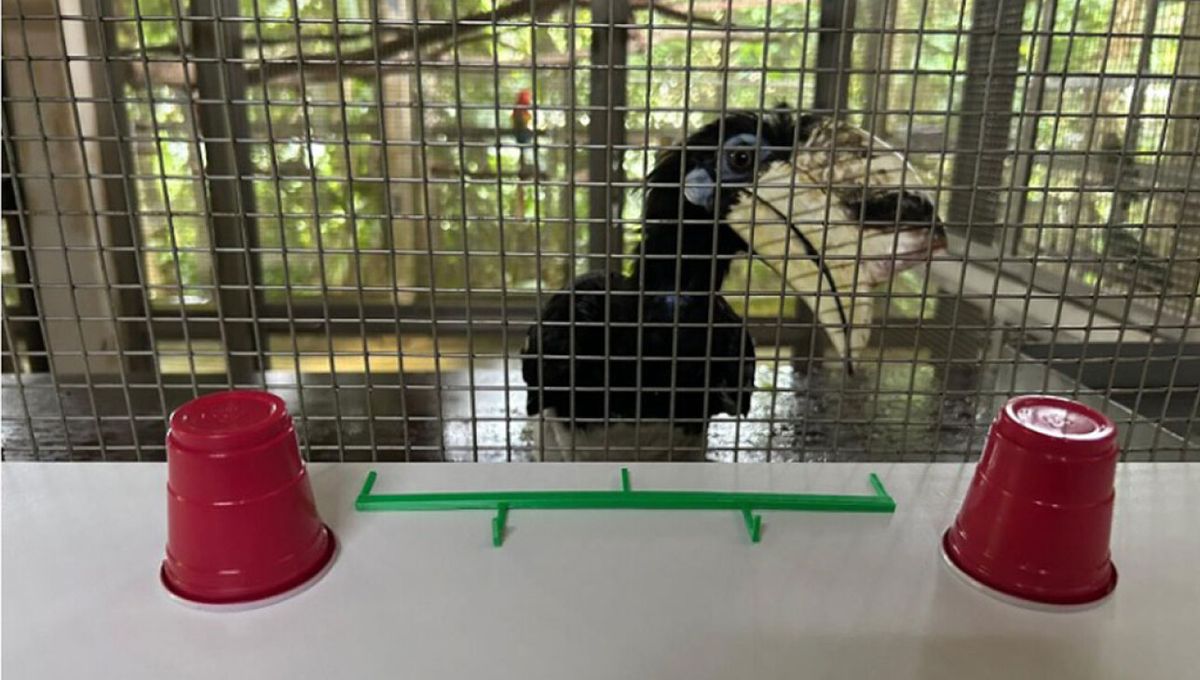
The birds were trained to use a plastic bar with three prongs facing them, which they could use to indicate where they thought a food reward was out of three possible options hidden under red cups. The birds had never before been in a situation where the food reward was either partially or fully hidden from their view.

Advertisement

In the later stages of the experiment, a red box was introduced and the food was manipulated under the cups within the box before the box was shown to be empty,  adding greater complexity, as can be seen in this video of the experiments. 


Of the six hornbills tested, three achieved full stage six, or double invisible displacement. The other three achieved stage five, double visible displacement. 

These findings represent the first time a bird not in either the parrot or corvid families has displayed object permanence levels that are comparable to apes. 

Advertisement

The paper is published in Biology Letters. 

Deborah Bloomfield
Deborah Bloomfield

Related posts:

  1. Soccer – FIFA backs down on threat to fine Premier clubs who play South American players
  2. U.S. House passes abortion rights bill, outlook poor in Senate
  3. UBS clients raise $650 million for biggest yet biotech impact fund
  4. We’ve Breached Six Of The Nine “Planetary Boundaries” For Sustaining Human Civilization

Source Link: Oriental Hornbills Show Off Cognitive Skills That Rival Those Of Apes

Filed Under: News

Primary Sidebar

  • Why People Still Eat Bacteria Taken From The Poop Of A First World War Soldier
  • Watch Rare Footage Of The Giant Phantom Jellyfish, A 10-Meter-Long “Ghost” That’s Only Been Seen Around 100 Times
  • The Only Living Mammals That Are Essentially Cold-Blooded Are Highly Social Oddballs
  • Hottest And Earliest Intergalactic Gas Ever Found In A Galaxy Cluster Challenges Our Models
  • Bayeux Tapestry May Have Been Mealtime Reading Material For Medieval Monks
  • Just 13 Letters: How The Hawaiian Language Works With A Tiny Alphabet
  • Astronaut Mouse Delivers 9 Pups A Month After Return To Earth
  • Meet The Moonfish, The World’s Only Warm-Blooded Fish That’s 5°C Hotter Than Its Environment
  • Neanderthals Repeatedly Dumped Horned Skulls In This Cave For An Unknown Ritual Purpose
  • Will The Earth Ever Stop Spinning?
  • Ammonites Survived The Asteroid That Killed The Dinosaurs, So What Killed Them Not Long After?
  • Why Do I Keep Zapping My Cat? The Strange Science Of Cats And Static Electricity
  • A Giant Volcano Off The Coast Of Oregon Is Scheduled To Erupt In 2026, JWST Finds The Best Evidence Yet Of A Lava World With A Thick Atmosphere, And Much More This Week
  • The UK’s Tallest Bird Faced Extinction In The 16th Century. Now, It’s Making A Comeback
  • Groundbreaking Discovery Of Two MS Subtypes Could Lead To New Targeted Treatments
  • “We Were So Lucky To Be Able To See This”: 140-Year Mystery Of How The World’s Largest Sea Spider Makes Babies Solved
  • China To Start New Hypergravity Centrifuge To Compress Space-Time – How Does It Work?
  • These Might Be The First Ever Underwater Photos Of A Ross Seal, And They’re Delightful
  • Mysterious 7-Million-Year-Old Ape May Be Earliest Hominin To Walk On Two Feet
  • This Spider-Like Creature Was Walking Around With A Tail 100 Million Years Ago
  • Business
  • Health
  • News
  • Science
  • Technology
  • +1 718 874 1545
  • +91 78878 22626
  • [email protected]
Office Address
Prudour Pvt. Ltd. 420 Lexington Avenue Suite 300 New York City, NY 10170.

Powered by Prudour Network

Copyrights © 2026 · Medical Market Report. All Rights Reserved.

Go to mobile version