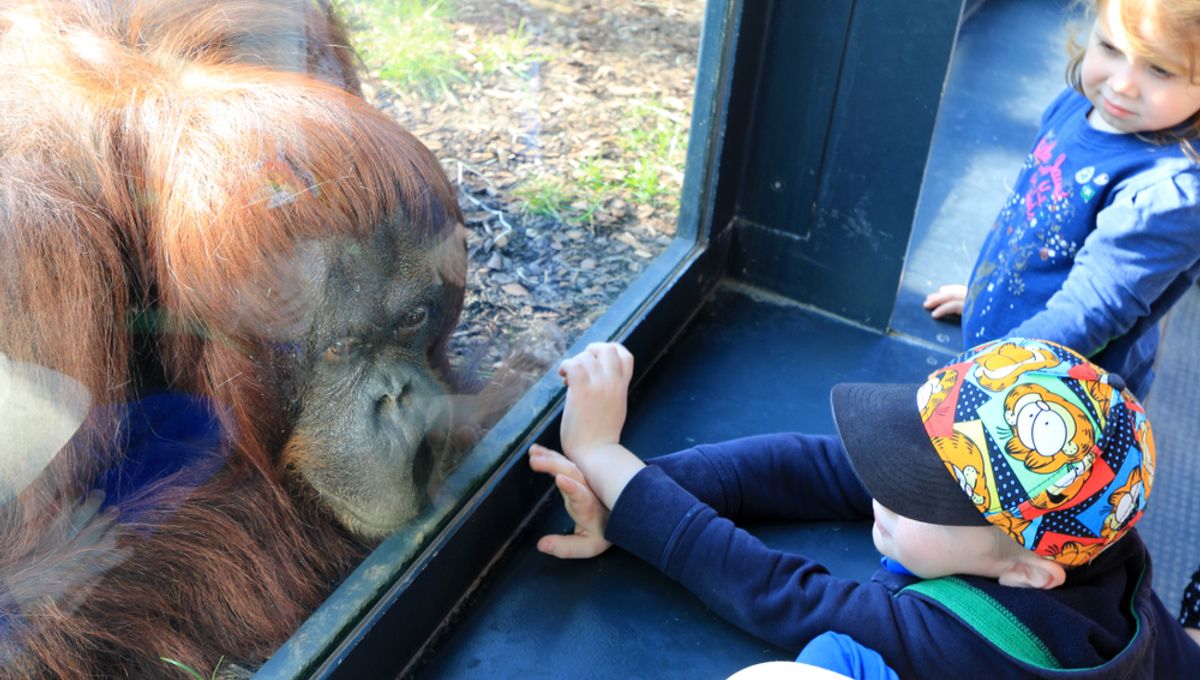
When offered either a transparent cup containing fruit or an opaque cup, four species of apes chose the safe option in a trial, a new study reports – human children aged 3-5, however, decided to risk the possibility of danger or disappointment over a guaranteed small reward. As much as anything else, this willingness to take risks to satisfy our curiosity may explain our dominance of the planet, for good and ill.
“Curiosity killed the cat,” the proverb goes, but this could be just another case of humans displacing our own character onto other creatures. Humanity is given to a restless searching few other animals can match, and new research demonstrates how wide the gap is with our nearest relatives.
To compare curiosity between humans and great apes Dr Alejandro Sánchez-Amaro and Dr Frederico Rossano offered chimpanzees, gorillas, bonobos, and orangutans a choice of two upside-down cups with grapes inside. The number of grapes varied, but the clear cup contained fewer than the opaque one. The pair of researchers, from the Max Plank Institute for Evolutionary Anthropology and the University of California San Diego respectively, report almost all the apes initially chose the grapes they could see.
This was not a case of the apes being satisfied with a small grape treat. When the contents of the opaque cup were revealed and the apes were given an opportunity to change, they chose the larger reward instead. Moreover, a previous stage had conditioned the apes to associate cups of the relevant color with a reward, they just didn’t know its size.
Human children were presented with a similar test, although stickers were used as a reward, in case grapes were just not much of an incentive. In this case, most chose the opaque cup at least once in several rounds of testing. Using slightly different test designs, the percentage shifted from 85 to 77 percent of human children – but either way, it is clear curiosity is a widespread trait.
“In this comparative set of studies, we explored whether children and non-human great apes would be curious to forego a visible benefit under a transparent cup to explore an uncertain option under an opaque cup. We found that children were more likely to explore the uncertain option than the great apes when no other information was available,” the authors explained in a statement. “Only after we unveiled the content of alternative opaque cups, which yielded better outcomes than the visible options during an intervention phase, did apes quickly overcome their initial risk aversion towards uncertain options. Children continued engaging in some level of exploration to diversify their options.”
The human behavior may be considered higher risk tolerance, or possibly just curiosity to learn what is hidden. Either way, it is striking that all four ape species tested (of the three orangutan and two gorilla species, only Bornean orangutans and western gorillas got to participate) responded similarly to each other but very differently from humans.
It’s not hard to imagine this difference contributed to humans being the ones who left the forests and reached the Moon. However, the authors also note past studies have shown adults; “Young children are predisposed to sample options more randomly than adults.”
Widespread stories warning about the dangers of too much curiosity might be seen as efforts by society to suppress a deeply ingrained tendency to gamble what we have for the sake of knowledge. When women from Pandora to Eve were blamed for the world’s troubles, curiosity was supposedly what led them astray. The point, presumably, was not merely to justify women’s social demotion, but to damp down a trait threatening to the powerful, but so natural to humans it took a lot of pushing to suppress.
The study is published in the journal PLOS ONE

Source Link: Our Curiosity Could Be What Most Distinguishes Humans From Apes
