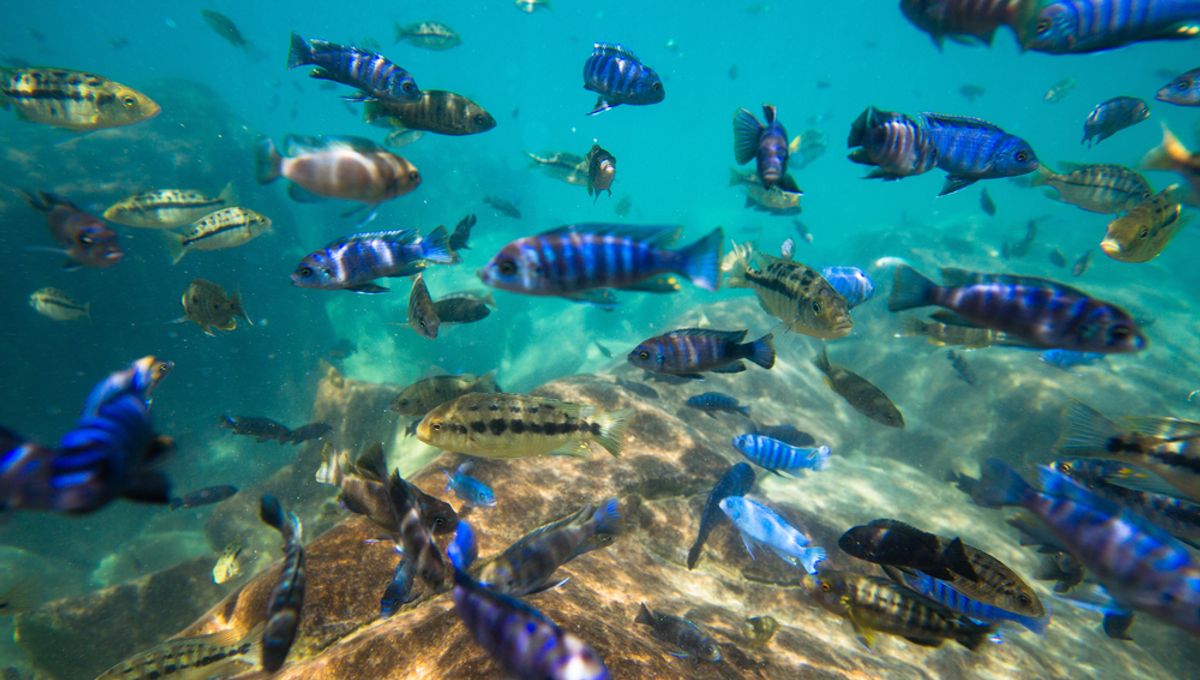
The Lake Victoria of today is relatively young at just 16,000 years old, but within this tiny timeframe, some 500 different species of cichlid fish have managed to evolve here. Remarkably, this explosion of diversity is primarily thanks to hybrids born as a result of inter-species breeding.
In a new study, scientists at the University of Bern, the University of Cambridge, and the Wellcome Sanger Institute discovered that the hundreds of wildly different species had, in fact, all evolved from just three lineages of cichlid that arrived in Lake Victoria – Africa’s largest lake – around 16,000 years ago when it refilled after an intense dry spell. This is unbelievably fast in terms of evolution.
“They evolved from probably three lineages that came together in the lake, hybridized, combined their genetic variation, and generated this huge diversity of hybrids, which then evolved into different species,” Dr Joana Meier, first author of the study and group leader at the Wellcome Sanger Institute, told IFLScience.
“We now find over 500 species of cichlid fishes. We found out that all those cichlid fish species actually evolved within the lake in just 16,000 years, which is absolutely crazy. Usually, it takes over a million years for a new species to evolve,” Dr Meier added.
“It’s kind of like a rabbit turning into a wolf within an eyeblink. Super crazy ecological differentiation – very, very fast.”
From their humble beginnings, the cichlids now thrive in Lake Victoria and occupy almost every imaginable niche in the ecosystem. They also look visibility different, boasting a variety of different shapes, sizes, colors, and forms.
“The species are super different too. Some are algae scrapers, others eat zooplankton, and others are top predators that eat other fish,” Dr Meier explained.
The team thinks this astonishing situation came about because the lake’s water would’ve been very murky when it first refilled. This meant that the cichlids couldn’t tell each other’s colors and found it difficult to identify different species. Shrouded by the muddy waters, a festival of hybridization took place.
The success of cichlid hybridization in Lake Victoria challenges one of the oldest assumptions about evolution that two different species can not reproduce and create viable or fertile offspring. As opposed to hybrids always being an evolutionary dead-end, it is possible for them to become a positive force in the survival of a gene.
Many hybrids born to parents of different species won’t be successful and might even be infertile. However, for a lucky few, the combination of genes could provide them with an advantage over their peers, helping them to survive and reproduce.
“They are generating a lot of genetic diversity. Even if some of them are doing really badly, it can still be beneficial if some are doing well,” Meier told IFLScience.
This doesn’t just apply to cichlids in Lake Victoria, either. If you look around, you’ll be able to see glimpses of introgressive hybridization within the genome of most living animals, from butterflies and spiders to marine mammals.
“With new genomic technologies to sequence DNA, we now see that basically all species – including humans – have some parts of the DNA that are derived from another species, which suggests that there was hybridization in the past,” Meier explained.
Indeed, if you look at the genome of many modern humans, you can find genetic evidence of Homo sapiens breeding with both Neanderthals and Denisovans, two other species of hominin that have since fallen into extinction.
For better or for worse, humans are also the products of hybridization. In the case of some people living in East Asia, there is evidence that Denisovan DNA has helped them to acclimatize to higher altitudes. On the other hand, Neanderthal DNA in the genome of people from Europe can lead to a higher risk of some diseases, including COVID-19 and depression.
The study challenges the idea that hybrization always end in a genetic dead-end. “Under certain circumstances, some hybrids may actually be doing better. It’s possible that in most circumstances they are not, but in some they are,” Meier said.
The new study is published in the journal Science.
Curious about nature? Join us for our first-ever free virtual festival of science, CURIOUS Live, where we talk queerness in nature with science writer Josh Davis. Streaming online on October 21, 2023, we have a line-up of fascinating experts discussing all things Life, Death, and Creation (y’know, the small stuff) across three festival “stages”. Sign up now to find out more and secure your spot.

Source Link: Over 500 Fish Have Rapidly Evolved In A Single Lake Thanks To Hybridization
