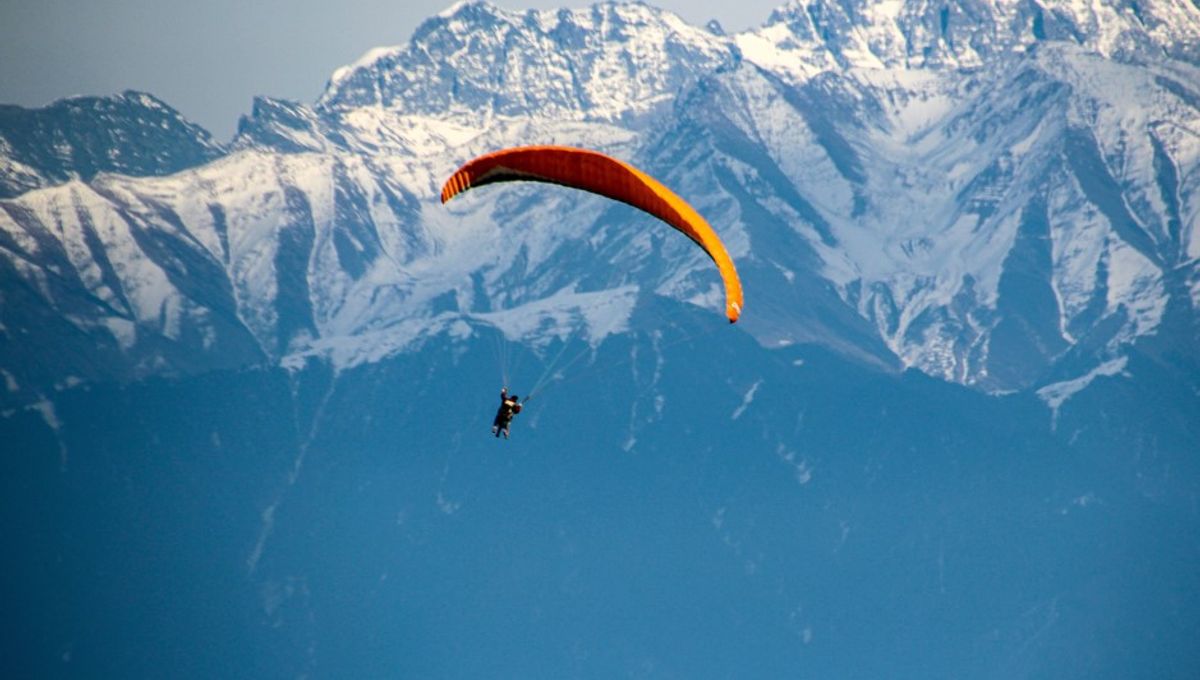
A Chinese paraglider is thankful to be back on solid ground after unintentionally soaring to an altitude referred to as the “death zone“. Peng Yujiang, 55, was testing out some new equipment on the ground, with no intention of flying, when a strong updraft unexpectedly swept him skywards to a height of more than 8,500 meters (27,890 feet).
“I had just bought a second-hand paragliding harness and wanted to test it, so I was conducting ground parachute shaking,” Peng told Chinese state broadcaster China Central Television, according to CNN. “After a while, the wind suddenly picked up and lifted me into the air. I tried to land as soon as possible, but I failed.”
The inadvertent Icarus appears to have been wafted away by a dangerous air current known as cloud suck, whereby pilots get caught up in rising thermals under the base of certain cloud formations. Peng explained that the uplift likely occurred due to a towering vertical cloud known as a cumulonimbus.
“I found myself surrounded by cumulonimbus clouds and trapped inside. It was terrifying – everything around me was white,” said Peng. “Without the compass, I wouldn’t have known which direction I was heading. I thought I was flying straight, but in reality, I was spinning.”
Viral footage shows Peng with his face and body covered in icicles as he attempts to control his canopy. According to Sixth Tone, data from the pilot’s flight tracker shows that he reached a maximum altitude of 8,598 meters (28,209 feet), which is only just lower than the summit of Mount Everest.
Mountain climbers typically refer to altitudes above 8,000 meters as the “death zone”, as the thin air at this height poses a serious risk of hypoxia, whereby the body suffers from a lack of oxygen. This causes the heart and respiratory system to go into overdrive in an attempt to keep the blood oxygenated, leading to an increased risk of heart attack.
Weakness, cognitive impairment, and psychosis also become real possibilities at this altitude, as a lack of oxygen in the brain triggers a dangerous condition known as high-altitude cerebral edema (HACE). On top of all that, temperatures in the death zone can be as low as -40°C (-40°F), which means any exposed body parts are likely to experience frostbite.
Peng said he thinks he might have passed out at some point during his ordeal before eventually landing some 30 kilometers (19 miles) away from where he started. In China, paragliders are required to register all flights prior to take-off, and Peng has now been banned from flying for six months as a result of this unauthorized adventure – not that he’d be in any hurry to be airborne again anyway.
Despite reaching the cruising altitude of some aircraft, Peng’s aeronautical antics fell short of the reported world record for a paraglider. That honor is held by Polish pilot Ewa Wiśnierska, who was lifted to just over 10,000 meters (32,808 feet) when she got caught in an updraft in Australia in 2007.
Wiśnierska says she spent about 40 minutes of that flight unconscious, and only realized where she’d been when she checked her flight data after landing.

Source Link: Paraglider Accidentally Flies Into The “Death Zone” 8,500 Meters Up – And Survives
