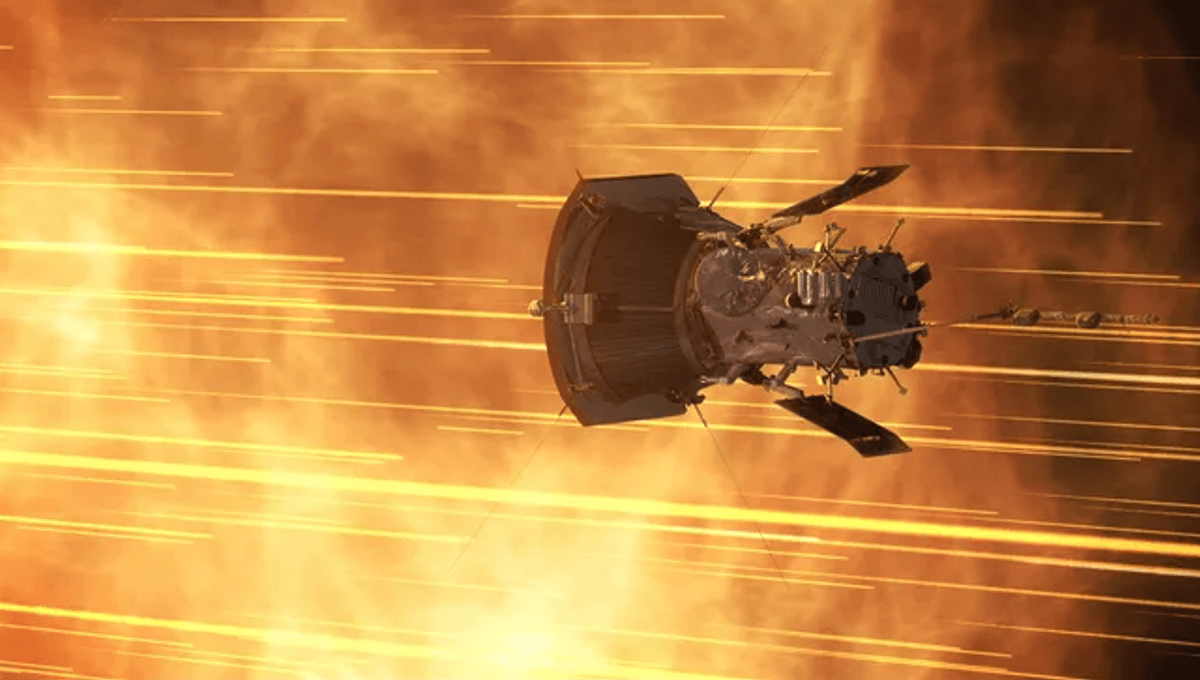
Parker Solar Probe has survived achieving the record-breaking closest pass to the Sun by a human-made spacecraft ever – and phoned home even earlier than expected, confirming it survived “touching the Sun” and reaching the pinnacle of its mission.
The already record-breaking probe – the fastest human-made object in the cosmos – carried out its closest pass to the Sun on December 24 but hadn’t communicated with NASA since December 20, when it sent a beacon signal to show all was well. In fact, NASA wasn’t expecting to hear from it until December 27, but has now confirmed it received a transmitted beacon signal back to Earth just before midnight EST on December 26, indicating the probe is “in good health and operating normally.”
The probe carried out its closest approach on December 24, where it whizzed past just 6.1 million kilometers (3.8 million miles) from the Sun’s surface while moving at around 690,000 kilometers per hour (430,000 miles per hour) – making it the fastest spacecraft ever.
Parker Solar Probe launched in 2018 to get closer to the Sun than humanity ever has before. Its mission to “touch the Sun” means flying through the Sun’s corona, its weak outer atmosphere – at scorching temperatures of up to 980°C (1,800°F) – to try and solve the mystery of why the Sun’s corona gets heated to millions of degrees, much hotter than the Sun’s surface. It will also help scientists trace the origin of the solar wind and how its energetic particles are accelerated to near-light speed when flung out into space.
To make this closest approach, Parker had to swing by Venus seven times to get a gravity assist to boost its speed and has orbited the Sun 21 times, inching closer with each pass. This 22nd flyby marks the closest the probe will get to the Sun. It has two more scheduled flybys at a similar distance and speed in March and June 2025.
“This is one example of NASA’s bold missions, doing something that no one else has ever done before to answer longstanding questions about our universe,” Parker Solar Probe program scientist Arik Posner said in a statement on December 20, when they last heard from it. “We can’t wait to receive that first status update from the spacecraft and start receiving the science data in the coming weeks.”
Now it has sent back its beacon indicating the craft’s general health, the team on Earth is expecting to receive a more detailed telemetry data report on January 1, and only then will they know if it collected the data to help solve some of the Sun’s enduring mysteries.
“No human-made object has ever passed this close to a star, so Parker will truly be returning data from uncharted territory,” Nick Pinkine, Parker Solar Probe mission operations manager at NASA’s Applied Physics Laboratory said.

Source Link: Parker Solar Probe Phones Home! Spacecraft Survives Record-Breaking Closest Pass To The Sun
