• Email Us: [email protected]
  • Contact Us: +1 718 874 1545
  • Skip to main content
  • Skip to primary sidebar

Medical Market Report

  • Home
  • All Reports
  • About Us
  • Contact Us

Peculiar, Unexpected Structures Discovered Floating Above Jupiter’s Great Red Spot

June 26, 2024 by Deborah Bloomfield

The atmosphere of Jupiter is a fascinating, ever-changing environment. Bands of different colors, storms, enormous clouds, and more are seen across the planet. Its upper atmosphere, though, has always been considered uneventful. Sure it is where the polar aurorae happen, but beyond that, it was believed that it had nothing weird going on. Now, a group of astronomers have turned that belief on its head.

Advertisement

The upper atmosphere is difficult to study. At the poles, particles from the volcanic moon Io follow the magnetic field lines to create aurorae in multiple wavelengths. Around the rest of the planet, the energy that shapes it is sunlight. And Jupiter only receives about 4 percent of the sunlight that Earth gets. That’s why astronomers assumed that it was going to be very uniform.

Advertisement

“We thought this region, perhaps naively, would be really boring,” team leader Henrik Melin, of the University of Leicester in the United Kingdom, said in a statement. “It is in fact just as interesting as the northern lights, if not more so. Jupiter never ceases to surprise.”

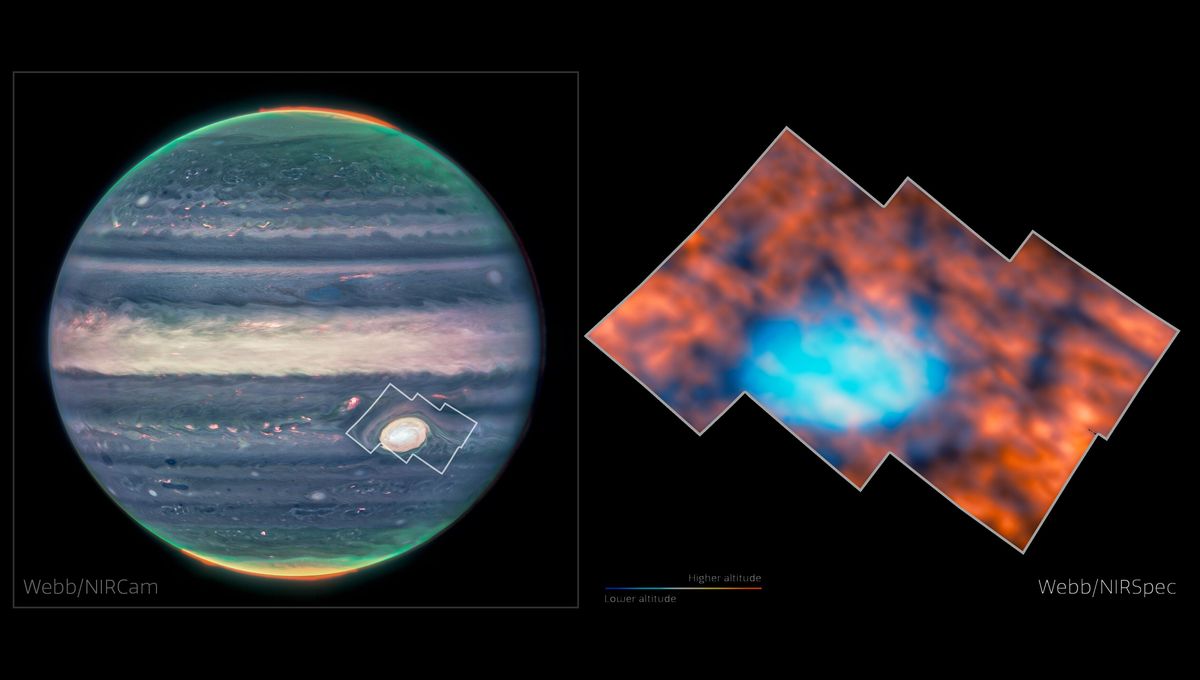
Observations by JWST have revealed intricate structures above the iconic Great Red Spot, a storm that is wider than Earth. They found dark arcs and bright spots that are visible in infrared. The source of this variation is not sunlight, but the deeper messy layers of the Jovian atmosphere.

“One way in which you can change this structure is by gravity waves – similar to waves crashing on a beach, creating ripples in the sand,” explained Melin. “These waves are generated deep in the turbulent lower atmosphere, all around the Great Red Spot, and they can travel up in altitude, changing the structure and emissions of the upper atmosphere.”

Such gravity waves are also present on Earth but, if the mechanism at play is the same, they are a lot weaker. 

Advertisement

The discovery was a long time coming. These observations were part of the Early Release Science program (ERS) for JWST as astronomers have been curious about Jupiter’s upper atmosphere for a while.

“This ERS proposal was written back in 2017,” shared team member Imke de Pater of the University of California, Berkeley. “One of our objectives had been to investigate why the temperature above the Great Red Spot appeared to be high, as at the time recent observations with the NASA Infrared Telescope Facility had revealed. However, our new data showed very different results.”

The team hopes to follow up the observations with JWST to better understand this portion of the Jovian Atmosphere. It will also help with planned observations for the European Space Agency’s JUICE mission, which will explore the planet and its three icy moons. 

These results are published in Nature Astronomy.

Deborah Bloomfield
Deborah Bloomfield

Related posts:

  1. Factbox-Top announcements from Apple event
  2. WTO chief says trade must do more to address ‘devastating’ vaccine inequity
  3. Internet Figures Out Which Muppets Are Predators And Which Are Prey Based On Their Eyes
  4. AI Discovers New Material That Could Slash Lithium Use In Batteries

Source Link: Peculiar, Unexpected Structures Discovered Floating Above Jupiter’s Great Red Spot

Filed Under: News

Primary Sidebar

  • Is This How The Voynich Manuscript Was Made? A New Cipher Offers Fascinating Clues
  • An Extremely Rare And Beautiful “Meat-Eating” Plant Has Been Found Miles From Its Known Home
  • Scheerer Phenomenon: Those White Structures You See When You Look At The Sky May Not Be “Floaters”
  • The Science Of Magic At CURIOUS Live: Psychologist Dr Gustav Kuhn On Using Magic To Study The Human Mind
  • Around 5 Percent Of Cancers Are Of “Unknown Primary”. Could A New Blood Test Track Them Down?
  • With Only 5 Years Left In Space, The International Space Station Just Hit A New Milestone
  • 7,000-Year-Old Atacama Mummies May Have Been Created As “Art Therapy”
  • In 1985, A Newborn Underwent Heart Surgery Without Pain Relief Because Doctors Didn’t Think Babies Could Feel Pain
  • Ancient Roman Military Officers Had Pet Monkeys, And The Pet Monkeys Had Pet Piglets
  • Lasting 29 Hours, The World’s Longest Commercial Scheduled Flight Is Set To Take Off This Week
  • What Is Christougenniatikophobia, And What Do I Do About It?
  • Sun’s Ancient Encounter With Two Hot Stars Left A Legacy In The Solar System’s Neighborhood
  • Defiant Stars And Unusual Objects Survive Against The Milky Way’s Supermassive Black Hole
  • A Wobbling Brown Dwarf Might Be A Sign Of The First Discovered “Exomoon” – A Moon Outside The Solar System
  • “Happy Molecule” Precursor Discovered In Extraterrestrial Material For The First Time
  • Why Do Seals Slap Their Belly?
  • Interstellar Comet 3I/ATLAS Appears To Be Experiencing “Cryovolcanism”, And Is Eerily Similar To Objects In The Outer Solar System
  • Catch The Last Supermoon Of The Year This Week
  • Why Does It Feel Like You’re Dropping Around 30 Seconds After A Plane Takes Off?
  • We Finally Understand Why We “Feel” It When We See Someone Get Hurt
  • Business
  • Health
  • News
  • Science
  • Technology
  • +1 718 874 1545
  • +91 78878 22626
  • [email protected]
Office Address
Prudour Pvt. Ltd. 420 Lexington Avenue Suite 300 New York City, NY 10170.

Powered by Prudour Network

Copyrights © 2025 · Medical Market Report. All Rights Reserved.

Go to mobile version