• Email Us: [email protected]
  • Contact Us: +1 718 874 1545
  • Skip to main content
  • Skip to primary sidebar

Medical Market Report

  • Home
  • All Reports
  • About Us
  • Contact Us

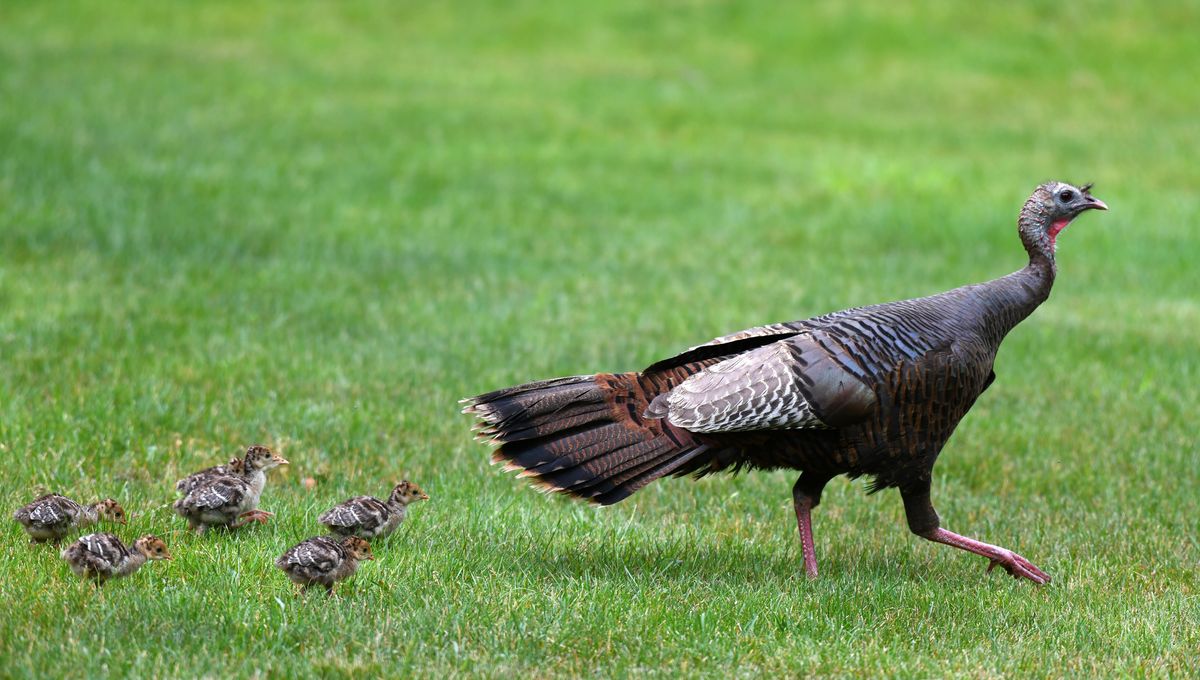
People Are Just Learning What A Baby Turkey Is Called

November 10, 2025 by Deborah Bloomfield

While many of us might associate turkeys with Thanksgiving or Christmas meals, they are actually remarkable birds capable of high-speed runs, possessing over 5,000 feathers, and a whole repertoire of noises beyond gobbling. But do you know what a baby turkey is called?

The rest of this article is behind a paywall. Please sign in or subscribe to access the full content.

Adult male turkeys – which are much bigger than females, standing 1.2 meters (4 feet) tall and weighing up to 11 kilograms (24 pounds) – are called toms, and the females are known as hens. In the wild, nesting season for these birds starts in the late spring, and the females build their nests at ground level. Typically, around 10 to 12 eggs are laid, which will take around one month to hatch.

Once those eggs hatch, for the next four weeks of a young domestic turkey’s life, they are known as a poult. The term “poult” seems to be more commonly used for domesticated birds, while “chick” is used interchangeably between wild and domesticated turkeys.

These are young birds that still rely on their mother for protection and can’t yet fly. Once they reach about 5 weeks old, they are able to seek protection in trees. Poults typically eat insects, but as they get older, their diet expands to seeds, grasses, berries, acorns, and even frogs and lizards. 

There are more names for the adults too; juvenile males become jakes before they are known as toms, and young females can be known as jennys. A group of turkeys is called a flock, though some suggest the collective noun “rafter”. 

Given the consumption of turkey meat during key events across the US and the wider world, it might seem strange that we don’t often eat turkey eggs. The reason for this is simply that it is not financially worth it to farmers. 

Chickens require less space, food, and mature faster and are able to produce eggs at a faster rate. Turkey eggs, while reportedly said to taste similar, can only be laid after 24-32 hours, and turkeys take several months to reach the age of sexual maturity. Add to this the additional space and feed needs of a large female turkey, and you start to understand the cost breakdown. Turkey eggs are at least pretty normal-tasting though, compared to the “somewhat fishy” flavors of a penguin egg. 

The wild turkey (Meleagris gallopavo) is something of a comeback success story, having increased in numbers by a significant amount in North America. There were once thought to be just 30,000 turkeys left in the wild, but now they number around 6.5 million in the United States alone. 

If you already knew about poults, take it one step further and find out what a baby anteater is called. 

Deborah Bloomfield
Deborah Bloomfield

Related posts:

  1. ViacomCBS unveils a Paramount+ and Showtime streaming bundle, starting at $9.99 per month
  2. Man With Parkinson’s Now Able To Walk Kilometers A Day Thanks To Spinal Implant
  3. Japanese Government Declares Victory In “War Against Floppy Disks”
  4. Blood-Powered Toes Give Wandering Salamanders The Perfect Take-Off And Landing

Source Link: People Are Just Learning What A Baby Turkey Is Called

Filed Under: News

Primary Sidebar

  • Gravitational Lenses Confirm That Something Is Still Broken In The Universe
  • Adorable Camera Trap Footage Of Moms And Cubs Heralds Conservation Win For Sunda Tigers
  • Exercise VS Sleep: Which Is More Important When You Don’t Have Time For Both?
  • A Deep-Sea Mining Test Carved Up The Seabed. Two Years On, We’re Seeing Devastating Impacts
  • Enormous New Study Finds COVID-19 mRNA Shots Associated With 25 Percent Lower Risk Of Death From Any Cause
  • What Is The Best Movie Set In Space? We Asked Real-Life Astronauts To Find Out
  • Chernobyl’s Protective Shield Is Broken After A Drone Strike, Warns UN Nuclear Watchdog
  • Isaac Newton Was Born On Christmas Day – And January 4th
  • Why Is December The 12th Month Of The Year When Its Name Means 10?
  • Poor Sauropod Was Limping When It Made Curious 360° Looping Dinosaur Track
  • Inhaling “Laughing Gas” Could Treat Severe Depression, Live Seven-Arm Octopus Spotted In The Deep Sea, And Much More This Week
  • People Are Surprised To Learn That The Closest Planet To Neptune Turns Out To Be Mercury
  • The Age-Old “Grandmother Rule” Of Washing Is Backed By Science
  • How Hero Of Alexandria Used Ancient Science To Make “Magical Acts Of The Gods” 2,000 Years Ago
  • This 120-Million-Year-Old Bird Choked To Death On Over 800 Stones. Why? Nobody Knows
  • Radiation Fog: A 643-Kilometer Belt Of Mist Lingers Over California’s Central Valley
  • New Images Of Comet 3I/ATLAS From 4 Different Missions Reveal A Peculiar Little World
  • Neanderthals Used Reindeer Bones To Skin Animals And Make Leather Clothes
  • Why Do Power Lines Have Those Big Colorful Balls On Them?
  • Rare Peek Inside An Egg Sac Reveals An Adorable Developing Leopard Shark
  • Business
  • Health
  • News
  • Science
  • Technology
  • +1 718 874 1545
  • +91 78878 22626
  • [email protected]
Office Address
Prudour Pvt. Ltd. 420 Lexington Avenue Suite 300 New York City, NY 10170.

Powered by Prudour Network

Copyrights © 2025 · Medical Market Report. All Rights Reserved.

Go to mobile version