• Email Us: [email protected]
  • Contact Us: +1 718 874 1545
  • Skip to main content
  • Skip to primary sidebar

Medical Market Report

  • Home
  • All Reports
  • About Us
  • Contact Us

People Are Showing Unusual Signs Of Liver Stiffness Months After COVID-19 Infection

December 6, 2022 by Deborah Bloomfield

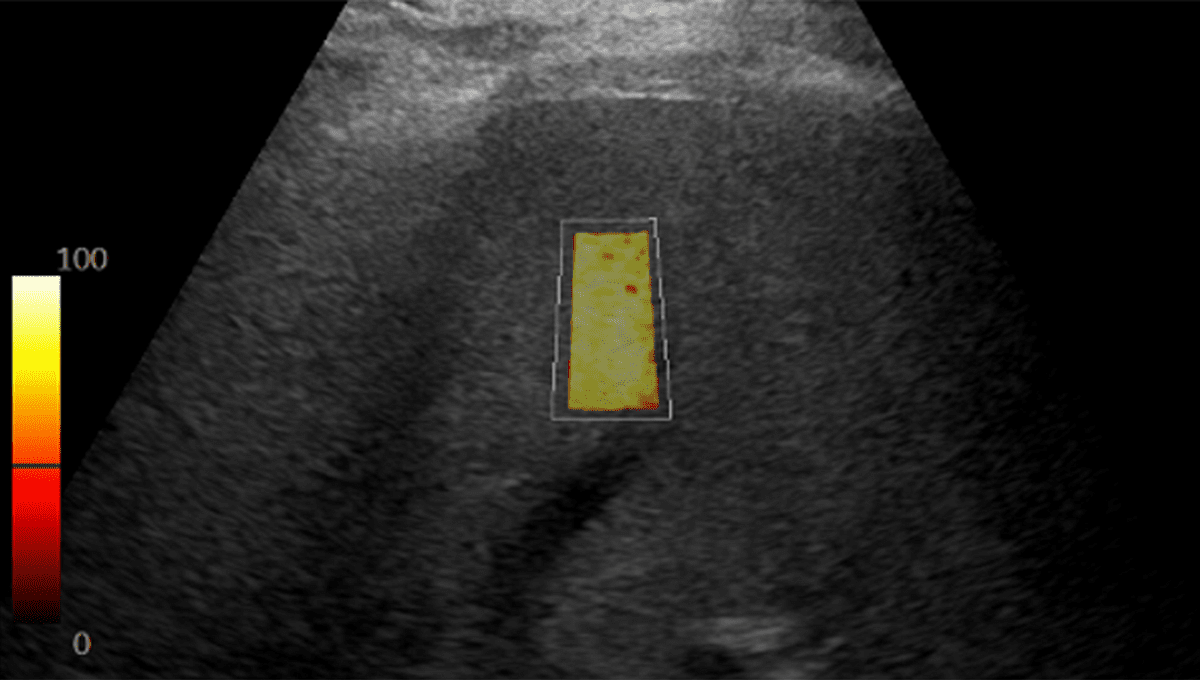
A study presented at the Radiological Society of North America conference has found signs of liver injury in patients, months after going through a COVID-19 infection. The study adds to evidence of SARS-CoV-2 infecting and damaging the organ.

The retrospective study, which has not yet been peer-reviewed, looked at patient data going back three years, using ultrasound shear wave elastography scans that took place at Massachusetts General Hospital between 2019 and 2022. This particular scan uses sound waves to measure the stiffness of tissue, allowing them to assess a patient’s liver stiffness. Liver stiffness is a marker of liver damage such as fibrosis (build-up of scar tissue) and inflammation. 

Advertisement

The team compared patients who had tested positive for COVID-19 at least 12 weeks prior to their scan to control groups of people who had tested only tested negative for COVID-19 and patients who underwent their scans prior to the pandemic. Controlling for factors such as age and sex, the team found that patients in the positive COVID-19 group had statistically significant higher levels of liver stiffness than those who had only tested negative for the disease.

People who had had COVID-19 as confirmed by a test had a median liver stiffness of 7.68 kilopascals (kPa) compared with the pandemic control group of 5.99 kPa. Unexpectedly, patients in the pre-pandemic control group had a higher median stiffness than the pandemic control, at 7.01 kPa. While the reason for this is not yet fully understood, the team suspect that it may be due to a change in patterns of referrals for ultrasound shear wave elastography scans during the pandemic.

“We don’t yet know if elevated liver stiffness observed after COVID-19 infection will lead to adverse patient outcomes,” study co-author Dr  Firouzeh Heidari said in a press release. The team has since moved on to attempting to find out.

Advertisement

“We are currently investigating whether the severity of acute COVID-related symptoms is predictive of long-term liver injury severity,” Heidari said. 

“We hope to enrich our existing database with additional patient data and a broader scope of co-variates to better understand the post-acute effects of COVID-19 within the liver.”

The findings were presented at the annual meeting of the Radiological Society of North America.

Deborah Bloomfield
Deborah Bloomfield

Related posts:

  1. Motor racing-Zandvoort turns orange in expectation of Verstappen win
  2. Ford to boost F-150 Lightning production capacity to 80,000 per year
  3. China’s Evergrande should not bet on govt bailout – Global Times editor
  4. Denmark charges women evacuated from Syrian detention camps

Source Link: People Are Showing Unusual Signs Of Liver Stiffness Months After COVID-19 Infection

Filed Under: News

Primary Sidebar

  • Fastest Cretaceous Theropod Yet Discovered In 120-Million-Year-Old Dinosaur Trackway
  • What’s The Moon Made Of?
  • First Hubble View Of The Crab Nebula In 24 Years Is A Thing Of Beauty… With Mysterious “Knots”
  • “Orbital House Of Cards”: One Solar Storm And 2.8 Days Could End In Disaster For Earth And Its Satellites
  • Astronomical Winter Vs. Meteorological Winter: What’s The Difference?
  • Do Any Animal Species Actively Hunt Humans As Prey?
  • “What The Heck Is This?”: JWST Reveals Bizarre Exoplanet With Inexplicable Composition
  • The Animal With The Strongest Bite Chomps Down With A Force Of Over 16,000 Newtons
  • The Eschatian Hypothesis: Why Our First Contact From Aliens May Be Particularly Bleak, And Nothing Like The Movies
  • The Great Mountain Meltdown Is Coming: We Could Reach “Peak Glacier Extinction” By 2041
  • Comet 3I/ATLAS Is Experiencing A Non-Gravitational Acceleration – What Does That Mean?
  • The First Human Ancestor To Leave Africa Wasn’t Who We Thought It Was
  • Why Do Warm Hugs Make Us Feel So Good? Here’s The Science
  • “Unidentified Human Relative”: Little Foot, One Of Most Complete Early Hominin Fossils, May Be New Species
  • Thought Arctic Foxes Only Came In White? Think Again – They Come In Beautiful Blue Too
  • COVID Shots In Pregnancy Are Safe And Effective, Cutting Risk Of Hospitalization By 60 Percent
  • Ramanujan’s Unexpected Formulas Are Still Unraveling The Mysteries Of The Universe
  • First-Ever Footage of A Squid Disguising Itself On Seafloor 4,100 Meters Below Surface
  • Your Daily Coffee Might Be Keeping You Young – Especially If You Have Poor Mental Health
  • Why Do Cats And Dogs Eat Grass?
  • Business
  • Health
  • News
  • Science
  • Technology
  • +1 718 874 1545
  • +91 78878 22626
  • [email protected]
Office Address
Prudour Pvt. Ltd. 420 Lexington Avenue Suite 300 New York City, NY 10170.

Powered by Prudour Network

Copyrights © 2025 · Medical Market Report. All Rights Reserved.

Go to mobile version