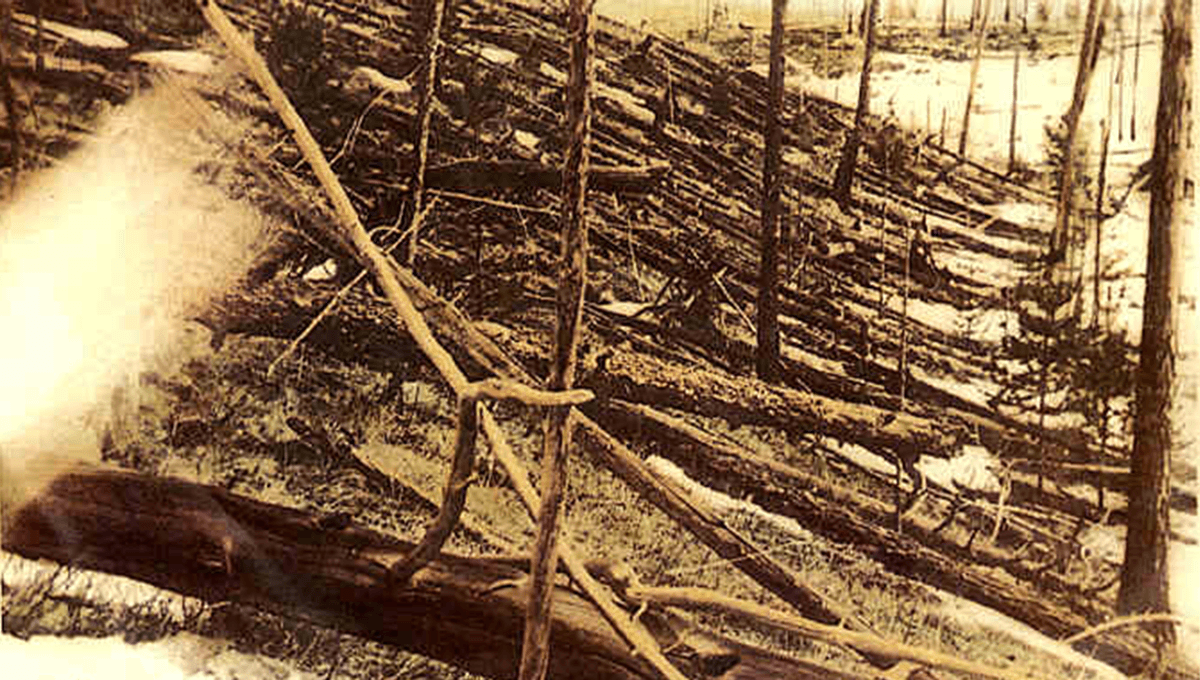
At around 7:14 am on June 30, 1908, a giant explosion occurred above the Podkamennaya Tunguska river in what is now Krasnoyarsk Krai, Russia.
The explosion flattened 2,150 square kilometers (830 square miles) with the force of an estimated 10-20 megatons, making it possibly thousands of times more powerful than the atomic bomb the US dropped on Hiroshima, Japan, at the end of World War II.
Eyewitnesses described shockwaves from hundreds of kilometers away, and hearing several explosions like cannons.
“Suddenly, over the mountain where the forest had already fallen, it became very light, and, how can I tell you, as if a second sun had appeared,” one witness to the event later described. “My eyes hurt, and I even closed them. It looked like what the Russians call lightning. And immediately there was […] strong thunder. This was the second blow. The morning was sunny, there were no clouds, our sun was shining brightly, as always, and then a second sun appeared!”
“With difficulty, Chekaren and I crawled out from under [shelter]. After that, we saw that above, but in a different place, it flashed again and there was strong thunder. This was the third blow. The wind came at us, knocked us off our feet, and hit us against fallen wood.”
Others described seeing a “tube” in the sky, with reports describing it as blue. What was puzzling about the event was a lack of an impact crater, which hasn’t been found to this day (despite claims to the contrary). Over the years, a number of explanations have been proposed for the event, from asteroids skimming the atmosphere to, briefly, primordial black holes passing directly through the Earth.
In the current age of the universe, black holes form when gigantic stars run out of fuel and collapse under their own gravity. This places a limit on how small a stellar black hole can be in the current universe; they have to form from large amounts of mass condensed into one small region, and only occur in stars around 20 times the mass of the Sun. Primordial black holes, on the other hand, are hypothetical black holes that are proposed to have formed in the first few seconds of the universe, when all the stuff that would go on to create the stars and galaxies was more tightly packed together.
“In that moment, pockets of hot material may have been dense enough to form black holes, potentially with masses ranging from 100,000 times less than a paperclip to 100,000 times more than the Sun’s,” NASA explains. “Then as the universe quickly expanded and cooled, the conditions for forming black holes this way ended.”
If they did form – and we have never detected one – it is possible that they could still be out there. There have even been suggestions primordial black holes smaller than an atom could pass through Earth every day without harm to the planet, or maybe a larger one every thousand years or so.
Looking at the Tunguska event, one team of physicists suggested in a 1973 Nature paper that it could have been caused by a primordial black hole passing through the planet. The team claimed that a black hole with the mass of a large asteroid would explain the lack of impactor seen at Tunguska, as well as blue light seen by witnesses.
“Most of the radiation from the shock front would be in the vacuum ultraviolet and would be absorbed and reradiated at longer wavelengths,” the team explained. “There would be little hard X radiation and the accompanying plasma column would appear deep blue.”
While a very “out there” suggestion, the team suggested a way that the idea could be tested – essentially, looking for signs of an exit wound on the other side of the planet.
“[The black hole] would enter the Earth, and the rigidity of rock would allow no underground shock wave,” the team wrote in their paper. “Because of its high velocity and because it loses only a small fraction of its energy in passing through the Earth, the black hole should very nearly follow a straight line through the Earth, entering at 30° to the horizon and leaving through the North Atlantic in the region 40°-50° N 30°-40° W. This exit provides a check for the whole hypothesis. “
The team proposed looking for shockwaves and disturbances of the ocean on the opposite side of the world. While a fun idea, no such evidence has been found, and we still don’t know that primordial black holes exist at all.
The Tunguska event can be explained without resorting to black holes from the dawn of time that happen to be the mass of a large asteroid. The other explanation is: a large asteroid, around the mass of a large asteroid. The generally accepted explanation is that an asteroid around 50 to 80 meters (160–262 feet) across exploded in an airburst 10 to 14 kilometers (6 to 9 miles) above the ground.

Source Link: Physicists Once Proposed The Tunguska Event Was Caused By A Black Hole Passing Through Earth
