• Email Us: [email protected]
  • Contact Us: +1 718 874 1545
  • Skip to main content
  • Skip to primary sidebar

Medical Market Report

  • Home
  • All Reports
  • About Us
  • Contact Us

“Potential Impact On Saturn”: Astronomers Appeal For Help As Video Appears To Show Object Hitting The Gas Giant

July 8, 2025 by Deborah Bloomfield

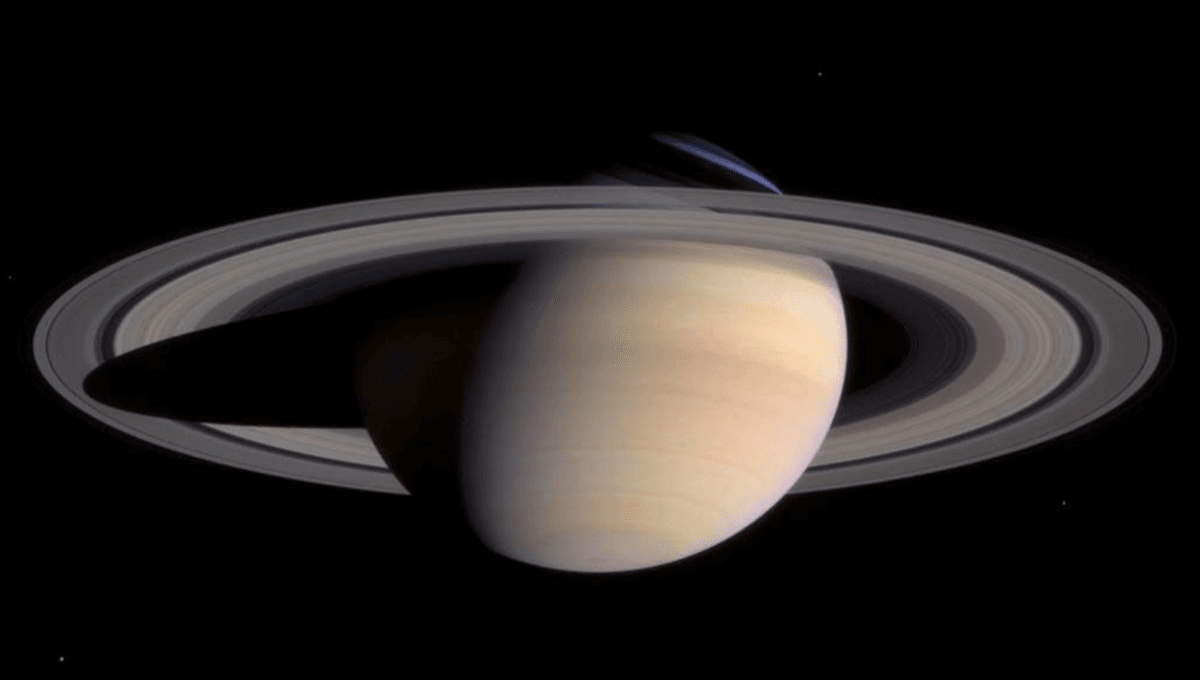
Astronomers at the Planetary Virtual Observatory and Laboratory (PVOL) are appealing for help, after an image taken by NASA’s Mario Rana appears to show an object slamming into Saturn.

Saturn, like Jupiter, is a gas giant. With their impressive masses, you would expect these giants to attract their share of asteroid impacts. Unlike terrestrial planets, which are usually left with an obvious crater after impact, on gas giants, it is not entirely obvious. With outer layers primarily composed of hydrogen and helium, any trace of an impact can disappear.

Astronomers have attempted to model how many impacts take place on the gas giant. One recent study put the number of impacts by objects over 1 kilometer at around 3.2 × 10⁻³ yr−1 ( 0.0032 per year, or 1 every 3,125 years). Smaller impacts are thought to be more common, with Cassini data showing that impacts can leave telltale ripples in Saturn’s rings.

“These new results imply the current-day impact rates for small particles at Saturn are about the same as those at Earth – two very different neighborhoods in our Solar System – and this is exciting to see,” Linda Spilker, Cassini project scientist at NASA’s Jet Propulsion Laboratory, explained in 2013. “It took Saturn’s rings acting like a giant meteoroid detector – 100 times the surface area of the Earth – and Cassini’s long-term tour of the Saturn system to address this question.”

Despite these impacts being relatively common – around 8,000 meteorites impact Earth every year – we have never observed an object hitting Saturn. Until, just maybe, now. On Saturday, July 5, NASA’s Mario Rana captured a potential impact, which has now been reported to the Planetary Virtual Observatory & Laboratory (PVOL).

ⓘ IFLScience is not responsible for content shared from external sites.

The bright flash highlighted in the left side of the picture has the appearance of an impact event. Objects have been observed slamming into Jupiter every now and then, producing similar flashes. 

While exciting, it is far from confirmed. PVOL is now appealing for further observations taken this morning in an attempt to confirm or refute the potential impact.

“Marc Delcroix reports a potential impact in Saturn captured in a few frames in a video observation obtained by Mario Rana,” PVOL explains. “The potential impact would be very faint and is unconfirmed. The very short impact flash occurred on Saturn on July 5th 2025, between 09:00 and 09:15 UT. It is very important to get other videos of Saturn taken during that time frame.”

Any astronomers who have observations from this time are urged to contact Delcroix to submit their data. Hopefully, soon we will have further observations from Saturday, helping us to confirm whether we have seen our first ever impact with gas giant Saturn.

Deborah Bloomfield
Deborah Bloomfield

Related posts:

  1. Biden nominee for key China export post expects Huawei to remain blacklisted
  2. New Images From Inside Fukushima Nuclear Plant Are Causing Big Worries
  3. 100-Year Floods May Be Looming If We Don’t Change Our Ways
  4. Disk Called “Dracula’s Chivito” Has The Largest Collection Of Planet-Making Materials Ever Found

Source Link: "Potential Impact On Saturn": Astronomers Appeal For Help As Video Appears To Show Object Hitting The Gas Giant

Filed Under: News

Primary Sidebar

  • US Just Killed NASA’s Mars Sample Return Mission – So What Happens Now?
  • Art Sleuths May Have Recovered Traces Of Da Vinci’s DNA From One Of His Drawings
  • Countries With The Most Narcissists Identified By 45,000-Person Study, And The Results Might Surprise You
  • World’s Oldest Poison Arrows Were Used By Hunters 60,000 Years Ago
  • The Real Reason You Shouldn’t Eat (Most) Raw Cookie Dough
  • Antarctic Scientists Have Just Moved The South Pole – Literally
  • “What We Have Is A Very Good Candidate”: Has The Ancestor Of Homo Sapiens Finally Been Found In Africa?
  • Europe’s Missing Ceratopsian Dinosaurs Have Been Found And They’re Quite Diverse
  • Why Don’t Snorers Wake Themselves Up?
  • Endangered “Northern Native Cat” Captured On Camera For The First Time In 80 Years At Australian Sanctuary
  • Watch 25 Years Of A Supernova Expanding Into Space Squeezed Into This 40-Second NASA Video
  • “Diet Stacking” Trend Could Be Seriously Bad For Your Health
  • Meet The Psychedelic Earth Tiger, A Funky Addition To “10 Species To Watch” In 2026
  • The Weird Mystery Of The “Einstein Desert” In The Hunt For Rogue Planets
  • NASA Astronaut Charles Duke Left A Touching Photograph And Message On The Moon In 1972
  • How Multilingual Are You? This New Language Calculator Lets You Find Out In A Minute
  • Europa’s Seabed Might Be Too Quiet For Life: “The Energy Just Doesn’t Seem To Be There”
  • Amoebae: The Microscopic Health Threat Lurking In Our Water Supplies. Are We Taking Them Seriously?
  • The Last Dogs In Antarctica Were Kicked Out In April 1994 By An International Treaty
  • Interstellar Comet 3I/ATLAS Snapped By NASA’s Europa Mission: “We’re Still Scratching Our Heads About Some Of The Things We’re Seeing”
  • Business
  • Health
  • News
  • Science
  • Technology
  • +1 718 874 1545
  • +91 78878 22626
  • [email protected]
Office Address
Prudour Pvt. Ltd. 420 Lexington Avenue Suite 300 New York City, NY 10170.

Powered by Prudour Network

Copyrights © 2026 · Medical Market Report. All Rights Reserved.

Go to mobile version