English physicist and science communicator Brian Cox has given some of his thoughts on comet 3I/ATLAS, the interstellar visitor currently hurtling its way through the Solar System.
On July 1, 2025, astronomers at the Asteroid Terrestrial-impact Last Alert System (ATLAS) spotted an object moving through the Solar System. That’s no surprise, given the name. What was unusual, and highly interesting, was that the object appeared to be the fastest object of this type ever observed, and had an eccentricity of between 6.1 and 6.2.
This means that it is an interstellar object, the third we have found so far. It was named 3I/ATLAS to reflect it is the third interstellar object discovered, and the team that found it in our skies.
Astronomers have since been tracking the object, which was confirmed to be a comet due to its outgassing. The object has been subject to (dubious) speculation that it is not a natural object, earning responses from SETI and NASA. Though there is little reason to suspect 3I/ATLAS is anything other than a natural object, it is of high interest to scientists and the public alike, having traveled alone through interstellar space for possibly 10 billion years, a time capsule from an earlier age of the universe.
Irritatingly (do better, interstellar chunks of ice, cyanide, and rock) 3I/ATLAS’s path took it behind the Sun from our perspective. But in an impressive display of getting our astronomical shit together, the European Space Agency (ESA) was able to capture images of it as it passed by Mars using the ExoMars Trace Gas Orbiter, while the Jupiter Icy Moons Explorer (JUICE) spacecraft will image it as it heads near Jupiter.
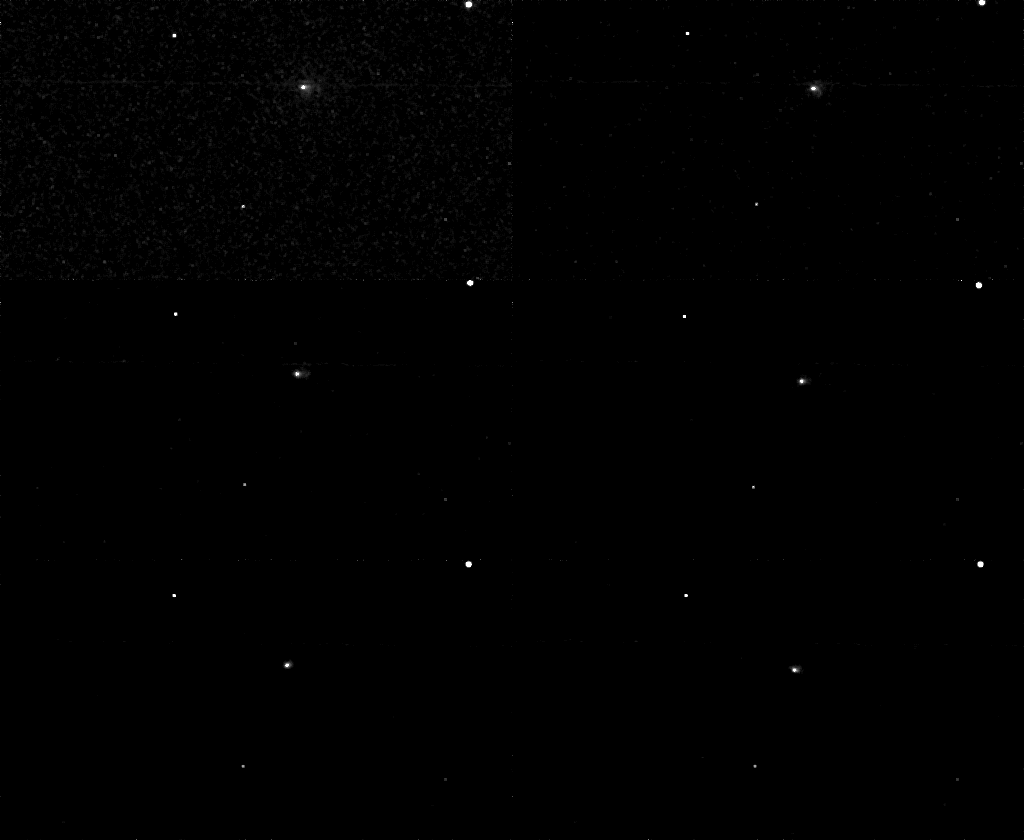
ExoMars Trace Gas Orbiter observes comet 3I/ATLAS.
Image credit: ESA/TGO/CaSSI
In an interview with the BBC, professor of particle physics in the School of Physics and Astronomy at the University of Manchester, and former keyboard player for dance act D:Ream, Brian Cox, explained why he finds the object and humanity’s reaction to it “remarkable”, drawing particular attention to the photos taken of the object from Mars.
“There’s an estimate a couple of days ago that it might have formed seven and a half billion years ago,” he told the presenters. “So it was made before the Earth and the Sun had formed out of a cloud of dust. And it’s been on its journey across the Milky Way galaxy, and the thing I find remarkable, […] it’s only 400 years [ago] that we were arguing about whether the Earth went around the Sun.”
“Now we’ve sent spacecraft to the planets that Kepler and others were seeing move in the sky, and we’re taking photographs of interstellar comets from the surface of other planets in about 400 years. So that, to me, is a remarkable story.”
Which puts the achievement in perspective nicely. While we agree with the sentiment, we should point out that though NASA was attempting to capture images of 3I/ATLAS using the Perseverance rover on Mars’ surface, and though the object may have been caught, this has not yet been confirmed by NASA.
Nonetheless, capturing an interstellar object from the orbits of two other planets is an impressive achievement for a species who were injecting frogs with pee to find out if we were pregnant less than a hundred years ago.

Source Link: Prof Brian Cox Explains What He Finds "Remarkable" About Interstellar Object 3I/ATLAS Story
