It’s a thought that may have crossed your mind at some point: what would be the practicalities of firing your enemies into the Sun? Fortunately, an associate professor of astronomy, who hopefully doesn’t have access to a rocket ship, has the answers.
Apart from the obvious moral difficulties, physics is not working in your favor. Intuitively it may seem easy – just point a rocket at it and shoot. The Sun contains around 99.8 percent of the Solar System’s mass, so you might think it would be quite easy to just let our star’s gravity do the work. While that is part of the answer, it may be a little more complicated than you think.
First up, just pointing a rocket at the Sun and blasting as hard as you can would result in a wild miss. The main problem you face, other than capturing your enemy and/or convincing them to step into your spaceship, is the Earth’s velocity relative to the Sun.
“Our planet is traveling very fast – about 67,000 miles per hour – almost entirely sideways relative to the Sun,” NASA explains. “The only way to get to the Sun is to cancel that sideways motion.”
If you were to just aim at the Sun and fire your rockets, it would result in a sizeable miss, because of the velocity you inherit from the Earth’s movement relative to the Sun.
“When our rocket leaves the proximity of the Earth it is travelling faster around the Sun than towards the Sun. At first the rocket gets closer to the Sun. But the motion of the rocket around the Sun and gravity results in an elliptical orbit that misses the Sun entirely,” Michael J. I. Brown, Associate Professor in Astronomy at Monash University, explains in a piece for The Conversation. “It isn’t even close: we miss the sun by almost 100 million km.”
According to Brown, launching at a velocity of 7,000 kilometers per second (4,350 miles per second) would cut it. But the fastest that any human has traveled is 39,937.7 kilometers per hour (24816.1 miles per hour) relative to the Sun. Good luck getting up to 7,000 kilometers per second without any major physics breakthroughs, or a warp drive.
So how do you fire your nemesis into the Sun without asking them to wait around for Einstein 2 to physics our way through the problem?
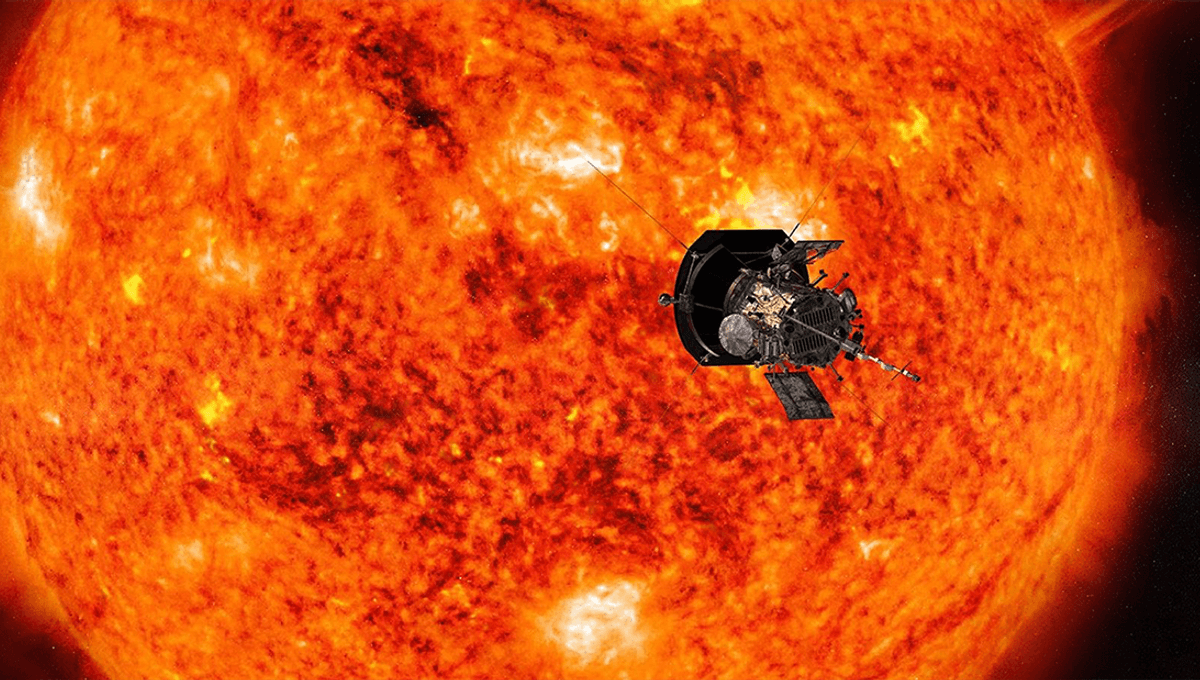
Of course, this isn’t completely a hypothetical question. NASA has sent the Parker Solar Probe to as close to the Sun as possible in order to study the Sun’s outer atmosphere, or corona. On it’s closest approach – the nearest humanity’s probes have ever approached our star – it was only 6.1 million kilometers (3.8 million miles) from its surface. That might sound pretty far in Earth terms, but space is large. That is only 0.066 astronomical units (AU) from the Sun’s surface, with one AU being the distance from the Earth to the Sun.
The way you do it is to counteract the motion you inherit from the Earth.
“To do this, we would have a rocket leave low Earth orbit at 32km per second travelling in the opposite direction to Earth’s motion. If the Sun was overhead, the rocket would be travelling almost horizontally due east,” Brown explains. “Once the rocket leaves the proximity of Earth, its speed relative to the Sun would be almost zero. At this point the Sun’s gravity would pull the rocket (and the villain contained therein) inexorably inward.”
“Given this is a journey of 150 million km, the trip would take roughly 10 weeks – plenty of time for our villain to consider their sins before fiery destruction.”
Unfortunately, those speeds are still currently unachievable with a simple “blast and point” mission. In fact, it would take less fuel to launch your enemies right out of the Solar System than it would to burn them up in the Sun.
In order to get objects into the Sun, or near as damnit, our spacecraft have to perform maneuvers using the gravitational influence of a planet to alter their velocity, known as a “gravity assist“.
“Spacecraft can leverage the gravity of other planets to speed up, like a slingshot, or to slow down, like tapping the brakes,” a video from the Johns Hopkins Applied Physics Laboratory explains.
“A planetary gravity assist changes a spacecraft’s heliocentric speed by rotating the direction of the spacecraft’s flyby velocity,” they add. “As Parker Solar Probe speeds towards Venus, it flies in front of the planet to slow down – kind of like swimming against a current. This actually allows the spacecraft to leave a little of its momentum with Venus as it zips by. The flyby alters Parker Solar Probe’s orbit – sometimes by millions of miles, sending it closer to the Sun.”
With careful planning, and still a lot of fuel and thrust, you could use Venus for the purpose of discarding your nemesis, though it may take some time.
“In addition to using a powerful rocket, the Delta IV Heavy, Parker Solar Probe will perform seven Venus gravity assists over its seven-year mission to shed sideways speed into Venus’ well of orbital energy,” NASA added ahead of the mission. “These gravity assists will draw Parker Solar Probe’s orbit closer to the Sun for a record approach of just 3.83 million miles from the Sun’s visible surface on the final orbits.”
At least your enemy would get a nice view of Earth’s “sister planet” before they meet their demise.

Source Link: Professor Of Astronomy Explains Why You Can't Fire Your Enemies Straight Into The Sun
