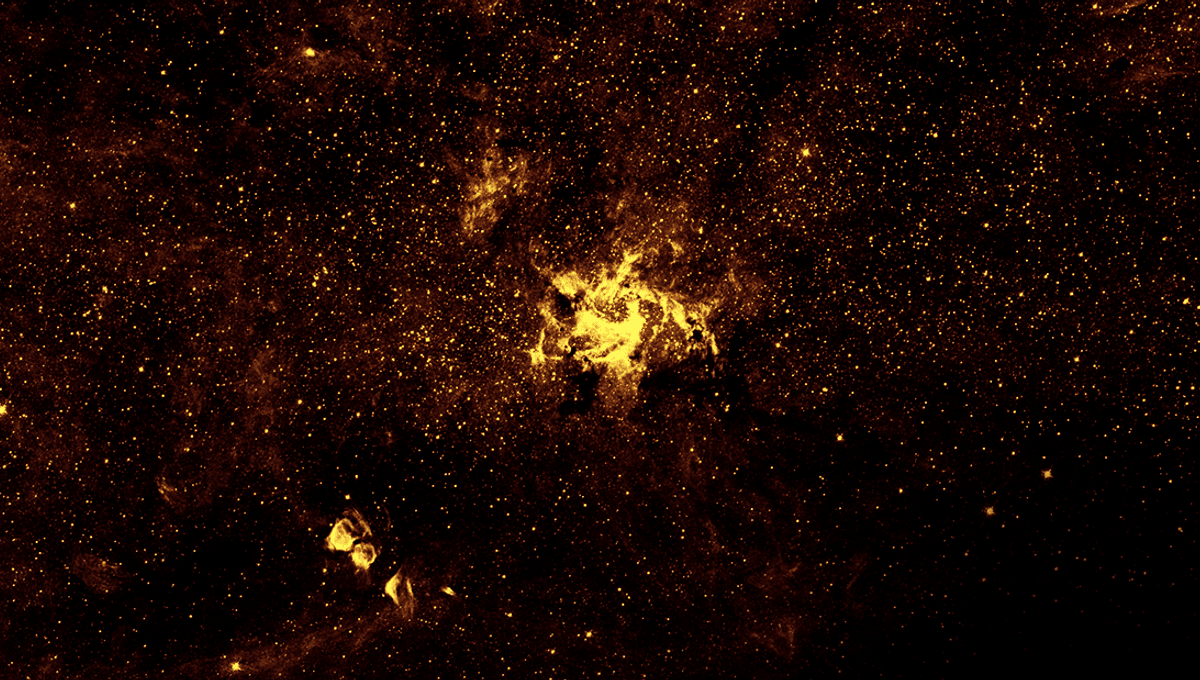
Two studies have taken a closer look at the mysterious stars surrounding our galaxy’s black hole, confirming that they are a lot younger than we expected, are highly organized, and are possibly “immortal” thanks to being continuously replenished by dark matter.
About 30 years ago, astronomers discovered stars moving around Sagittarius A*, the supermassive black hole at the center of the Milky Way.
These stars – designated S stars – zip around the supermassive black hole at incredible velocities. Any object that falls into the black hole becomes invisible to us, as not even light can escape the immense gravity that made the star (or perhaps cloud of interstellar dust) collapse in the first place.
“Its vicinity, however, contains a fairly high density of stars […], including one big star – about 15 times the mass of the Sun and seven times its radius – which was recently found to go around the center with an orbital period of only 15.2 years,” NASA explains of one of these objects. “That star, designated S2 by astronomers, follows an ellipse which at its closest comes within about 124 astronomical units (1 AU=mean Sun-Earth distance) of the center of the galaxy […]. At that time it speeds up to about 5,000 [kilometers per second; 3,100 miles per second] – close to 2 percent of the velocity of light.”
What is particularly puzzling about these stars is that they appear younger than we would expect. In a new study, researchers from Europe looked at a dozen young stellar objects (YSOs) discovered in the region of the black hole, finding a further puzzle.
“Interestingly, these YSOs exhibit the same behaviour as S stars. This means that the YSOs circumnavigate the supermassive black hole with speeds of several thousand kilometres per second in a few years,” Dr Florian Peißker from the University of Cologne’s Institute for Astrophysics and corresponding author of the study explained in a statement. “The S stars were found to be surprisingly young. According to conventional theories, the additional presence of a stellar kindergarten composed of YSOs is completely unexpected.”
Though these objects appear like a chaotic swarm of bees, studying their orbit the team found patterns and formations to it.
“This means that there are specific preferred star constellations,” Peißker added. “The distribution of both star variations resembles a disc which gives the impression that the supermassive black hole forces the stars to assume an organized orbit.”
Though more observations need to be made, the team proposes a few explanations.
“The pattern of the dusty sources manifested in the distribution of the position angles, inclinations, and longitudes of the ascending node strongly suggests two different scenarios: the main-sequence stars and the dusty stellar S-cluster sources share a common formation history or migrated with a similar formation channel in the vicinity of Sgr A*,” the team wrote in their paper. “Alternatively, the gravitational influence of Sgr A* in combination with a massive perturber, such as a putative intermediate mass black hole in the IRS 13 cluster, forces the dusty objects and S-stars to follow a particular orbital arrangement.”
In a second paper, aimed at explaining why S stars appear to be so young, another team proposes that they can become “immortal” as they move through dark matter and capture it, and are then powered by dark matter collisions.
“The dark matter density in these stars continuously replenishes, granting these stars immortality and solving multiple stellar anomalies,” the authors write in their not yet peer-reviewed paper. “Upcoming telescopes could detect the dark main sequence, offering a new dark matter discovery avenue.”
The first paper is published in Astronomy and Astrophysics. The second paper is posted on preprint server arXiv.

Source Link: Puzzlingly Young Stars Are Swarming Around Our Galaxy's Black Hole
