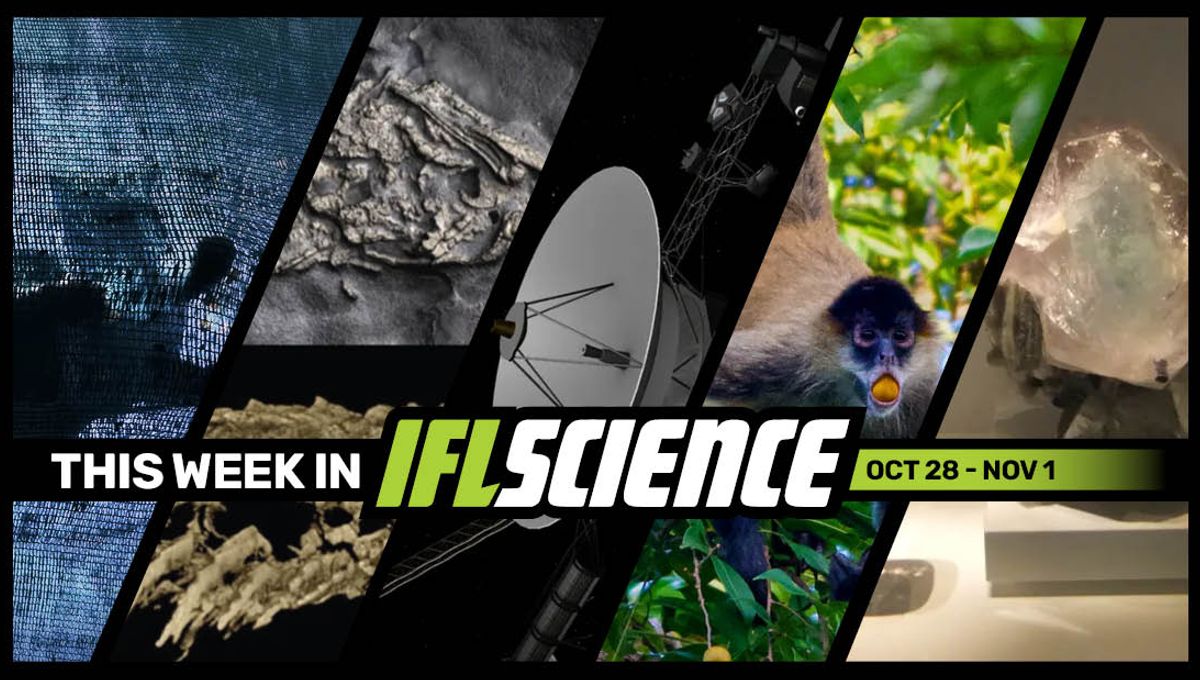
This week, an “extremely rare” fool’s gold fossil revealed the soft tissue of a 450-million-year-old new-to-science sea creature, Voyager 1 has phoned home from 24 billion kilometers away, and we ask: what is the rarest gemstone? Finally, as we celebrate the 70th year since the creation of the Godzilla franchise, we discuss the lessons learned from the king of metaphors.
Subscribe to the IFLScience newsletter for all the biggest science news delivered straight to your inbox every Wednesday and Saturday.
Quantum Cat Experiment Breaks Record By Surviving For Incredible 1,400 Seconds
States in quantum superposition are notoriously fragile but researchers in China have reported creating such a state that lasted for a whopping 23 minutes and 20 seconds. This record-breaking result is exciting in itself but the team believes that it could open new ways to high-precision measurements and even information processing for quantum computers – possibly even allowing scientists to probe the limits of physical theories. Read the full story here
“Extremely Rare” Fool’s Gold Fossils Show Soft Tissues Of 450-Million-Year-Old Sea Creature
Some “extremely rare” fossils that date back 450 million years have revealed a new-to-science species. They were retrieved from a famous fossil site in New York State, USA – and best of all? They’re preserved in glittering fool’s gold. Read the full story here
Voyager 1 Just Phoned Home From 24 Billion Kilometers Away On A Transmitter Not Used Since 1981
Voyager 1 continues to amaze. After 47 years, having crossed together with its twin into interstellar space, you’d think the spacecraft would stop surprising us. No chance. The probe had another glitch in the last few weeks that caused a loss of communication, but it managed to find a fix all by itself using hardware that had not been used since 1981. Read the full story here
Animals Like Getting Drunk More Than We Realized, But We Don’t Know Why
Animals are even more partial to fermented fruits than had been assumed, indicating ethanol has a big attraction to a great many of the creatures with which we share the planet. In particular, species for which fruit or nectar are a big part of the diet are more likely than not to indulge in a tipple, at least now and then. Read the full story here
What Is The Rarest Gemstone?
The world’s rarest gemstone is made of kyawthuite, a transparent reddish-orange mineral that’s known from just one sample housed at the Natural History Museum of Los Angeles County. It was retrieved near Mogok, Myanmar, and recognized in 2015 by the International Mineralogical Association (IMA), whose goal it is to standardize the nomenclature of the 5,000+ known mineral species. Read the full story here
TWIS is published weekly on our Linkedin page, join us there for even more content.
Feature of the week:
Godzilla At 70: What Lessons Have We Learned From The King Of Metaphors?
Godzilla has made something of a comeback in recent years. Ever since he stomped back into Western cinemas in 2014, it seems the monstrous reptile has barely left the screen. But while Godzilla’s destructive antics are easy entertainment, in the 70 years since its creation, the creature itself has always walked a line between chaotic spectacle and deeper metaphor. Read the full story here
More content:
Have you seen our e-magazine, CURIOUS? Issue 28 November 2024 is available now. This month we asked, “Will We All Be Eating Insects In The Future?” – check it out for exclusive interviews, book excerpts, long reads, and more.
PLUS, the We Have Questions podcast – an audio version of our coveted CURIOUS e-magazine column – has begun. In episode 2, we ask “What’s It Like Working In A Human Tissue Bank?”
Season 4 of IFLScience’s The Big Questions podcast has concluded. This season we’ve asked:

Source Link: Quantum Cat Experiment Breaks Record By Surviving For 1,400 Seconds, Animals Like Getting Drunk More Than We Realized, And Much More This Week
