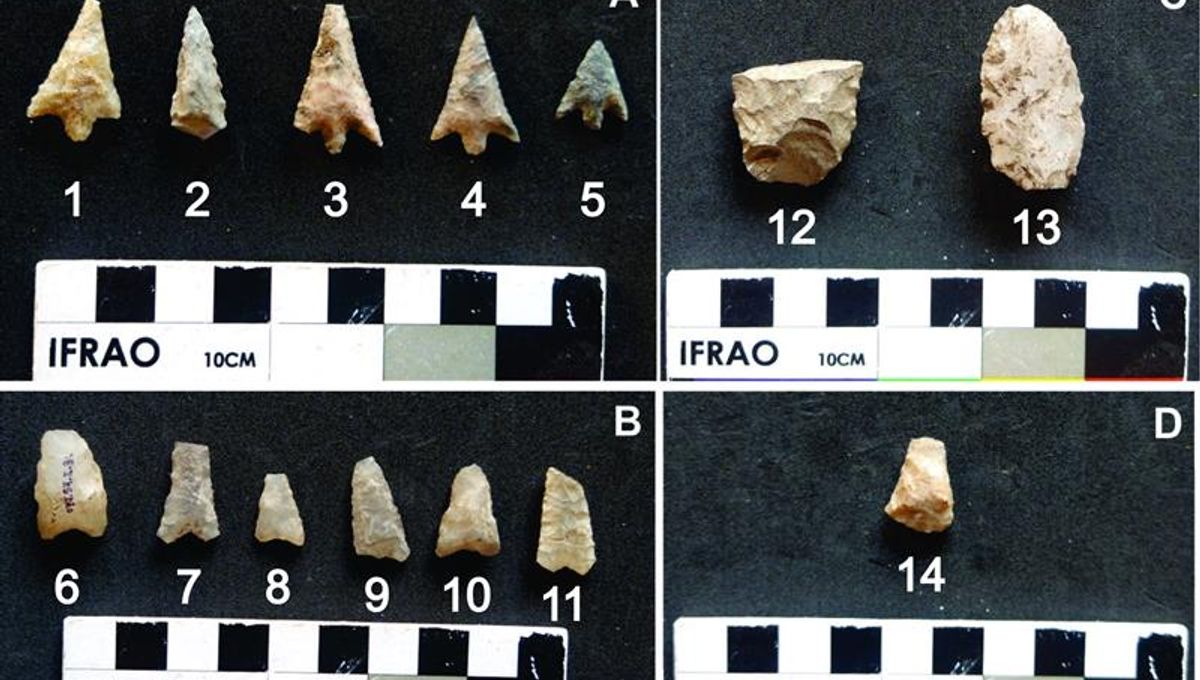
Archaeologists have uncovered 14 arrowheads that are changing our understanding of how bows and arrows were developed and used in pre-Hispanic South America. The research not only provides new insights into how these tools for hunting and warfare were used, but also helps uncover their symbolic significance for the surrounding region.
A unique find
The subject of bows and arrows in pre-Hispanic South America has been of interest to researchers for some time. This is for a set of very basic reasons. Firstly, archaeologists and historians are not sure when these tools were first developed in this region, nor do they know what motivated the adoption of this weapon and how it came to replace others, such as thrown spears. Moreover, it is not even clear who in South America was the first to develop such technologies and how they were communicated to other populations.
This is especially true for the region of northwest Argentina, the El Alto-Ancasti Mountain range, where evidence of bows and arrows has been missing from the archaeological record.
For 15 years, Dr Débora Egea and colleagues have been conducting research in this mountain range, alongside other archaeological teams. During this time, they had never found any projectile weapons or stone tools that could have made them, despite there being evidence that humans hunted large animals in the area.
One of the explanations for this could relate to the fact that the local population used quartz to make many of their tools. This material is notoriously difficult to shape into effective arrowheads (quartz fractures too easily).
Despite the absence of bows and arrows in the archaeological record, there are depictions of archers painted onto the walls of caves in the Oyola archaeological site, located in the El Alto-Ancasti mountains. In particular, Oyola 7 shows a character shooting an arrow from a bow into the sky. The individual is also depicted with an animal’s body on their back, which presumably represents a hunter’s catch.
For a long time, archaeologists attributed the various paintings in these caves to the La Aguanda culture, which existed between 600-900 CE – several centuries before the Spanish invaded the continent in the 16th century. But the archer’s presence confuses this idea as there is no evidence of bow use by the people living in these mountains. As such, researchers assumed the image depicted a member of a hunter-gatherer tribe who may have come from the plains to the east and who were thought to have used bows in their conflicts with other populations. Alternatively, the art may have been created at a later date, when these weapons were more common in the area.
However, Dr Egea and her colleagues recently discovered 14 projectile points in the Oyola site that are changing this perspective.
A new interpretation
The projectile points are mostly made of quartz and exhibit triangular shapes which, the researchers believe, were used as arrowheads.
“The presence of triangular projectile points, both with and without stems, assigned to arrows and manufactured during the most intensive occupations at Oyola 7, suggests the importance of arrow-based weaponry during those periods,” the authors write.
Contrary to previous beliefs, it seems the people living in and around the Oyola sites did know how to make arrowheads from quartz, despite the limitations this material presented.
“Therefore, the presence of quartz projectile points at Oyola 7 indicates that these individuals possessed the necessary knowledge and techniques to exploit this particular raw material effectively. The results present here suggest that the majority of these pieces were likely used as part of bow and arrow set-up.”
Given these developments, the authors have proposed a new interpretation for the narrative of arrows and bows in this part of Argentina’s history.
Rather than being objects imported into the region by hostile invading tribes, as was derived from colonial narratives about the pre-Hispanic people in the area, Egea and her team propose a history of social and cultural overlap between various tribes.
In particular, they believe that visitors from the eastern populations, who had bows and arrows, may have used them for ritualistic purposes while taking part in local ceremonies. In this way, the objects had greater significance than just being tools for hunting or warfare.
“The interpretation of weapons being connected to ritual practices has been previously proposed by other authors in various contexts,” the authors explain.
“Quartz projectile points were manufactured by populations who either resided in or visited these landscapes. Therefore, technical limitations alone cannot explain the absence of these stone tools in other archaeological sites. Hence, it becomes plausible to consider the significance of bow and arrow not only as functional tools for hunting or warfare but also as artifacts involved in ritual practices, related to social construction of past territories.”
These weapons helped start social interactions among populations that used them where they were used in ways that deviated from those described by colonizers, which represented these populations as savage aggressors who attacked these highlands people.
The study is published in the journal Quaternary International.

Source Link: Quartz Arrowheads Discovered In Andes Mountains Challenge Understanding Of Ancient Inhabitants
