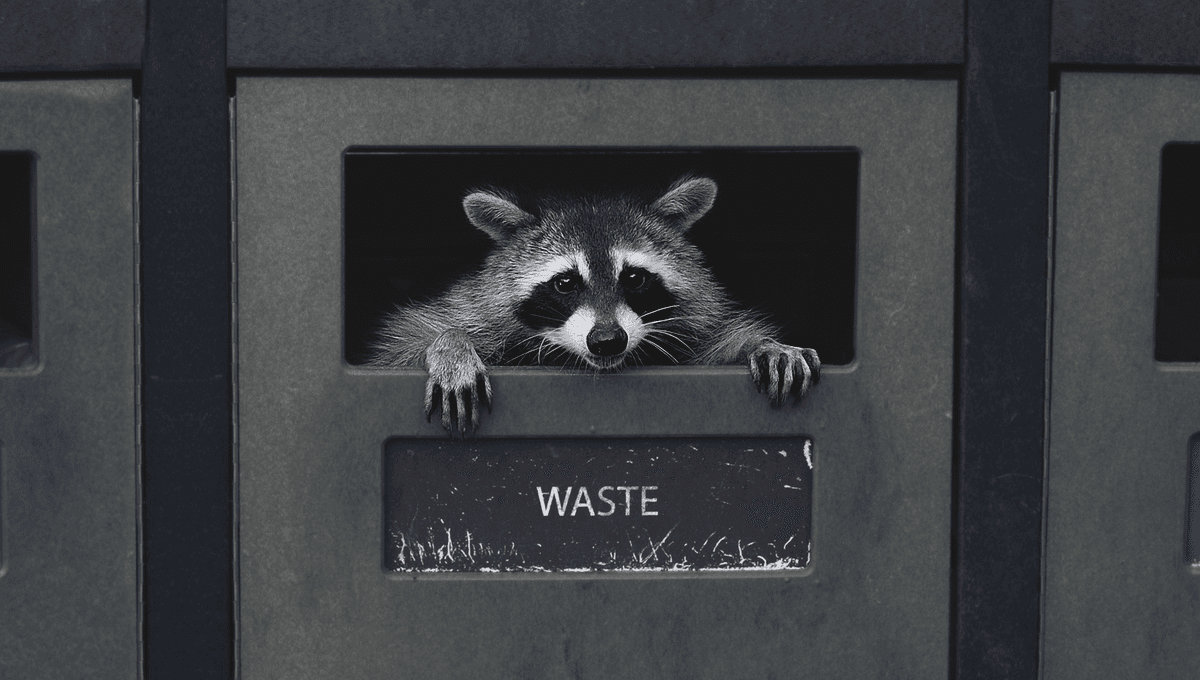
Something’s up with raccoons. Scientists have recently reported that those living in US cities have evolved much shorter snouts than their rural counterparts, a sure sign that urban “trash pandas” have self-domesticated in response to human presence.
Biologists from the University of Arkansas at Little Rock studied thousands of images of North American raccoons (Procyon lotor) captured in the US between 2000 and 2024. Using computer software, they analyzed the skull and snout size of the animals, comparing those living in cities to those in rural settings.
“I wanted to know if living in a city environment would kickstart domestication processes in animals that are currently not domesticated,” Dr Raffaela Lesch, lead study author and an assistant professor of biology at the University of Arkansas at Little Rock, said in a statement. “Would raccoons be on the pathway to domestication just by hanging out in close proximity to humans?”
Their work revealed that the urban-dwelling raccoons had a 3.56 percent reduction in snout length, suggesting they were experiencing a phenomenon known as domestication syndrome.
Domestication syndrome is a collection of traits that emerge when animals adapt to living closely with humans. Decreased aggression is a prime feature, but it also includes attributes like floppier ears, more varied fur patterns, smaller teeth, smaller brains, and shorter muzzles.
The most obvious example can be seen in the differences between domestic dogs and their wild canine cousins, like wolves and foxes, but domestication syndrome is also evident in cats, horses, cattle, pigs, and other animals that have a tight relationship with humans.
Domestication is often seen as an “unnatural” process forced on animals, but it can emerge without the active efforts of people. This, the new study suggests, is what’s happening with North American raccoons.
Those living in cities are faced with a new environmental niche to fill. Large predators are largely absent, plus they’re faced with readily available food in the form of trash. To thrive in this new urban environment, raccoons appear to be undergoing changes associated with self-domestication, essentially making city populations more tame, less aggressive, and “pet-like.”
“Trash is really the kickstarter. Wherever humans go, there is trash. Animals love our trash. It’s an easy source of food. All they have to do is endure our presence, not be aggressive, and then they can feast on anything we throw away,” Dr Lesch explained.
This phenomenon isn’t unique to raccoons. Urban foxes, for instance, have significantly longer, thinner snouts, seemingly perfect for foraging around trash cans and burrowing underneath garden walls.
According to this latest research, something very similar has been happening with urban raccoons. If these changes continue to deepen and become entrenched, perhaps we could even witness the emergence of a new domesticated species: trash panda (Procyon trashicus).
“It would be fitting and funny if our next domesticated species was raccoons. I feel like it would be funny if we called the domesticated version of the raccoon the trash panda,” added Dr Lesch.
The study is published in the journal Frontiers in Zoology.

Source Link: Raccoons In US Cities Are Evolving To Become More Pet-Like
