• Email Us: [email protected]
  • Contact Us: +1 718 874 1545
  • Skip to main content
  • Skip to primary sidebar

Medical Market Report

  • Home
  • All Reports
  • About Us
  • Contact Us

Rare 2-Million-Year-Old Infant Facial Fossils Expand What We Know About Prehistoric Human Children

October 28, 2025 by Deborah Bloomfield

Prehistoric human babies probably looked just like their parents from the moment they were born. Not only would this have come as something of a relief to new parents back in the Pleistocene, but it’s also highly useful information for modern anthropologists, as it provides new insights into the development of facial morphology in early Homo species.

The rest of this article is behind a paywall. Please sign in or subscribe to access the full content.

According to the authors of a recent study, adults belonging to species like Homo habilis, Homo rudolfensis, and Homo erectus can often be distinguished by their facial features. H. habilis, for instance, possessed a robust jaw with elongated tooth rows, while H. rudolfensis sported a foreshortened subnasal region, and H. erectus rocked a continuous brow ridge.

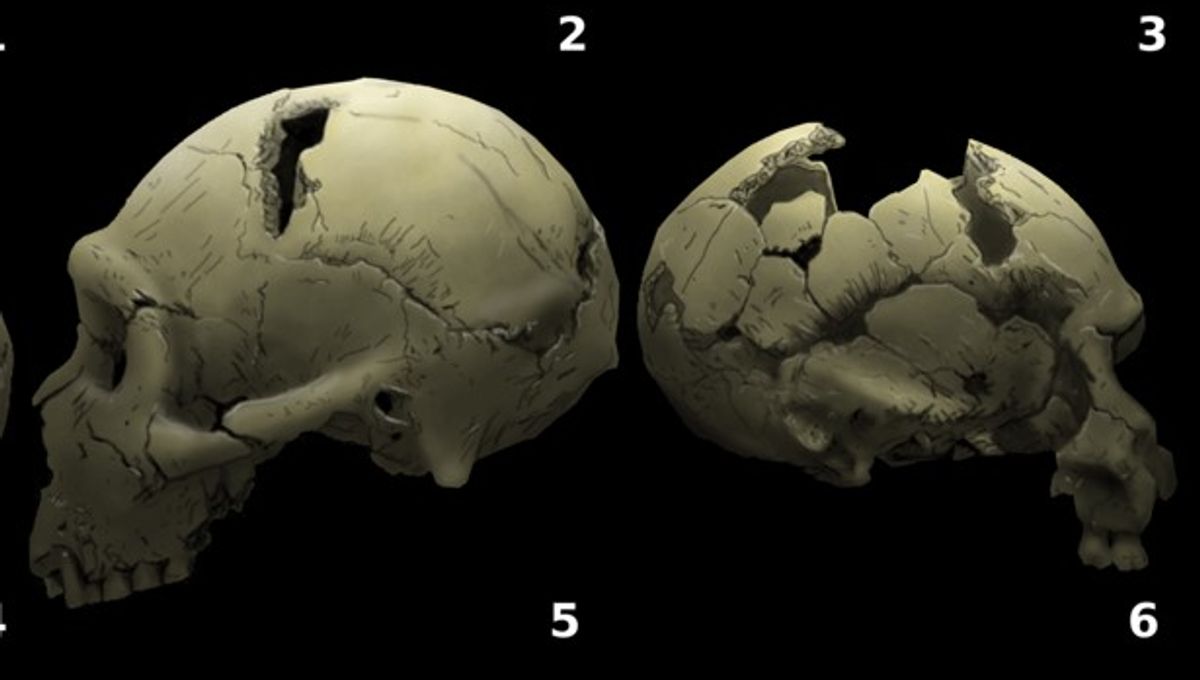
However, because infant specimens are extremely rare in the fossil record, scientists were until now unsure if these species-specific traits were present from birth. To find out, the study authors examined three fragmented infant crania from South Africa and Ethiopia, all dated to between 2.31 and 1.95 million years ago.

The three specimens all represent babies or young children that had died before their first permanent premolars had appeared, and were compared with 15 other prehistoric human crania belonging to slightly older juveniles. Ultimately, the researchers found that two of the infants could be identified as belonging to H. habilis and H. affinis erectus – which means it was closely related to H. erectus – while the third could not be confidently assigned to a particular species.

Despite this, the authors note that the third child’s features are clearly distinguishable from those of earlier hominins like Paranthropus or Australopithecus, and that the specimen could easily be identified as Homo. They therefore conclude that “taxonomic diversity in early Homo was already evident in infancy,” meaning that Pleistocene babies already displayed facial traits associated with adults of their kind.

Such a finding adds to the small but growing body of information regarding early Homo children. For instance, 400,000-year-old mammoth ivory pieces from Ukraine have been interpreted as toys used by the kids of an unknown extinct species, while 300,000-year-old “throwing sticks” found in Germany may have been used as practice weaponry by youngsters learning to hunt.

There’s even evidence that Neanderthal children living in Spain between 40,000 and 55,000 years ago may have collected marine fossils, in much the same way that modern kids collect stickers or toy cars.

Combined with the new findings regarding the facial characteristics of Pleistocene kids, these discoveries are helping anthropologists to build a picture of what childhood was like for the earliest members of our genus.

The study is published in the journal Nature Communications.

Deborah Bloomfield
Deborah Bloomfield

Related posts:

  1. Environmentalists urge extension of Indonesia palm permit moratorium
  2. Ford, SK to spend $11.4B to build two US manufacturing campuses dedicated to EVs and batteries
  3. Google DeepMind Reveals Robot That Plays Table Tennis At A Delightful “Solidly Amateur” Level
  4. Bite Mechanics Could Help Reveal If Rumors Of Rat-Kangaroo’s Death Are Exaggerated

Source Link: Rare 2-Million-Year-Old Infant Facial Fossils Expand What We Know About Prehistoric Human Children

Filed Under: News

Primary Sidebar

  • Europa’s Seabed Might Be Too Quiet For Life: “The Energy Just Doesn’t Seem To Be There”
  • Amoebae: The Microscopic Health Threat Lurking In Our Water Supplies. Are We Taking Them Seriously?
  • The Last Dogs In Antarctica Were Kicked Out In April 1994 By An International Treaty
  • Interstellar Comet 3I/ATLAS Snapped By NASA’s Europa Mission: “We’re Still Scratching Our Heads About Some Of The Things We’re Seeing”
  • New Record For Longest-Ever Observation Of One Of The Most Active Solar Regions In 20 Years
  • Large Igneous Provinces: The Volcanic Eruptions That Make Yellowstone Look Like A Hiccup
  • Why Tokyo Is No Longer The World’s Most Populous City, According To The UN
  • A Conspiracy Theory Mindset Can Be Predicted By These Two Psychological Traits
  • Trump Administration Immediately Stops Construction Of Offshore Wind Farms, Citing “National Security Risks”
  • Wyoming’s “Mummy Zone” Has More Surprises In Store, Say Scientists – Why Is It Such A Hotspot For Mummified Dinosaurs?
  • NASA’s Hubble Space Telescope Observations Resolve “One Of The Biggest Mysteries” About Betelgeuse
  • Major Revamp Of US Childhood Vaccine Schedule Under RFK Jr.’s Leadership: Here’s What To Know
  • 20 Delightfully Strange New Deep Reef Species Discovered In “Underwater Hotels”
  • For First Time, The Mass And Distance Of A Solitary “Rogue” Planet Has Been Measured
  • For First Time, Three Radio-Emitting Supermassive Black Holes Seen Merging Into One
  • Why People Still Eat Bacteria Taken From The Poop Of A First World War Soldier
  • Watch Rare Footage Of The Giant Phantom Jellyfish, A 10-Meter-Long “Ghost” That’s Only Been Seen Around 100 Times
  • The Only Living Mammals That Are Essentially Cold-Blooded Are Highly Social Oddballs
  • Hottest And Earliest Intergalactic Gas Ever Found In A Galaxy Cluster Challenges Our Models
  • Bayeux Tapestry May Have Been Mealtime Reading Material For Medieval Monks
  • Business
  • Health
  • News
  • Science
  • Technology
  • +1 718 874 1545
  • +91 78878 22626
  • [email protected]
Office Address
Prudour Pvt. Ltd. 420 Lexington Avenue Suite 300 New York City, NY 10170.

Powered by Prudour Network

Copyrights © 2026 · Medical Market Report. All Rights Reserved.

Go to mobile version