• Email Us: [email protected]
  • Contact Us: +1 718 874 1545
  • Skip to main content
  • Skip to primary sidebar

Medical Market Report

  • Home
  • All Reports
  • About Us
  • Contact Us

Rare Crystalline Gold Accounts For Just 1 Percent Of The World’s Gold, And It’s Beautiful

August 18, 2025 by Deborah Bloomfield

Gold has captivated humans for millennia, but it comes in many different forms out in the wild. Among the rarest and most peculiar is crystalline gold, which forms deep underground and maintains its original shape – crafted by the formation of cracks in Earth’s crust.

The rest of this article is behind a paywall. Please sign in or subscribe to access the full content.

It requires the right combination of temperature, pressure, and chemistry for gold to form in a repeating pattern that builds up into crystals. The resulting shapes can be cubes, octahedra, or branching “dendritic” (tree-like) structures, but it’s rare for that shape to be maintained.

Gold has often travelled a long way before we find it, by which time it has been smoothed out and eroded into more typical nugget-like shapes. This is what makes crystalline gold nuggets so rare and intriguing, as they’ve escaped that wear and tear to maintain their original shape.

The crystalline gold forms deep underground in cracks between rock, and then gets brought to the surface as the rock itself moves (never a bad time to remember the Earth is basically a big magma puzzle). The steps required for crystalline gold to be preserved are so precise that it’s thought to account for just 1 percent of the world’s gold.

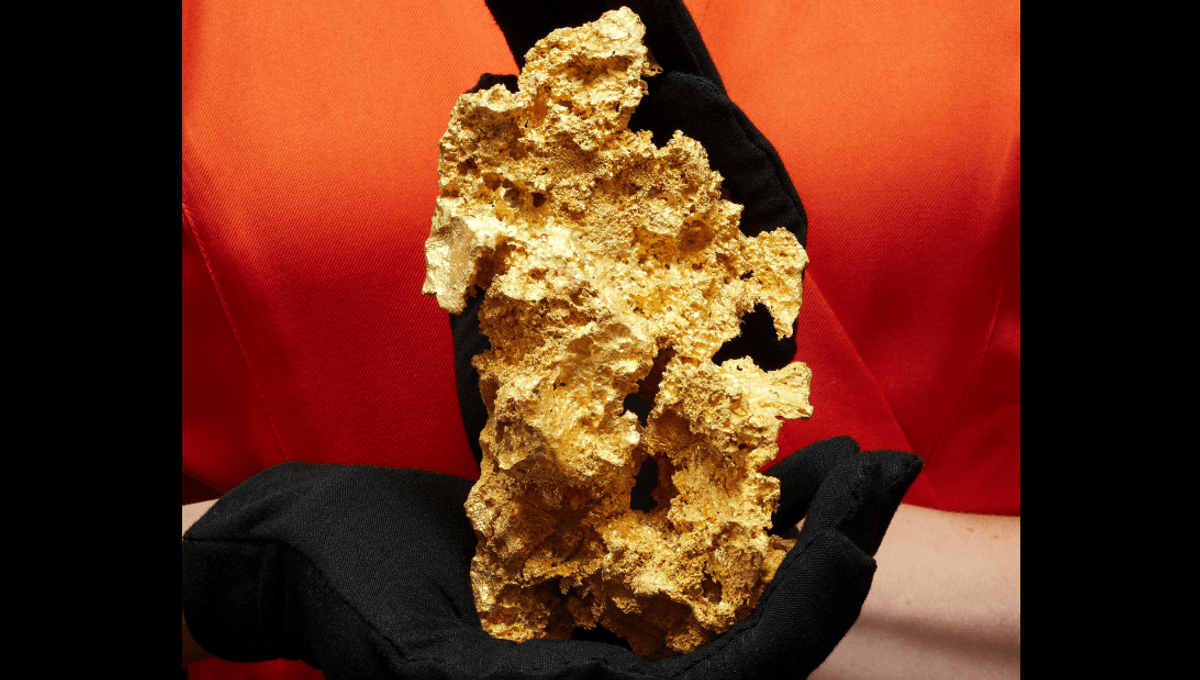
That rarity means crystalline gold nuggets are often sold for far more than their weight in gold, because they’re like their own kind of art. Such a nugget was recently added to Heritage’s Nature & Science Signature Auction, and it’s a whopper.

“The most obvious attribute of this exemplary Crystalline Gold Nugget is its size – the total weight of the massive specimen is 53.67 troy ounces [1.7 kilograms],” reads Heritage’s listing for the gold. “From Western Australia, the enormous stunner has an artistic natural shape with incredible dimensionality. Folds of the leafy and foil-like precious metal have grown in such a way as to result in a work of art piece measuring over 5.5 inches [14 centimeters] long.”

The Ironstone’s Crown Jewel is thought to be the world’s largest crystalline gold nugget. Weighing 44 troy pounds (16.4 kilograms), it was found in 1992 by the Sonora Mining Company. It was embedded in quartz, but extracted using acid, revealing an enormous single mass of crystalline gold.

Natural crystalline gold is remarkable to behold, but did you know we can also make synthetic gold crystals in the lab? All you need is a nuclear reaction, a particle accelerator, or the blast of a supernova.

Deborah Bloomfield
Deborah Bloomfield

Related posts:

  1. Russia moves Sukhoi Su-30 fighter jets to Belarus to patrol borders, Minsk says
  2. French senators to visit Taiwan amid soaring China tensions
  3. Thought Unicorns Don’t Exist? Turns Out They Live In A Chinese Cave
  4. Moon’s Magnetic Field Experienced Mysterious Resurgence 2.8 Billion Years Ago Before Disappearing

Source Link: Rare Crystalline Gold Accounts For Just 1 Percent Of The World's Gold, And It's Beautiful

Filed Under: News

Primary Sidebar

  • US Just Killed NASA’s Mars Sample Return Mission – So What Happens Now?
  • Art Sleuths May Have Recovered Traces Of Da Vinci’s DNA From One Of His Drawings
  • Countries With The Most Narcissists Identified By 45,000-Person Study, And The Results Might Surprise You
  • World’s Oldest Poison Arrows Were Used By Hunters 60,000 Years Ago
  • The Real Reason You Shouldn’t Eat (Most) Raw Cookie Dough
  • Antarctic Scientists Have Just Moved The South Pole – Literally
  • “What We Have Is A Very Good Candidate”: Has The Ancestor Of Homo Sapiens Finally Been Found In Africa?
  • Europe’s Missing Ceratopsian Dinosaurs Have Been Found And They’re Quite Diverse
  • Why Don’t Snorers Wake Themselves Up?
  • Endangered “Northern Native Cat” Captured On Camera For The First Time In 80 Years At Australian Sanctuary
  • Watch 25 Years Of A Supernova Expanding Into Space Squeezed Into This 40-Second NASA Video
  • “Diet Stacking” Trend Could Be Seriously Bad For Your Health
  • Meet The Psychedelic Earth Tiger, A Funky Addition To “10 Species To Watch” In 2026
  • The Weird Mystery Of The “Einstein Desert” In The Hunt For Rogue Planets
  • NASA Astronaut Charles Duke Left A Touching Photograph And Message On The Moon In 1972
  • How Multilingual Are You? This New Language Calculator Lets You Find Out In A Minute
  • Europa’s Seabed Might Be Too Quiet For Life: “The Energy Just Doesn’t Seem To Be There”
  • Amoebae: The Microscopic Health Threat Lurking In Our Water Supplies. Are We Taking Them Seriously?
  • The Last Dogs In Antarctica Were Kicked Out In April 1994 By An International Treaty
  • Interstellar Comet 3I/ATLAS Snapped By NASA’s Europa Mission: “We’re Still Scratching Our Heads About Some Of The Things We’re Seeing”
  • Business
  • Health
  • News
  • Science
  • Technology
  • +1 718 874 1545
  • +91 78878 22626
  • [email protected]
Office Address
Prudour Pvt. Ltd. 420 Lexington Avenue Suite 300 New York City, NY 10170.

Powered by Prudour Network

Copyrights © 2026 · Medical Market Report. All Rights Reserved.

Go to mobile version