• Email Us: [email protected]
  • Contact Us: +1 718 874 1545
  • Skip to main content
  • Skip to primary sidebar

Medical Market Report

  • Home
  • All Reports
  • About Us
  • Contact Us

Rats Make Adorable Happy Squeaks When They’re With Their Buddies

November 12, 2023 by Deborah Bloomfield

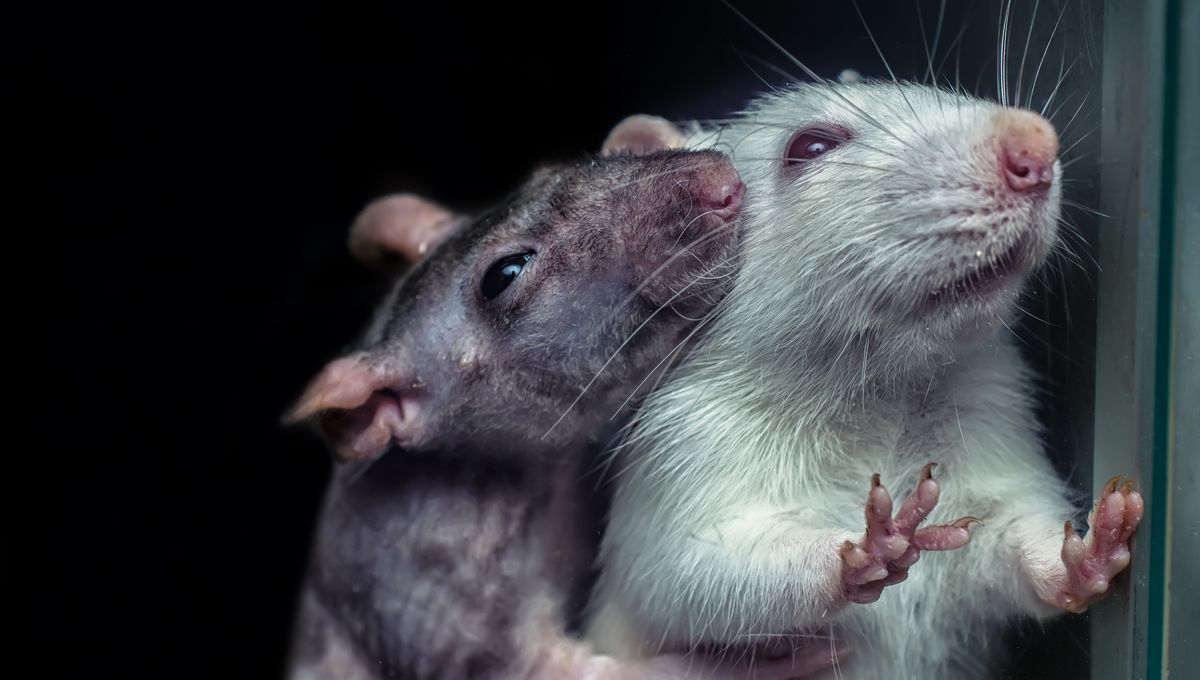
Rats make high-pitched, happy squeaks when in the company of another rat, new research has revealed. The rodents are renowned for their fondness for friendship, frequently choosing it over food (but not heroin) and jumping for joy when watching their besties getting tickled. Now, for the first time, the glee that individuals feel when around another rat has been recorded, in the form of high-frequency squeals.

During social interactions, rats make ultrasonic vocalizations, imperceptible to the human ear, which reflect their emotions. For example, when happy, they tend to emit squeaks at about 50 kHz. However, until now, it has proved challenging to identify which rat is responsible for which sound. 

Advertisement

Using novel mini-microphones connected to the rats’ noses, the team behind the new study were able to pinpoint the individual rats making each vocalization, and therefore gain insight into their emotional state.

In doing so, they discovered that the little cuties made more 50 kHz (positive) vocalizations during close interactions with other rats, “yet it is not linked to any specific behavioral event we could recognize,” the researchers write. By this, they mean the rats weren’t attempting to communicate or respond to something – they were simply expressing their contentment.

“We think that this isn’t a language, but actually another way to pronounce happiness in general,” Shai Netser, one of the study authors, told New Scientist.

Netser and co-authors surgically attached their teeny microphones to the noses of 13 rats, before placing them in cages with another rat, either directly or separated by mesh. 

Advertisement

The 50 kHz squeaks were more prominent when the rats were in physical contact with one another and only began after another rat was introduced, and so may reflect social bonding processes, the team suggests.

They also discovered a new sound made by the rats: a low-frequency vocalization marking rat social interactions. These noises (4–10 kHz) are within human hearing range but were too weak to be detected by the microphones in the cages, which may explain why they’ve never been reported before. The meaning of this novel sound is yet to be determined.

The researchers anticipate that their findings, and new miniature microphones, will help shed some light on social behaviors and emotions in rats. 

“We hope that this method will enable for the monitoring of socio-emotional states in laboratory rats, including models of neurodevelopmental disorders, upon exposure to various environmental and internal conditions,” they write.

Advertisement

In other unexpected (and adorable) animal vocalization news, how about this tiny crocodile that can moo?

The study is published in the journal Cell Reports Methods.

[H/T: New Scientist]

Deborah Bloomfield
Deborah Bloomfield

Related posts:

  1. UK clears Facebook’s purchase of CRM maker, Kustomer
  2. California becomes 8th U.S. state to make universal mail-in ballots permanent
  3. MLB roundup: Logan Webb, Giants silence Dodgers in NLDS Game 1
  4. Hot As The Sun? People Are Still Confused About The Titan Implosion

Source Link: Rats Make Adorable Happy Squeaks When They’re With Their Buddies

Filed Under: News

Primary Sidebar

  • “Unidentified Human Relative”: Little Foot, One Of Most Complete Early Hominin Fossils, May Be New Species
  • Thought Arctic Foxes Only Came In White? Think Again – They Come In Beautiful Blue Too
  • COVID Shots In Pregnancy Are Safe And Effective, Cutting Risk Of Hospitalization By 60 Percent
  • Ramanujan’s Unexpected Formulas Are Still Unraveling The Mysteries Of The Universe
  • First-Ever Footage of A Squid Disguising Itself On Seafloor 4,100 Meters Below Surface
  • Your Daily Coffee Might Be Keeping You Young – Especially If You Have Poor Mental Health
  • Why Do Cats And Dogs Eat Grass?
  • What Did Carl Sagan Actually Mean When He Said “We Are All Made Of Star Stuff”?
  • Lonesome George: The Giant Tortoise Who Was The Very Last Of His Kind
  • Bermuda Sits On A Strange, 20-Kilometer-Thick Structure That’s Like No Other In The World
  • Time Moves Faster Up A Mountain – And That’s Why Earth’s Core Is 2.5 Years Younger Than Its Surface
  • Bio-Hybrid Robots Made Of Dead Lobsters Are The Latest Breakthrough In “Necrobotics”
  • Why Do Some Italians Live To 100? Turns Out, Centenarians Have More Hunter-Gatherer DNA
  • New Full-Color Images Of Interstellar Comet 3I/ATLAS, As We Are Days Away From Closest Encounter
  • Hilarious Video Shows Two Young Andean Bears Playing Seesaw With A Tree Branch
  • The Pinky Toe Has A Purpose And Most People Are Just Finding Out
  • What Is This Massive Heat-Emitting Mass Discovered Beneath The Moon’s Surface?
  • The Man Who Fell From Space: These Are The Last Words Of Cosmonaut Vladimir Komarov
  • How Long Can A Bird Can Fly Without Landing?
  • Earliest Evidence Of Making Fire Has Been Discovered, X-Rays Of 3I/ATLAS Reveal Signature Unseen In Other Interstellar Objects, And Much More This Week
  • Business
  • Health
  • News
  • Science
  • Technology
  • +1 718 874 1545
  • +91 78878 22626
  • [email protected]
Office Address
Prudour Pvt. Ltd. 420 Lexington Avenue Suite 300 New York City, NY 10170.

Powered by Prudour Network

Copyrights © 2025 · Medical Market Report. All Rights Reserved.

Go to mobile version