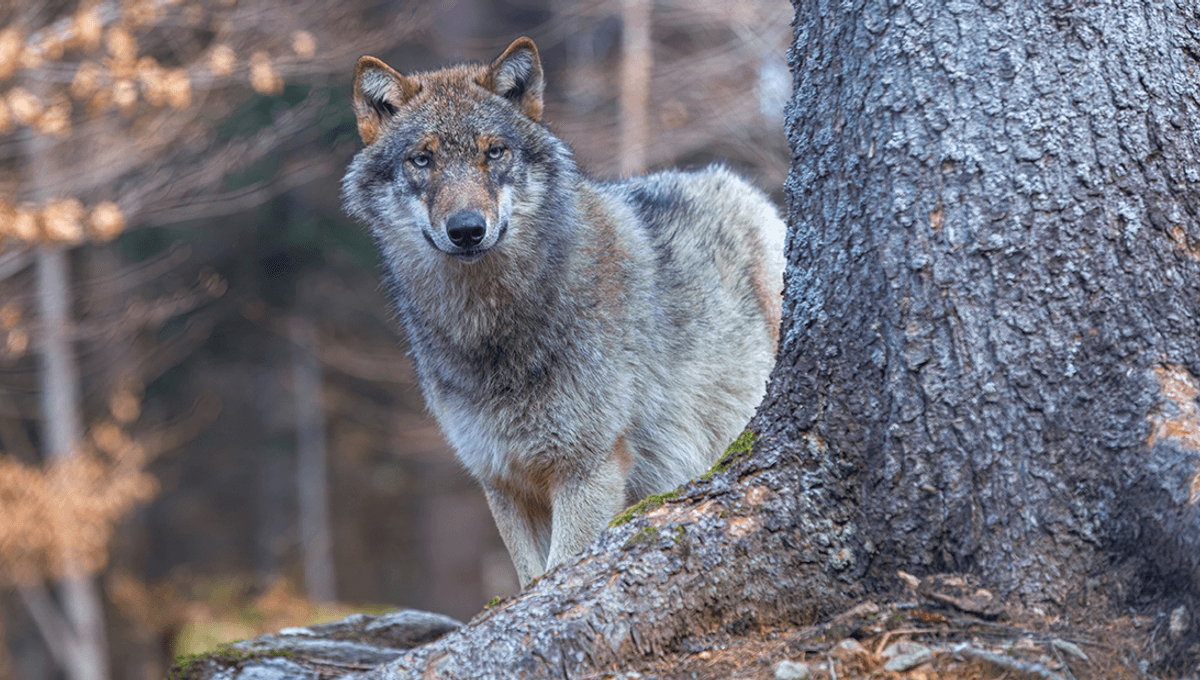
A team of researchers from the University of Leeds in the UK has come up with a surprising way to help tackle the climate crisis; reintroducing wolves to Scotland. According to the team, introducing a population of wolves to the Cairngorms, South-west Highlands, Central Highlands, and North-west Highlands could help capture and store up to 1 million metric tons of CO2 every year.
ADVERTISEMENT GO AD FREE
Wolf populations across Europe have faced a pretty tough few centuries, as humans affected their habitat, or actively hunted them. In the UK, this was sometimes at the request of the reigning monarch of the time. In England, Edward I, who reigned from 1272-1307, ordered the killing of all wolves within the country, though it would take until the reign of Henry VII (1485-1509) before wolves were extinct in England.
“In Scotland, a wilder, more mountainous, sparsely populated country, wolves survived until the 17th century. This respite was not due to lack of persecution. As early as 1283 an allowance was paid to ‘one hunter of wolves’ in Stirling and in 1427 under James I of Scotland, an act was passed requiring all lairds to seek out and destroy wolves. In 1491 a bounty was paid for the taking of two wolves in Linlithgow in the lowlands,” the UK Wolf Conservation Trust explains.
“The Earl of Athol in 1528 organized a hunt for James V of Scotland which had ‘woulff, fox and wild cattis’ as the quarry and a later Earl of Athol in 1563 provided a hunt for Mary, Queen of Scots, which reported the kill included five wolves.”
Despite a longer run, wolves were eventually eradicated from Scotland around 250 years ago. It might sound like a good thing to not have these large predators, along with the lynx that suffered an earlier demise, roaming around the land. But of course, there are knock-on effects. Without these animals, red deer in these areas of Scotland have no natural predators, and their population has bloomed to as high as around 400,000 animals. While everyone enjoys a good deer, this is a problem as they tend to eat young tree saplings, preventing tree growth.
“Deer, in combination with sheep in some areas, prevents tree regeneration across much of Scotland,” the team writes. “Lack of tree regeneration has contributed to a long term decline and loss of native woodland, with less than 4 percent of Scotland currently covered by native woodland. At such high deer densities, natural regeneration and colonisation of woodland is largely restricted to areas where deer are excluded by fencing.”
ADVERTISEMENT GO AD FREE
In the new study, the team attempted to look at the effect of reintroducing wolves as a natural predator to the deer, and the potential benefit to the environment. Using the Markov predator-prey model, the team found that reintroduction would lead to a population of around 167 wolves, enough to reduce deer populations to below four deer per square kilometer. At these levels, trees would be able to begin natural recolonization, and woodlands could begin to expand again.
According to the team, the newly grown woodlands could take up to 1 million tons of CO2 every year, accounting for around 5 percent of the carbon removal target for UK woodlands, or 6,080 metric tons of CO2 per wolf per year. At the current cost of “removing” carbon, that makes each wolf’s financial “worth” around £154,000.
“There is an increasing acknowledgment that the climate and biodiversity crises cannot be managed in isolation,” lead author Professor Dominick Spracklen of the University of Leeds’ School of Earth and Environment said in a statement. “We need to look at the potential role of natural processes such as the reintroduction of species to recover our degraded ecosystems and these in turn can deliver co-benefits for climate and nature recovery.”
The idea is not without controversy, and would require careful management when they are near human populations or livestock.
ADVERTISEMENT GO AD FREE
“Our aim is to provide new information to inform ongoing and future discussions about the possibility of wolf reintroductions both in the UK and elsewhere,” Lee Schofield, a co-author of the study, added. “We recognize that substantial and wide-ranging stakeholder and public engagement would clearly be essential before any wolf reintroduction could be considered. Human-wildlife conflicts involving carnivores are common and must be addressed through public policies that account for people’s attitudes for a reintroduction to be successful.”
The study is published in Ecological Solutions and Evidence.

Source Link: Reintroducing Wolves To Scotland Could Help Capture 1 Million Tons Of CO2 Per Year
