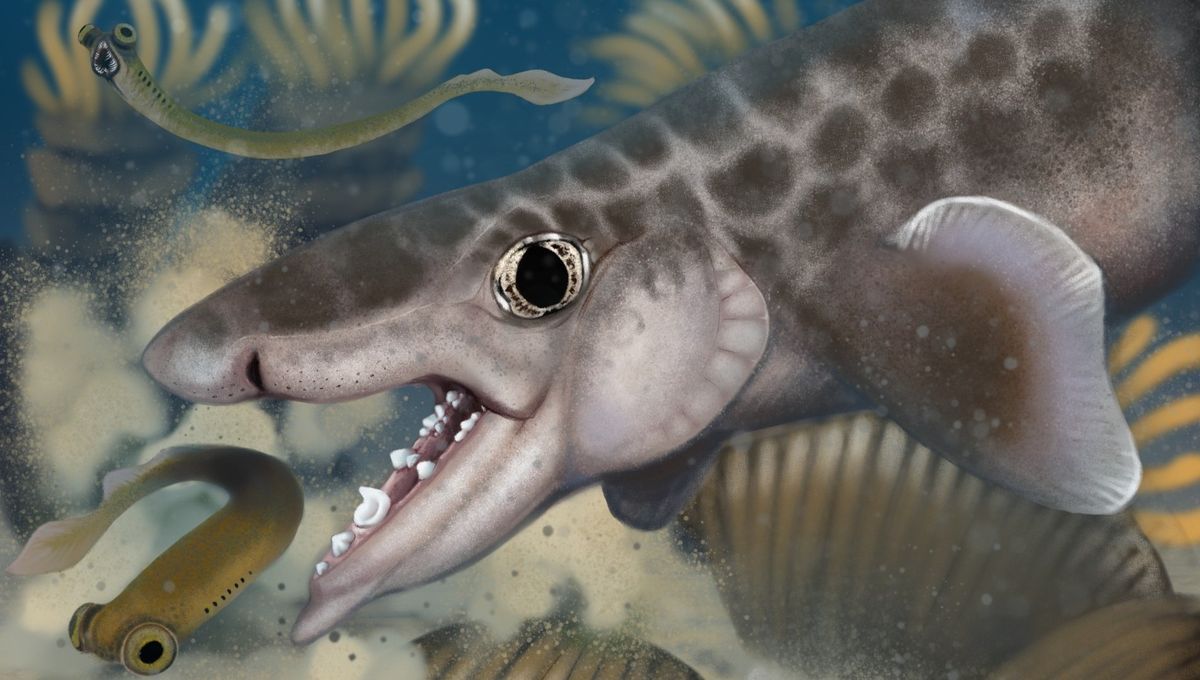
The sharks just don’t stop coming at Mammoth Cave National Park in the US, where palaeontologists have uncovered yet another new species of ancient shark that lurked in the shallow seas submerging the region millions of years ago.
The new species, which is thought to have only reached less than 30 centimeters (12 inches) in length, has been named Macadens olsoni in honor of the park and retired park scientist Rickard Olson, who played a significant part in documenting Mammoth Cave’s abundance of shark fossils.
It was discovered in the Ste. Genevieve Formation, a vast hunk of limestone that dates back between 340 to 335 million years. Though hard to believe today, when Mammoth Cave is hundreds of miles away from the ocean, back then, the area was covered by a warm, shallow sea connecting what would later become eastern North America, Europe, and northern Africa.
This seaway was positively teeming with life, including the bizarre mollusks and worms (seen looking incredibly shocked in the header above) that M. olsoni would’ve preyed upon. It did so using a unique, curved set of teeth – known as a tooth whorl – that were particularly well-adapted to crushing the shark’s prey.
“This discovery is a remarkable addition to our understanding of ancient marine life and underscores the importance of preserving and studying our natural history,” said the park’s Superintendent Barclay Trimble in a statement.
The researchers behind the discovery also identified morphological similarities between M. olsoni and another species of ancient shark, one that has previously been classified as Helodus coxanus. However, this comparison has led the team to conclude that the shark known as H. coxanus might not actually belong to the Helodus genus after all. Instead, they suggest it should be put within an entirely new one: Rotuladens.
“This finding not only enhances our knowledge of ancient marine ecosystems but also emphasizes the critical role of paleontological research in our national parks,” said Trimble. “Every discovery connects the past with the present and offers invaluable educational opportunities for students and the public.”
The new species is just one in a whole treasure trove of ancient sharks that have been uncovered within the world’s longest cave system as part of ongoing research that aims to survey national parks for fossils, assess their significance, and identify how they can be managed and preserved.
The bounty of sharks discovered in the cave’s depths include a fellow 340-million-year-old species named McGinnis’ nail tooth shark (Clavusodens mcginnisi), whose tiny size but mighty bite led members of its taxonomic family to be nicknamed “chipmunk sharks”.
Palaeontologists at the park have also uncovered the partial remains of an ancient shark skull – a particularly rare find, given that shark skeletons are made of cartilage, which doesn’t preserve as well as bone – and a new species of ctenacanth that pushed back the origin of its genus 50 million years earlier than was previously thought.
Who knows what kind of wonderfully weird prehistoric beasties they’ll uncover next? We for one can’t wait to find out.

Source Link: “Remarkable” New Species Of 340-Million-Year-Old Ancient Shark Discovered In World’s Longest Cave System
