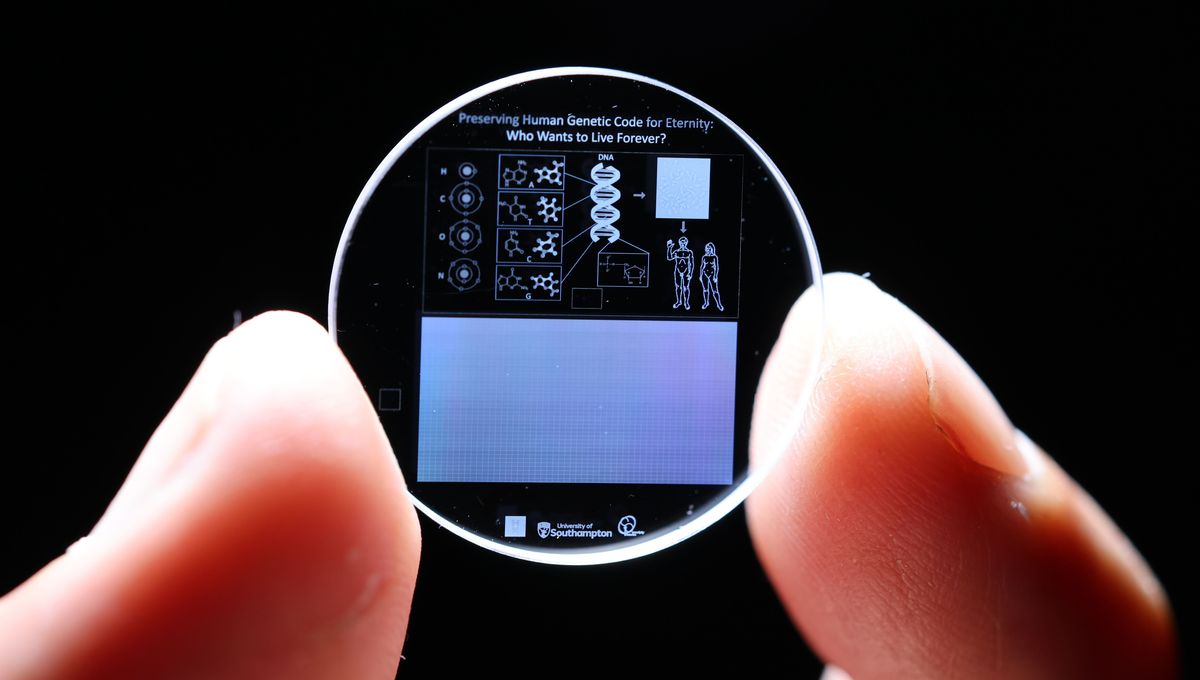
The entire human genome – all 3 billion or so base pairs – has been stored on a tiny, 5D memory crystal built to last for billions of years. In theory, should humans go extinct, this little chip could provide a blueprint to bring us back – providing the technology to do so has materialized by then.
Scientists from the University of Southampton’s Optoelectronics Research Centre (ORC) say they used ultra-fast lasers to etch the data onto the crystal, which can store up to 360 terabytes of information without loss for billions of years. The “revolutionary” technology holds the Guinness World Record, awarded in 2014, for the most durable data storage material.
“The crystal is equivalent to fused quartz, one of the most chemically and thermally durable materials on Earth,” reads a statement announcing the proof-of-concept study, which has not been peer-reviewed. It can withstand freezing, fire, and temperatures up to 1,000°C (1,832°F), as well as extreme pressure and cosmic radiation.
Data is encoded using two optical dimensions and three spatial coordinates – hence “5D” – and thanks to the crystal’s incredible durability, can be preserved long into the future. This means it will likely outlast humans and other species – the researchers hope the technology could also be used to record the genomes of endangered plant and animal species that are faced with extinction.
While it is not currently possible to synthetically create humans, plants, and animals using genetic information alone, future advances in the field could one day make this a reality. And if they do, the memory crystal will be ready and waiting.
“We know from the work of others that genetic material of simple organisms can be synthesised and used in an existing cell to create a viable living specimen in a lab,” Professor Peter Kazansky, who led the project, said.
“The 5D memory crystal opens up possibilities for other researchers to build an everlasting repository of genomic information from which complex organisms like plants and animals might be restored should science in the future allow.”
In case of the crystal being discovered by an intelligence (species or machine) long after we’re gone, the team inscribed it with a visual key to show what data is stored inside it and how it could be used.
The key shows the universal elements (hydrogen, oxygen, carbon, and nitrogen); the four DNA bases (adenine, cytosine, guanine, and thymine) with their molecular structures; their placement in the double helix structure of DNA; and how genes position into a chromosome, which can then be inserted into a cell. Essentially, all the information someone, or something, might need to build a human.
The crystal has been stored in the Memory of Mankind archive – a time capsule within a salt cave in Hallstatt, Austria.
“This could contribute significantly to biodiversity conservation and offer a means to preserve biological information for medical research, genetic studies, and future generations,” Kazansky told Technology Networks.
“Additionally, we are exploring the possibility of storing personalized medical data, which could be used in future healthcare applications, such as precision medicine. The durability and longevity of 5D memory crystals make them an ideal medium for preserving invaluable biological information that could be crucial in the future.”

Source Link: “Revolutionary” 5D Crystal Could Preserve Human Genome Long After We’re Extinct
