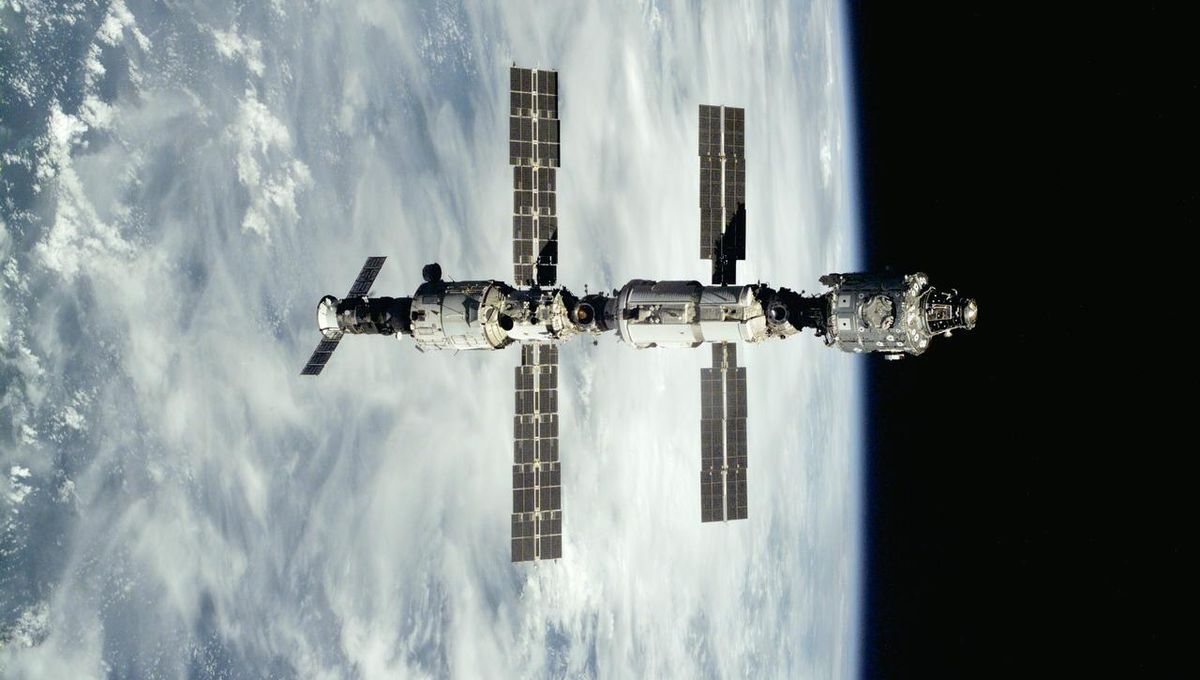
Runglish is the unlikely hybrid “language” created by fusing elements of English and Russian. While some forms of this Frankenstein parlance have been uttered by immigrant communities for decades, perhaps even centuries, it’s most prominently associated with day-to-day chattering between English-speaking astronauts and Russian cosmonauts onboard the International Space Station (ISS).
The ISS is a joint venture between NASA (the US), Roscosmos (Russia), JAXA (Japan), ESA (Europe), and CSA (Canada), but the US and Russia are considered to be the de facto chiefs – and that’s reflected in the language used here.
English serves as the primary language onboard the ISS, but all astronauts are expected to have some understanding of the Russian language. This is because Russia’s Soyuz spacecraft was the only way to transport astronauts back and forth to the ISS (before SpaceX arrived on the scene). As such, all buttons, signs, and procedures onboard the spacecraft while launching to and returning from the ISS were given in the Russian language.
Often, ISS crews are not totally proficient in each other’s language, forcing them to develop their own patchwork pidgin language that smashes together words, sounds, phrases, and expressions from both Russian and English.
“I’ve had different crews and depending on their language capabilities as a crew, you come up with a common language,” Peggy Whitson, an American biochemist who became the first woman to command the ISS twice, told the Cambridge University Press blog.
“For instance, in one case I knew one of my Russian crew mates always confused Tuesday and Thursday, so I always had to distinguish between the two. So we end up kind of developing a common language that we can understand with each other,” she added.
“It’s very important when we do emergency procedures training, that everyone understands what you’re doing. So you have to know your crew well enough to know, ok we need to talk about this in Russian, or I need to say this in Russian as well as English. You start to understand what vocabulary works that is common for everyone and that’s very beneficial,” Whitson explained.
As explained in a 2021 paper on the topic, there is no solid on agreement what defines Runglish. For some, it’s simply perceived as poorly spoken English, while others argue it’s a pidgin language (in other words, a grammatically simplified form of a language) or a pseudo-dialect. Conversely, some believe it borrows linguistic norms from both English and Russian to create new linguistic forms of its own.
Since there’s no single version of Runglish, nor any strict definition of it, it’s hard to give you an impression of what it sounds like. However, as one definition puts it: “Runglish is a transformation of English words or phrases into Russian style by adding prefixes, suffixes, and endings in order to adapt English vocabulary for use in everyday speech.”
In all likelihood, Runglish is ever-changing, depending on the language skills of whoever speaks it. The “language,” if we can call it that, is not set in stone, but constantly reinvented time and time again.
Runglish has emerged innumerous times throughout modern history whenever English speakers and Russian speakers have come into contact. One area where the hybrid language is particularly common is Brighton Beach, a neighborhood in New York City with a high proportion of Russian-speaking immigrants.
Of course, Runglish is not the only example of people melding their mother tongue with a second language. One of the most prominent instances can be found among people from Latin America who have immigrated to English-speaking countries and developed new “Spanglish” dialects.
These newly formed modes of communication can often attract criticism from native speakers, who accuse the emerging dialect of being “sloppy” or “lazy.” However, as any linguist can tell you, languages are constantly evolving in the face of new social and cultural forces – and their ever-shifting shape is part of what makes them so beautiful to understand.

Source Link: Runglish: The Mishmash "Language" Spoken By Astronauts On The ISS
