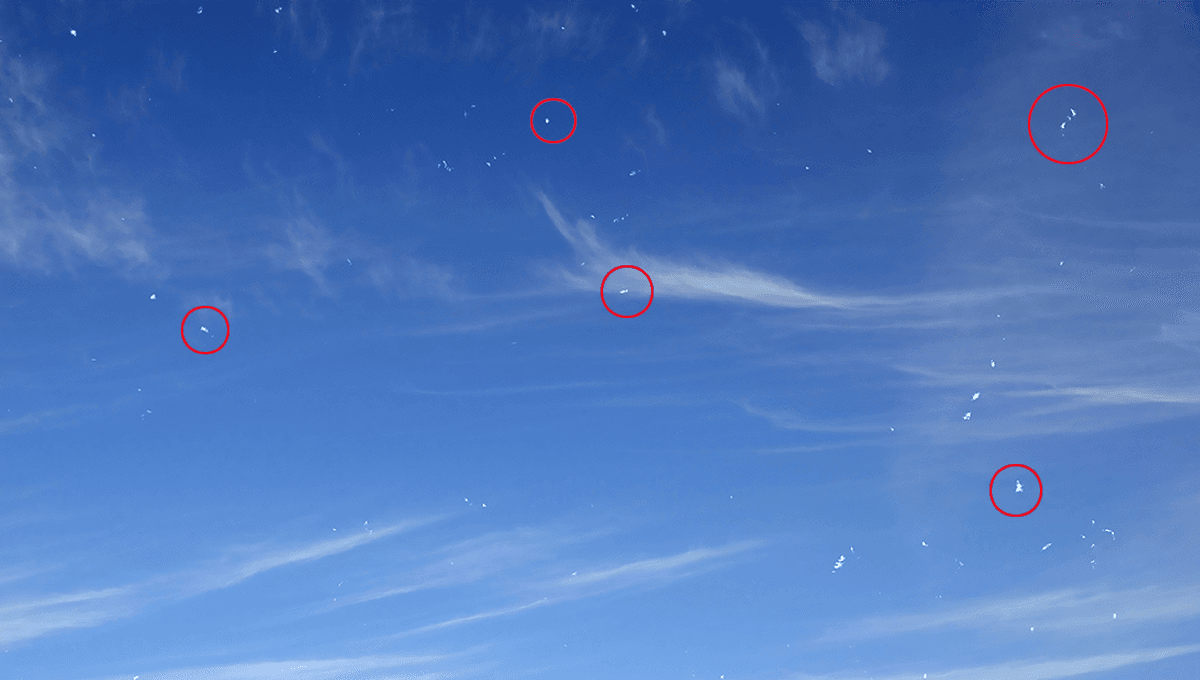
Every now and then, you may have noticed small worm-like structures in your vision, particularly if you are staring at a bright uniform color, such as a bright blue sky or a snowy landscape.
These worm-like structures are floaters, and are caused by objects such as protein clumps, bits of tissue, or red blood cells inside your vitreous humor, the transparent, jelly-like fluid in the center of your eyeball, located between the lens and the retina. They are, of course, generally nothing to worry about, though they can sometimes be an indication of a new condition.
“Eye floaters appear as specks of various shapes and sizes that move across your field of vision. These specks represent cells, clumps of collagen proteins, or debris that are present within the vitreous gel, which fills the back of the eye. They can interfere with vision by casting a shadow on the retina. They may be most obvious when looking at a something bright white,” ophthalmologist Sophie Cai explained in a piece for Johns Hopkins Medicine.
“Eye floaters are most commonly a result of normal aging-related changes in the vitreous gel. As we get older, an acute development of a big central floater is a common symptom of a posterior vitreous detachment, where the vitreous gel separates from the back of the eye.”
But there is another phenomenon that people commonly see when they look up at a bright blue sky. If you look up on a sufficiently bright day, you may see smaller dots darting around seemingly at random. Unlike floaters, which tend to follow slowly and stay put when your eyes stop moving, these little dots, sometimes known as blue-sky sprites, continue to whizz around and go about their business.
The dots are known as the blue field entoptic phenomenon, or Scheerer’s phenomenon, after the German ophthalmologist Richard Scheerer who first documented them in the literature. These, again, are quite common and usually nothing to worry about. Nevertheless, they might gross you out a little, if you aren’t too keen on being aware of the amount of activity taking place within your body. They are caused by your white blood cells moving through your eyeballs.
“Blood flows to your eyes through blood vessels that pass over the retina – the part of your eye that acts as a receptor for all light. Red blood cells, which make up more than 90 percent of your blood, absorb blue light. White blood cells let blue light through to your retina, which then sends a signal of increased brightness to the brain,” the American Academy of Ophthalmologists explains.
As your white blood cells stretch to pass through your eyes’ blood vessels, you may spot these little bright dots, which can appear to move at random and look a little elongated. Unlike floaters, which can be seen against a white backdrop, the blue field entoptic phenomenon is most noticeable when looking up at a bright blue sky.
“Speed of the moving dots vary in time with your pulse, accelerating with your heartbeat,” the American Academy of Ophthalmologists continues. “You may also see a dark tail with the dot of light, which is a bunch-up of red blood cells behind the slower-moving white blood cell.”
Seeing these in the sky is nothing to worry about, but they can be useful for investigating macular function. Their absence or uniform motion, however, can be a sign of certain problems.
“The Blue Field Entoptoscopy is a subjective test of central 15-20° of retinal circulation and visual function. The test yields information about the macular pathology and blood flow which is complimentary to other visual function tests and fluoresceingangiography,” one study explains.
“The pulsation of the particles may diminish or disappear in arteriolar sclerosis, partial obstruction of retinal artery and early cases of central serous retinopathy. Uniform motion may be seen in chronic simple glaucoma and fewer particles may be seen in angiospastic conditions. Any scotomas in particles correspond with Amsler grid scotomas.”
Seeing these structures is generally nothing to be concerned about, though ophthalmologists recommend seeking medical advice when there are noticeable changes to your vision, such as a sudden onset of floaters, which can indicate more serious problems.
All “explainer” articles are confirmed by fact checkers to be correct at time of publishing. Text, images, and links may be edited, removed, or added to at a later date to keep information current.
The content of this article is not intended to be a substitute for professional medical advice, diagnosis, or treatment. Always seek the advice of qualified health providers with questions you may have regarding medical conditions.

Source Link: Scheerer Phenomenon: Those White Structures You See When You Look At The Sky May Not Be "Floaters"
