• Email Us: [email protected]
  • Contact Us: +1 718 874 1545
  • Skip to main content
  • Skip to primary sidebar

Medical Market Report

  • Home
  • All Reports
  • About Us
  • Contact Us

Scientists Create Cyborg Cockroaches Controlled By Solar Powered Backpacks

September 7, 2022 by Deborah Bloomfield

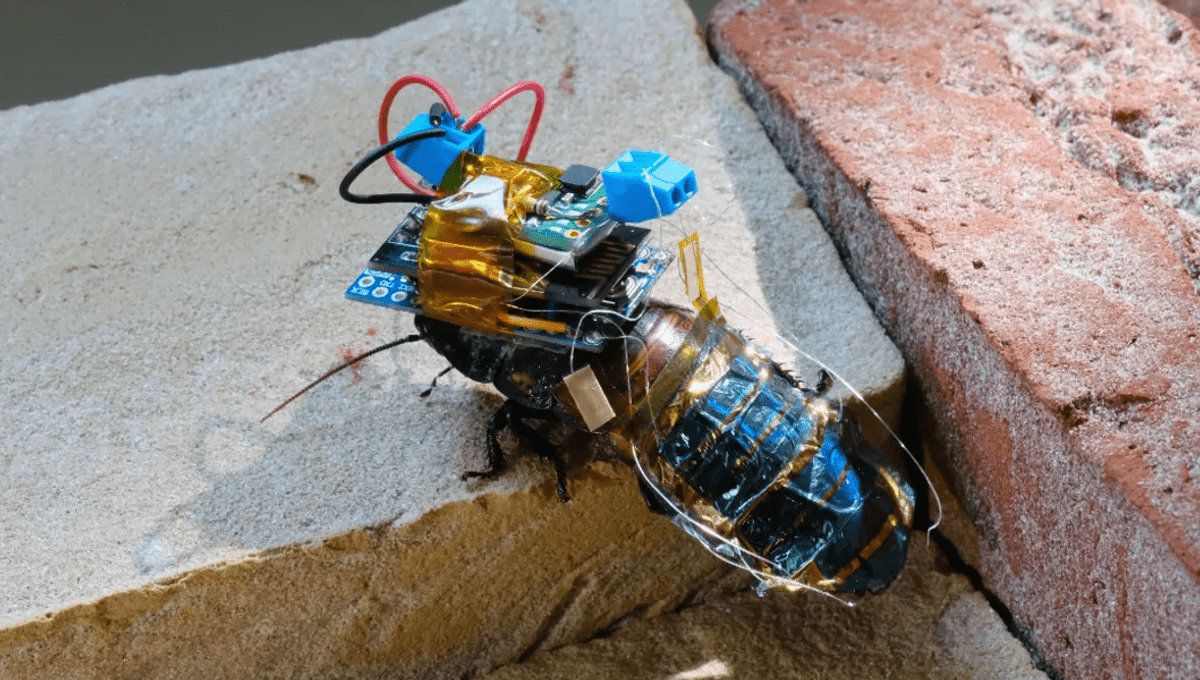
A rechargeable, remote-controllable robo-bug cockroach is the latest cyborg to come shuffling out of flexible electronics. The word salad for a cybernetic creation is thought to be a novel approach to urban search and rescue in creating a recon-ready cockroach that can be powered by the Sun (others are sniffing out explosives).

For a cockroach cyborg to be a good little search and rescue worker it needs to be able to take direction and, until we crack the linguistic code to Blattodea communication, achieving remote control is the best way to do that. As such, scientists created cyborg insects that were part roach, part machine that, with the aid of electronics, can be guided by a human pilot. But getting control is only half the battle.

Advertisement

The delicate and flexible electronics used to establish this control require power, and impressive though they may be there’s not a lot of room on a roach for storing a giant battery. Here, researchers on a new paper published to npj | Flexible Electronics got creative, instead looking to the Sun for a boost.

By creating tiny solar-power backpacks to be mounted on the cockroaches’ backs, the team has been able to create a setup that can maintain power under bright conditions. The onboard solar cell means there’s little risk of the cyborgs running out of juice partway through a mission.

Formulating a backpack that could fit onto a roach proved tricky, with the Madagascar cockroaches used in the study measuring just 6 centimeters (2.5 inches) long. But with the aid of ultrathin organic solar cell modules and a strong adhesive, the researchers were able to piece something together that was effective without limiting their movements.

Advertisement

Their device, which is created using a 3D printer and mounted on a cockroach’s thorax, outcompetes existing models for power and lasts for over one month.

“The body-mounted ultrathin organic solar cell module achieves a power output of 17.2 mW, which is more than 50 times larger than the power output of current state-of-the-art energy harvesting devices on living insects,” said lead research Kenjiro Fukuda of RIKEN CPR in a statement. And what’s more, the tech isn’t limited to just one insect.

“Considering the deformation of the thorax and abdomen during basic locomotion, a hybrid electronic system of rigid and flexible elements in the thorax and ultrasoft devices in the abdomen appears to be an effective design for cyborg cockroaches,” Fukuda explained. “Moreover, since abdominal deformation is not unique to cockroaches, our strategy can be adapted to other insects like beetles, or perhaps even flying insects like cicadas in the future.”

Advertisement

Is it a bird? Is it a plane? One day, it could be a search and rescue cicada.

Deborah Bloomfield
Deborah Bloomfield

Related posts:

  1. Bolsonaro supporters breach police cordon ahead of Tuesday’s marches
  2. Pakistan edtech startup Maqsad gets $2.1M pre-seed to make education more accessible
  3. UK meat industry warns some firms have just five days’ CO2 supply
  4. Golf-Willett leads heading into final round of Alfred Dunhill Links Championship

Source Link: Scientists Create Cyborg Cockroaches Controlled By Solar Powered Backpacks

Filed Under: News

Primary Sidebar

  • The Man Who Fell From Space: These Are The Last Words Of Cosmonaut Vladimir Komarov
  • How Long Can A Bird Can Fly Without Landing?
  • Earliest Evidence Of Making Fire Has Been Discovered, X-Rays Of 3I/ATLAS Reveal Signature Unseen In Other Interstellar Objects, And Much More This Week
  • Could This Weirdly Moving Comet Have Been The Real “Star Of Bethlehem”?
  • How Monogamous Are Humans Vs. Other Mammals? Somewhere Between Beavers And Meerkats, Apparently
  • A 4,900-Year-Old Tree Called Prometheus Was Once The World’s Oldest. Then, A Scientist Cut It Down
  • Descartes Thought The Pineal Gland Was “The Seat Of The Soul” – And Some People Still Do
  • Want To Know What The Last 2 Minutes Before Being Swallowed By A Volcanic Eruption Look Like? Now You Can
  • The Three Norths Are Moving On: A Once-In-A-Lifetime Alignment Shifts This Weekend
  • Spectacular Photo Captures Two Rare Atmospheric Phenomena At The Same Time
  • How America’s Aerospace Defense Came To Track Santa Claus For 70 Years
  • 3200 Phaethon: Parent Body Of Geminids Meteor Shower Is One Of The Strangest Objects We Know Of
  • Does Sleeping On A Problem Actually Help? Yes – It’s Science-Approved
  • Scientists Find A “Unique Group” Of Polar Bears Evolving To Survive The Modern World
  • Politics May Have Just Killed Our Chances To See A Tom Cruise Movie Actually Shot In Space
  • Why Is The Head On Beer Often White, When Beer Itself Isn’t?
  • Fabric Painted With Dye Made From Bacteria Could Protect Astronauts From Radiation On Moon
  • There Used To Be 27 Letters In The English Alphabet, Until One Mysteriously Vanished
  • Why You Need To Stop Chucking That “Liquid Gold” Down Your Kitchen Sink
  • Youngest Mammoth Fossils Ever Found Turn Out To Be Whales… 400 Kilometers From The Coast
  • Business
  • Health
  • News
  • Science
  • Technology
  • +1 718 874 1545
  • +91 78878 22626
  • [email protected]
Office Address
Prudour Pvt. Ltd. 420 Lexington Avenue Suite 300 New York City, NY 10170.

Powered by Prudour Network

Copyrights © 2025 · Medical Market Report. All Rights Reserved.

Go to mobile version