• Email Us: [email protected]
  • Contact Us: +1 718 874 1545
  • Skip to main content
  • Skip to primary sidebar

Medical Market Report

  • Home
  • All Reports
  • About Us
  • Contact Us

Scientists Detect “Switchback” Phenomenon In Earth’s Magnetosphere For The First Time

November 29, 2025 by Deborah Bloomfield

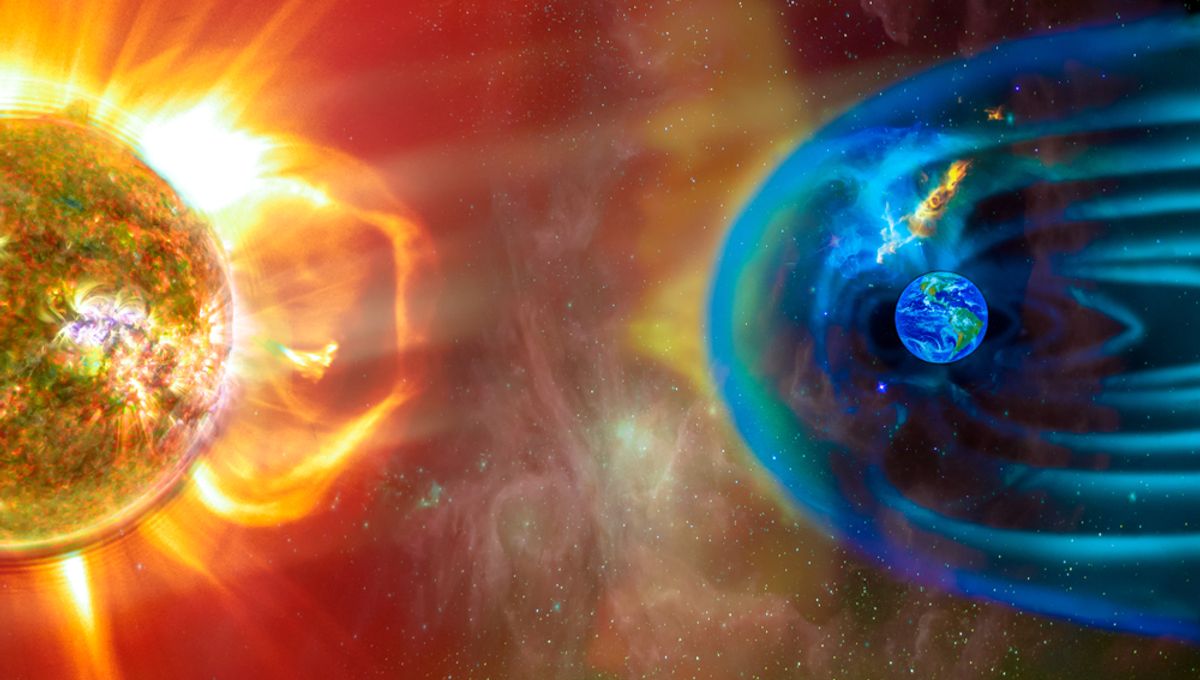
The Earth’s magnetosphere is a protective shroud that blocks charged particles and cosmic rays blasted out by the Sun. The four unmanned spacecraft that make up NASA’s Magnetospheric Multiscale Mission (MMS) have spent nearly a decade studying how the magnetosphere interacts with the Sun’s magnetic field. Now, they have discovered an unusual zigzag in our magnetosphere called a magnetic switchback, the first that scientists have discovered near Earth. 

The rest of this article is behind a paywall. Please sign in or subscribe to access the full content.

The study was led by Emily McDougall, an astrophysicist who conducted the work while at the University of New Hampshire. McDougall’s research focuses on a phenomenon called magnetic reconnection, in which nearby magnetic fields—like those of the Earth and the Sun—interact and release huge amounts of energy. These energy releases, far from our planet, kickstart processes that produce phenomena here on Earth, such as dramatic auroras. 


Switchbacks are kink-shaped plasma structures that form out of reconnection events. Switchbacks have been previously found near the Sun, by missions like the Parker Solar Probe, but not near Earth.

McDougall found the switchback in the magnetosheath, a layer just beyond the magnetosphere, where solar wind, diverted by the magnetosphere, flows. The switchback contained high-energy electrons that appeared to have come from the Earth’s magnetic field, on the Sun-facing southern end. 

This Earth plasma was mixed with Sun plasma inside the switchback. The four MMS probes were able to measure how the field rotated, the speeds of the particles inside, and assess how these compared with existing turbulence and reconnection models. 

The MMS team intends to send the probes on additional sorties through the area, which will hopefully provide more information on how switchbacks amass and what shifting energy conditions trigger them. Large reconnection events can trigger disruptive geomagnetic storms, which can interfere with terrestrial power grids and radio links. They can also pose risks for crewed spacecraft and satellites in Earth’s orbit. 

Now that McDougall’s work has shown reconnection events happening in our planet’s immediate neighborhood, studying these phenomena will become easier. Previous studies had to rely on probes operating far closer to the Sun. With more accessible, relevant testing data closer to home, scientists will be able to improve their predictions of which reconnection events are big enough to disrupt manmade systems and which will pass by harmlessly. 

The study was published in the Journal of Geophysical Research.

Deborah Bloomfield
Deborah Bloomfield

Related posts:

  1. Soccer-PSG hit back at LaLiga chief Tebas over age and spending jibes
  2. Investors tune in as Universal leaps on market debut
  3. U.S. urges fair treatment for Georgia’s Saakashvili
  4. Men Can’t Be Trusted To Measure Their Own Penis Size, Study Finds

Source Link: Scientists Detect “Switchback” Phenomenon In Earth’s Magnetosphere For The First Time

Filed Under: News

Primary Sidebar

  • US Just Killed NASA’s Mars Sample Return Mission – So What Happens Now?
  • Art Sleuths May Have Recovered Traces Of Da Vinci’s DNA From One Of His Drawings
  • Countries With The Most Narcissists Identified By 45,000-Person Study, And The Results Might Surprise You
  • World’s Oldest Poison Arrows Were Used By Hunters 60,000 Years Ago
  • The Real Reason You Shouldn’t Eat (Most) Raw Cookie Dough
  • Antarctic Scientists Have Just Moved The South Pole – Literally
  • “What We Have Is A Very Good Candidate”: Has The Ancestor Of Homo Sapiens Finally Been Found In Africa?
  • Europe’s Missing Ceratopsian Dinosaurs Have Been Found And They’re Quite Diverse
  • Why Don’t Snorers Wake Themselves Up?
  • Endangered “Northern Native Cat” Captured On Camera For The First Time In 80 Years At Australian Sanctuary
  • Watch 25 Years Of A Supernova Expanding Into Space Squeezed Into This 40-Second NASA Video
  • “Diet Stacking” Trend Could Be Seriously Bad For Your Health
  • Meet The Psychedelic Earth Tiger, A Funky Addition To “10 Species To Watch” In 2026
  • The Weird Mystery Of The “Einstein Desert” In The Hunt For Rogue Planets
  • NASA Astronaut Charles Duke Left A Touching Photograph And Message On The Moon In 1972
  • How Multilingual Are You? This New Language Calculator Lets You Find Out In A Minute
  • Europa’s Seabed Might Be Too Quiet For Life: “The Energy Just Doesn’t Seem To Be There”
  • Amoebae: The Microscopic Health Threat Lurking In Our Water Supplies. Are We Taking Them Seriously?
  • The Last Dogs In Antarctica Were Kicked Out In April 1994 By An International Treaty
  • Interstellar Comet 3I/ATLAS Snapped By NASA’s Europa Mission: “We’re Still Scratching Our Heads About Some Of The Things We’re Seeing”
  • Business
  • Health
  • News
  • Science
  • Technology
  • +1 718 874 1545
  • +91 78878 22626
  • [email protected]
Office Address
Prudour Pvt. Ltd. 420 Lexington Avenue Suite 300 New York City, NY 10170.

Powered by Prudour Network

Copyrights © 2026 · Medical Market Report. All Rights Reserved.

Go to mobile version