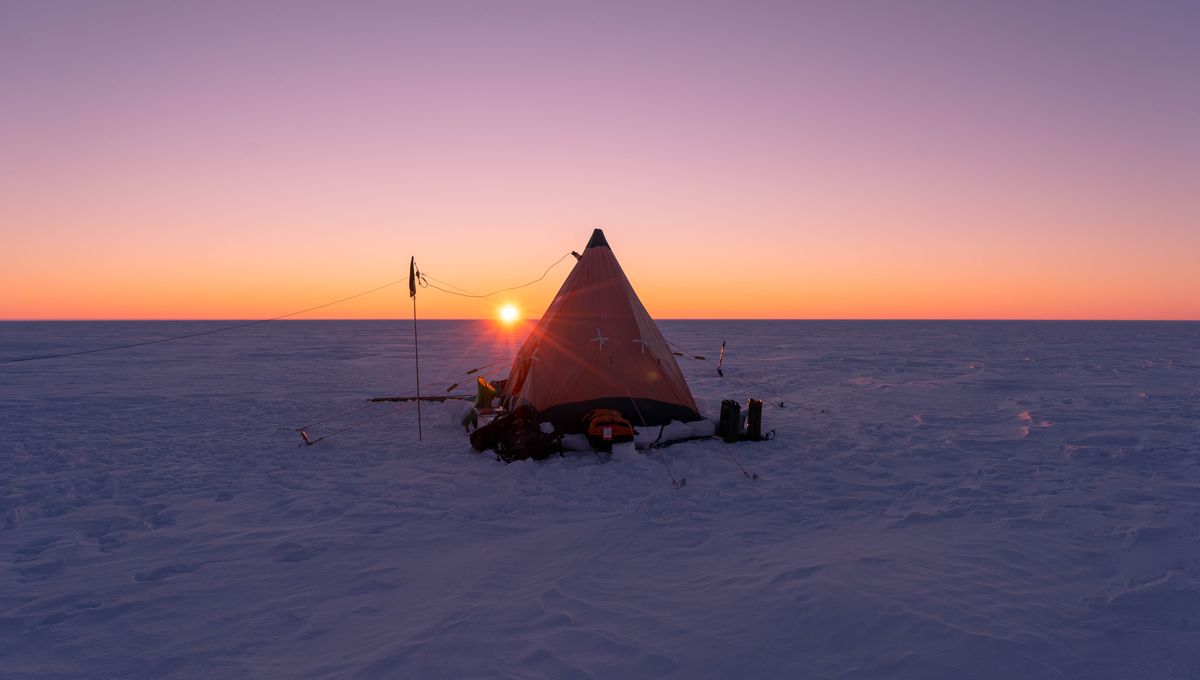
Scientists witnessed the first stages of a common accent developing in Antarctica among its ever-changing population of scientists who spend months together at research stations on the isolated continent.
Antarctica has no native population or permanent residents, but it does have a transitory community of scientists and support staff who live there for part of the year on a rotational basis. In the summer months, there are typically around 5,000 people living in Antarctica, but that drops to just 1,000 in the winter.
While most scientists are there to study things like climate and biodiversity, this extreme living environment has created the perfect petri dish to research certain aspects of human behavior, culture, and sociolinguistics.
In 2019, a team from the Ludwig Maximilian University of Munich studied the phonetic change in accents among 11 “winterers” recruited from the British Antarctic Survey. This included eight people born and raised in England (five in the south and three in the north), one person from the northwest US, another from Germany, and lastly an Icelandic person.
They recorded their voice at the beginning of the study, then made four more re-recordings at approximately six weekly intervals. During this time, they were working closely together, socializing with one another, and having limited contact with the outside world.
Throughout the stay, the researchers noticed significant changes in their accents.
One of the main shifts was how the study group started pronouncing their words with longer vowels. Furthermore, there was evidence of linguistic innovation in the group. Towards the end of their stay in Antarctica, the residents were pronouncing “ou” sounds – like those found in the words “flow” and “disco” – from the front of their mouth, as opposed to the back of their throats.
The changes in accent were subtle, but significant enough to be acoustically measured and even predicted by a computational model.
“The Antarctic accent is not really perceptible as such – it would take much longer for it to become so – but it is acoustically measurable,” Jonathan Harrington, study author and Professor of Phonetics and Speech Processing at the Ludwig-Maximilians University of Munich, told IFLScience.
“It’s mostly an amalgamation of some aspects of the spoken accents of the winterers before they went to Antarctica, together with an innovation,” added Harrington. “It’s far more embryonic [than conventional English accents] given that it had only a short time to develop and also, of course, because it’s only distributed across a small group of speakers.”
As this study shows, close contact and isolation create the ideal conditions for a new accent to rapidly evolve. The research also suggests that the winterers of Antarctica, all of whom arrived on the continent with their own regional accent, began to closely influence each other’s speech and behavior, whether they knew it or not. It’s effectively the same phenomenon that turned the English accent into the American accent (or Australian, Canadian, etc) albeit on a much smaller and shorter scale.
It begs the question of what other novel accents might emerge in response to humans being introduced to new social environments. One scenario is the potential development of a Martian accent.
“The study shows that if you isolate a group of individuals, then they will begin to show the beginnings of a new spoken accent whose form depends to a large extent on the accent characteristics of the speakers that went into the mixture,” Harrington told IFLScience. “We’d expect the same thing to happen if astronauts ever went on a mission to Mars.”
If humans manage to travel to the Red Planet and establish a colony on its dusty surface, their close contact and isolation are likely to foster a new accent very quickly. Over the course of generations, it could become very distinct from Earth-bound accents. After centuries, perhaps even a new Martian language could evolve.
An earlier version of this article was published in August 2023.

Source Link: Scientists Observe The Emergence Of A New Accent In Antarctica
