In 2017, an absolute unit of an iceberg calved from the Larsen C Ice Shelf in Antarctica’s Western Weddell Sea. It provided unprecedented access to this remote region that was a key search area in the hunt for Shackleton’s lost ship, Endurance.
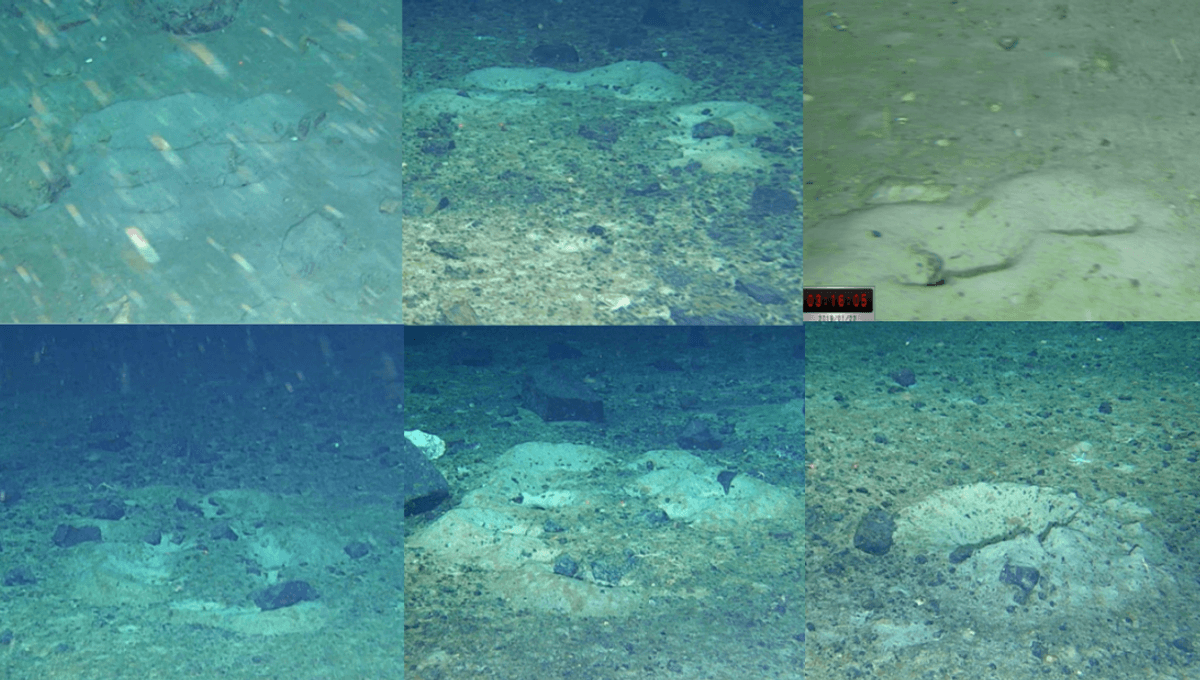
When scientists sent a remote-operated vehicle to investigate in 2019, they were hoping to find the ship. Instead, they discovered strange dimples dotted along the seafloor.
Further investigations revealed there were over 1,000 of them. The culprit? Icefish nests, hundreds of them.
Mysterious marks
“We originally were perplexed by them!” said study author Russ Connelly of the University of Essex to IFLScience. “Fervent discussions on board about what the dimples in the sand may be as they were so clear, and clean, in obvious contrast to the surrounding carpet of green phytoplankton.”
The dimples in the sand weren’t randomly positioned but instead arranged in an organized pattern across the sediment. Turns out this was with good reason.
These fish adhere to a kind of “selfish herd theory” in which nests in the middle are protected from predation, while nests at the edge of the group are typically owned by the biggest, strongest fish that have the best chance of protecting themselves. The subsequent organization was what gave the game away.
Their size and uniform shape, as well as the presence of fish nearby, meant that these were recognised as maintained fish nests.
Russ Connelly
“We considered them being foraging marks,” added Connelly, “but their size and uniform shape, as well as the presence of fish nearby, meant that these were recognised as maintained fish nests.”
The makers of the marks are icefish, specifically a type of rockcod known as the yellowfin notie (Lindbergichthys nudifrons). They are remarkable fish, but not quite as weird as the closely-related clear-blooded icefish that are the only known vertebrates to lack hemoglobin.
Cracking open an ice shelf
The iceberg that had to move out of the way to make all of this possible is known as the A68 iceberg, and it was enormous. Measuring 5,800 square kilometers (2,239 square miles), it was a tabular iceberg about twice the size of Luxembourg that was the largest iceberg on Earth when it formed, and the sixth biggest iceberg on record.
Before it calved in 2017, there would have been 200 meters (656 feet) of ice preventing scientists from getting a look at what was going on underneath. As for how long it’s been since this area of the ocean was exposed to the surface? “Unfortunately, we do not know,” said Connelly. “Unlike Larsen A and B, no studies have yet reconstructed Holocene exposure history for the Larsen C sector.”
The Weddell Sea: A marine protected area?
There’s a big push underway to get the Weddell Sea protected area status, and this discovery of icefish nests add weight to the argument. It’s evidence that despite the chilly waters, this part of the ocean hosts an abundance of marine life that’s an integral part of the Antarctic food web.
“The Weddell Sea is changing rapidly,” says the Antarctic and Southern Ocean Coalition. “Warmer, windier weather is affecting sea ice and other ocean habitats, putting pressure on finely balanced ecosystems to adapt. Despite this, the Weddell Sea is not fully protected.”
“In 2018, Germany proposed the Weddell Sea marine protected area (MPA) to the nations charged with protecting the Southern Ocean. It would offer protection to 790,000 square miles (over 2 million square kilometers) of virtually untouched marine wilderness, including extremely rare and vulnerable polar habitats.”
Shackleton’s “lost” ship, lost no more
At the time of the icefish nests’ discovery, the search for Shackleton’s “lost” ship was still ongoing. I say “lost”, because since then, it’s been found.
Having sunk in 1915, Endurance was found 100 years after the famous explorer’s death. The cold waters at the bottom of the Weddell Sea preserved the Endurance, leaving it in excellent condition. In the accompanying (and astonishing) photos, a few new crewmates spotted onboard included Antarctic sea anemones (including one at the wheel), sea squirts, sea stars, and crinoids.
The only thing better than finding a famous shipwreck? Discovering a deep-sea mystery along the way, too.
The study is published in the journal Frontiers in Marine Science.

Source Link: Search For Shackleton’s “Lost” Ship Uncovered 1,000 Dimples On The Antarctic Seafloor – What Are They?
