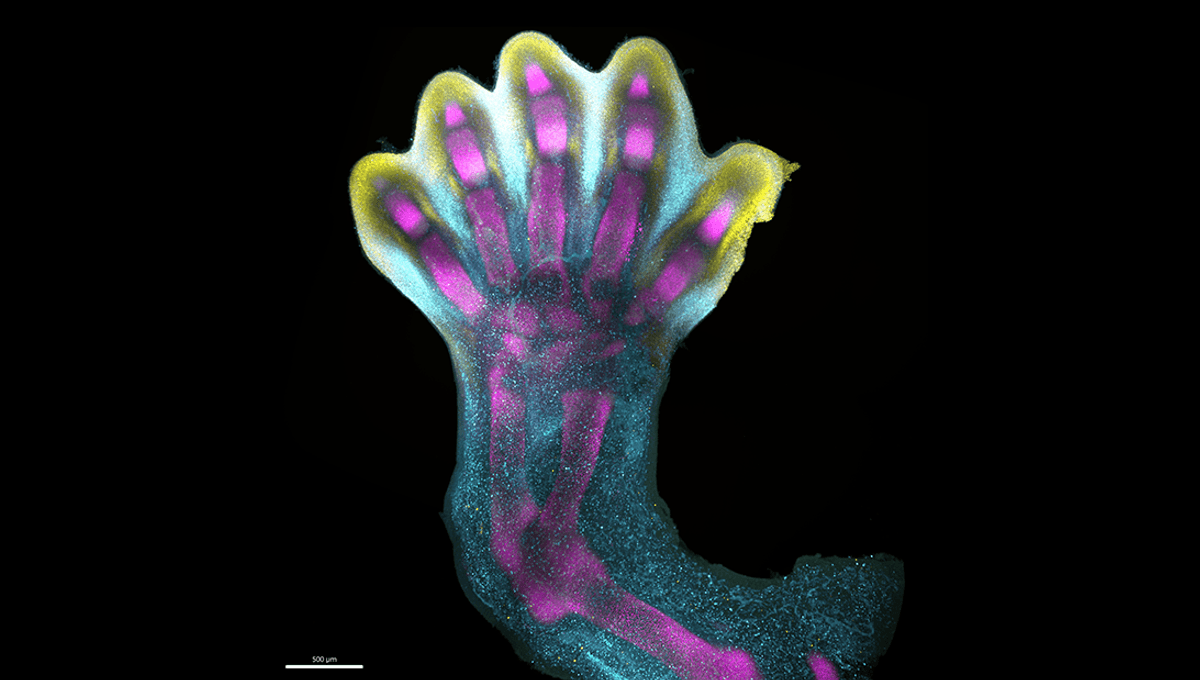
Our hands and feet are pretty important. They help us to walk, to grip things, to make sense of our environment – and yet we know surprisingly little about how they develop. Or we didn’t until a new study came along, uncovering some of the mysteries of the earliest stages of human limb development for the very first time.
To address the gap in our knowledge, researchers have created an atlas of cells involved in early human limb development, revealing how we get our fingers and toes. It forms part of the Human Cell Atlas – an international consortium that is creating comprehensive reference maps of every cell type in the human body – and made use of cutting-edge single-cell and spatial technologies to finally illuminate the intricacies of the perplexing process.
In doing so, the team not only provide a never-before-seen characterization of human digit development, but also further our understanding of congenital limb syndromes, which may have implications for their diagnosis and treatment.
“For the first time, we have been able to capture the remarkable process of limb development down to single cell resolution in space and time,” Dr Sarah Teichmann, senior author and co-founder of the Human Cell Atlas, said in a statement. This, Teichmann added, has “many implications for research and healthcare.”
“For instance, we discovered novel roles of key genes MSC and PITX1 that may regulate muscle stem cells. This could offer potential for treating muscle-related disorders or injuries.”
Our limbs spring from bundles of cells on the sides of our bodies, which initially lack shape or function. But by eight weeks of development, they start to resemble arms and legs and are anatomically complex. What happens in the interim to get this point has been extensively studied in mice and chicks, but not so much in humans.
“Decades of studying model organisms established the basis for our understanding of vertebrate limb development,” senior author Professor Hongbo Zhang explained. “However, characterising this in humans has been elusive until now.”
Zhang and co-authors turned to human tissues from between five and nine weeks of development to help investigate. Doing so enabled them to trace gene expression in the limb bud, providing a clearer picture of the genetic basis of limb formation.
They also stained the tissues to find out how different populations of cells behave during this formative process.
Their findings pinpoint particular genes that are involved, including some that, when disrupted, are associated with limb syndromes such as brachydactyly – short fingers and toes – and polysyndactyly – extra digits.
They also, unexpectedly, demonstrate that our fingers and toes don’t actually grow outwards, but instead collapse in on themselves from a larger foundational bud.
“What we reveal is a highly complex and precisely regulated process. It is like watching a sculptor at work, chiselling away at a block of marble to reveal a masterpiece. In this case, nature is the sculptor, and the result is the incredible complexity of our fingers and toes,” Zhang added.
In another of nature’s artistic triumphs, you can now see for yourself how hammerhead sharks get their distinctive hammers – another developmental feat that had never before been observed.
The study is published in Nature.

Source Link: See For Yourself How Fingers And Toes Grow In First-Of-Its-Kind Footage
