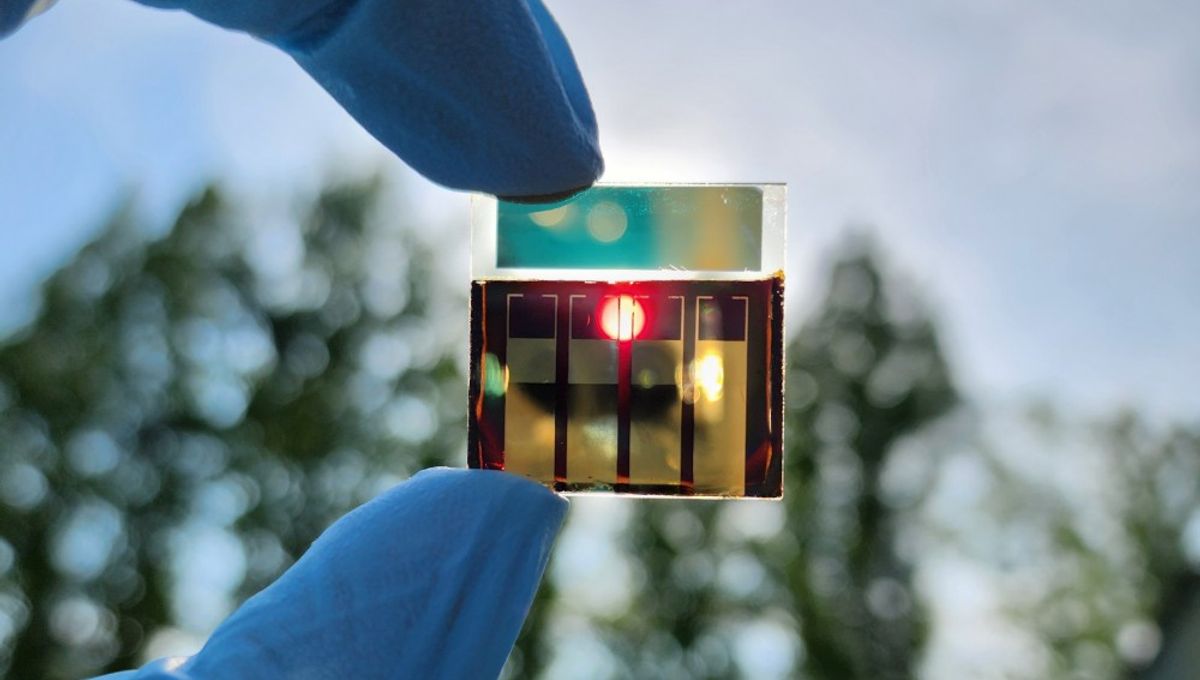
Scientists in South Korea have announced a step forward in the development of semi-transparent perovskite solar cells that could someday allow windows to generate energy. In the latest tests, the semi-transparent perovskite solar cells achieved an efficiency of over 21 percent, which the researchers claim is a record for this type of technology. Furthermore, over 99 percent of the initial efficiency was maintained for up to 240 hours of operation.
Developed by the Korea Institute of Energy Research (KIER), the new solar cell technology replaces the metal electrodes of typical solar cells with transparent electrodes that allow light to pass through.
This process is easier said than done. For unknown reasons, initial tests with the semi-transparent materials resulted in reduced charge transporting properties and stability. To solve this, they closely analyzed the material using electro-optical analysis and atomic-level computational science.
This revealed that lithium ions were causing the problem. Lithium ions are added to the “hole transport layer” of the solar cell to increase its conductivity, but they also diffuse into the metal oxide layer that serves as a buffer and degrades its useful qualities.
To overcome the problem, they converted the lithium ions into stable lithium oxide, making the cell much more stable.
“This study represents a significant advance in the field by examining the degradation process occurring at the interface of organic compound and metal oxide buffer layer which is unique to semi-transparent perovskite solar cells,” Dr Ahn SeJin, leader of the researcher at the KIER’s Photovoltaics Research Department, said in a statement.
“Our solution is readily implementable, demonstrating great potential for the future use of the technologies we have developed.”
Solar energy could become a major player in the transition away from fossil fuels. However, current solar cell technology has several shortcomings. One major problem is the materials they’re made from, which can be expensive, inefficient, and a pain to obtain.
There’s also the question of where to put the solar panels. To soak up vast amounts of solar energy, you need a vast amount of solar panels – and not everyone is a fan of them, aesthetically speaking.
As such, engineers and designers are keen to find inventive new ways to include solar cells that seamlessly blend into their surrounding environment. The idea goes that these semi-transparent perovskite solar cells could be installed in glass-paneled buildings, allowing light in and subtly producing electricity while barely being noticeable.
There’s still a long way to go before sun-soaking windows adorn our homes and office blocks, but this latest breakthrough marks a small but significant step closer.
The new study is published in the journal Advanced Energy Materials.

Source Link: Semi-Transparent Cells Could Turn Windows Into Solar Energy Collectors
