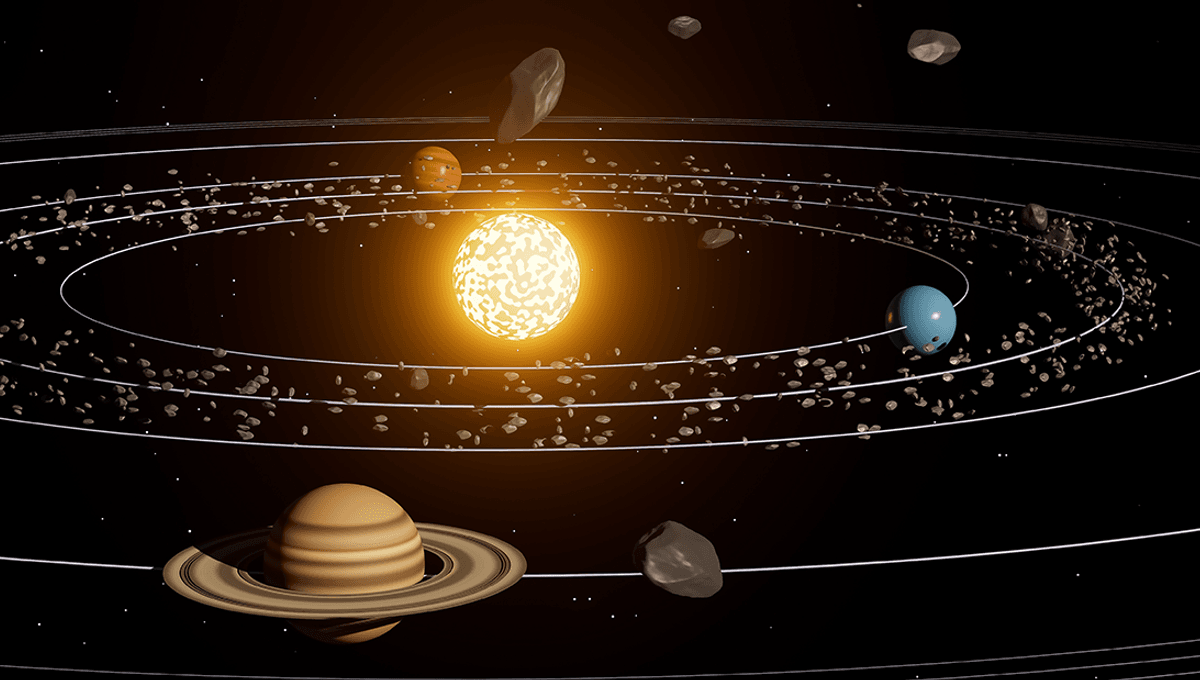
A new paper examining and simulating the formation of wide-orbit planets has put the chances of our own Solar System harboring the hypothetical “Planet Nine” at up to 40 percent.
In 2016, two astronomers at Caltech presented evidence that six objects past the orbit of Neptune were bunched together in a way that suggested they were being “herded” by something with a large gravitational pull. Since then, Konstantin Batygin, Mike Brown, and others have attempted to search for such a planet, dubbed “Planet Nine”.
While it remains elusive, many astronomers believe that it could explain puzzles such as the tilt of the orbit of long-period Kuiper belt objects, and objects that orbit the Sun in a retrograde direction between the giant planets.
“It could also make our Solar System seem a little more ‘normal’,” NASA explains. “Surveys of planets around other stars in our galaxy have found the most common types to be ‘super Earths’ and their cousins – bigger than Earth, but smaller than Neptune. Yet none of this kind exist in our Solar System. Planet Nine would help fill that gap.”
Looking at other star systems in recent years has revealed the existence of “wide-orbit” planets – gas giants and rocky planets orbiting their host stars thousands of astronomical units (AU) from their star, with one AU being the distance from the Earth to our own Sun. This has thrown up two puzzles: how these planets form, and whether our own Solar System has its own examples.
“The origins of planets on very wide orbits remain hard to explain. Planets orbiting a few hundred to a few thousand astronomical units from their host star are dynamically isolated from gravitational perturbations from any inner planet (≲10 au) as well as from Galactic perturbations,” the team explains in their paper. “Several hundred astronomical units is also wider than the size of most planet-forming disks, and the disk that formed the Solar System was smaller than ~80 au. However, so far, about a dozen exoplanets with orbits wider than 100 au have been discovered.”
In the new study, researchers from Rice University and the Planetary Science Institute ran simulations of a variety of different planetary systems – some like our own, and some more exotic, for example containing two suns – within realistic star clusters, close enough to affect their evolution. Doing so, the team found that wide-orbit planets were a natural outcome of chaotic early interactions in planetary development.
“Essentially, we’re watching pinballs in a cosmic arcade,” André Izidoro, assistant professor of Earth, environmental and planetary sciences at Rice and the study’s lead author, said in a statement. “When giant planets scatter each other through gravitational interactions, some are flung far away from their star. If the timing and surrounding environment are just right, those planets don’t get ejected, but rather they get trapped in extremely wide orbits.”
This stabilization happens because “perturbations from nearby stellar flybys stabilize the orbit by decoupling the planet from the interaction with the inner system”, according to the paper.
The team found that not all Solar System arrangements are as efficient at trapping these ejected planets in a stable, wide orbit. Solar Systems like our own had reasonable “trapping efficiency”, with probabilities of around 5-10 percent. Other systems, such as those with an abundance of ice giants, were far less efficient at capture.
“We expect roughly one wide-orbit planet for every thousand stars,” Izidoro added. “That may seem small, but across billions of stars in the galaxy, it adds up.”
The team found that wide-orbit planets are more likely to be found around stars with high metallicity, and that host their own gas giants. Our own Solar System is two for two on those counts.
“Our simulations show that if the early Solar System underwent two specific instability phases – the growth of Uranus and Neptune and the later scattering among gas giants – there is up to a 40 percent chance that a Planet Nine-like object could have been trapped during that time,” Izidoro said.
Further observations of high-metallicity stars could identify more wide-orbit planets, while upcoming observations from the Vera C. Rubin Observatory could catch a glimpse of Planet Nine itself, if it does exist. But the study could also shed a little light on rogue planets – planets that wander interstellar space, free from any host star.
“Not every scattered planet is lucky enough to get trapped,” study co-author Nathan Kaib, senior scientist and senior education and communication specialist at the Planetary Science Institute, said. “Most end up being flung into interstellar space. But the rate at which they get trapped gives us a connection between the planets we see on wide orbits and those we find wandering alone in the galaxy.”
“As we refine our understanding of where to look and what to look for, we’re not just increasing the odds of finding Planet Nine – we’re opening a new window into the architecture and evolution of planetary systems throughout the galaxy,” Izidoro added.
The study is published in Nature Astronomy.

Source Link: Simulations Of Early Solar Systems Find Up To 40 Percent Chance That Planet Nine Exists
