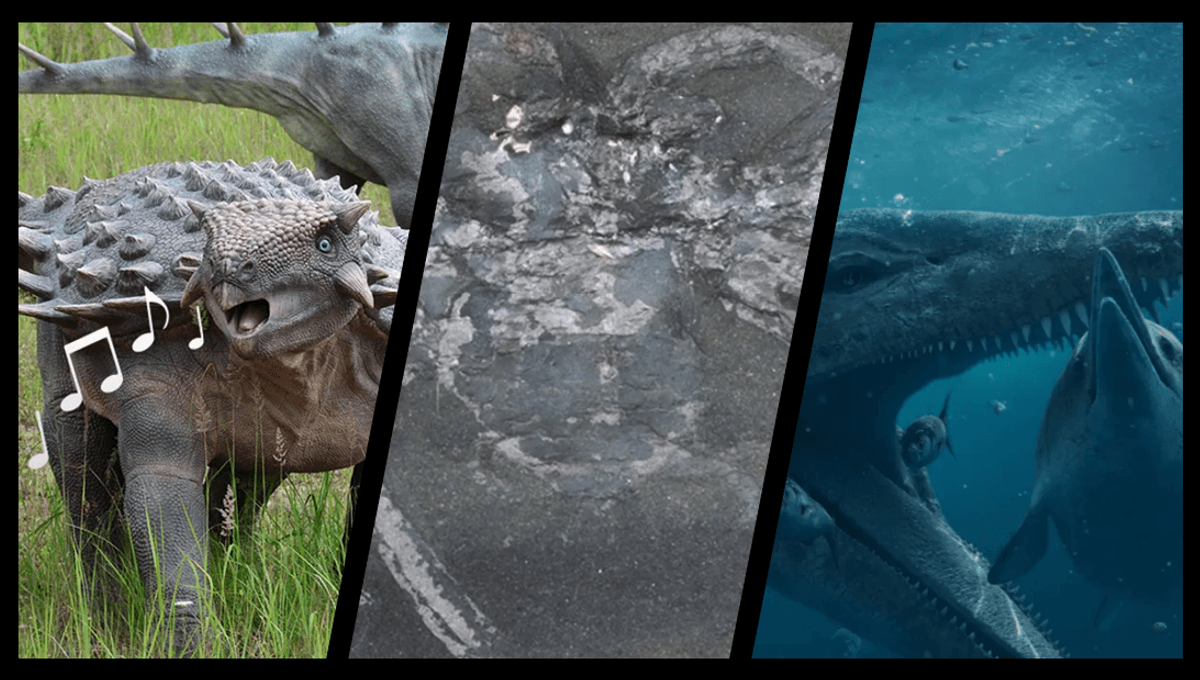
Some of the biggest news stories of 2023 were, in fact, tens, or even hundreds, of millions of years old, as we discovered incredible new species dating back to the Jurassic and beyond. As technology marches on, scientists are finding new ways to analyze ancient specimens all the time, and they’ve turned up some incredible stories in the last 12 months.
Giant Skull Of 150-Million-Year-Old “Sea Monster” Emerges From UK Cliffs
IFLScience had the honor of meeting the star of a new series from David Attenborough and the BBC, a 150-million-year-old pliosaur whose massive skull was retrieved during a perilous mission along the Jurassic Coast. Fossil experts Steve Etches and Chris Moore tackled the exhausting task of chipping it out of the cliff after someone found the snout rolling around on the beach.
Pliosaurs were some of the biggest animals the planet’s ever seen, and it’s estimated this (potentially new-to-science) species was 12 meters (39 feet) in length. This is a fossil you’ve really got to see to believe, and luckily, we got an exclusive interview for your viewing pleasure:
75-Million-Year-Old Fossil Is First-Ever Tyrannosaur Found With Stomach Contents
One dinosaur’s baby-eating ways were revealed in a study that described the first known fossil to contain tyrannosaur stomach contents. The Gorgosaurus selectively ate only the legs of the small Citipes dinosaurs before dying within a few days, and 75 million years on, it’s become one of the most remarkable fossil discoveries of 2023.
Fossil Spiders Aplenty
2023 was a great year for fossil spiders. A new-to-science specimen dating back 310 million years became the first “true spider” known from the Palaeozoic of Germany. Despite its incredible age, the fossil spider is near-perfect as an almost complete specimen. It’s survived in the fossil record to become one of just 12 Carboniferous species that can be confidently assigned to Araneae.
A second astonishing fossilized spider came from Australia, dating back 75 million years and proving it’s long been home to some impressive leggy bois. As the second-largest spider fossil ever found, it’s around five times bigger than similar spider species that still walk the Earth today. In terms of size, it’s comparable to a modern wolf spider at around 50 millimeters (2 inches) toe-to-toe.
Spiky Armored Ankylosaurs May Have Sounded Like Birds
When Clickhole wrote “Paleontologists Have Agreed To Start Saying That Stegosauruses Had Beautiful Singing Voices Because It’s A Nice Thought And It’s Not Like They’re Hurting Anyone” we felt that, so you can imagine our excitement when it was announced that ankylosaurs may have sounded like birds. The large larynx of Pinacosaurus grangeri means these non-avian dinosaurs may have been able to make bird-like vocalizations, which is sort of surprising for a spiky armored tank of an ancient animal.
Dinosaur Egg-In-Egg Action In India
Ovum-in-ovo describes the rare occurrence of an egg developing within an egg. It was thought to be unique to birds until scientists found dinosaur examples, one of which belongs to a group of sauropods in central India. “Such eggs have not been reported from reptiles but only from birds. This discovery has led us to hypothesize that titanosaur sauropod dinosaurs may have laid eggs in a sequential manner as is the case with birds,” said study author Dr Harsha Dhiman to IFLScience.
Giant Dinosaur Had The Longest Neck Of Any Animal Ever Discovered
In other big titanosaur news, the record for longest neck went to the Chinese sauropod Mamenchisaurus sinocanadorum, stretching to a whopping 15.1 meters (49.5 feet), which is around six times longer than a giraffe’s. Like all other sauropods, it would’ve been lined with balloon-like air sacs (remember the funny noises from Prehistoric Planet?) that made it lighter but also prone to respiratory infection.
Prehistoric Planets And Jurassic Worlds
And finally, we owe a hat-tip to the ground-breaking TV and cinema that came out in 2023 celebrating the wonders of the ancient world. Prehistoric Planet returned for a second, hugely successful season, including a victorious return for IFLScience’s favorite, Beelzebufo. Netflix also released Life On Our Planet, featuring an Arthropleura, a small car for a millipede that lived around 300 million years ago.
We also celebrated 30 years of Jurassic Park with an exclusive interview with Dr Susie Maidment of London’s Natural History Museum and Colossal Bioscience’s Ben Lamm. Maidment has done extensive research into fossilized remains of dinosaurs, meanwhile Lamm’s work centers around the de-extinction of lost species, setting the stage for a great discussion into “Can we bring back dinosaurs?”
Click here to see more of our palaeontological stories from 2023, or stay tuned for the ancient animal discoveries we await in 2024.

Source Link: Singing Ankylosaurs, 310-Million-Year-Old Fossil Spiders, And A “Giant Sea Monster” Join The Planet's Prehistoric Wonders
