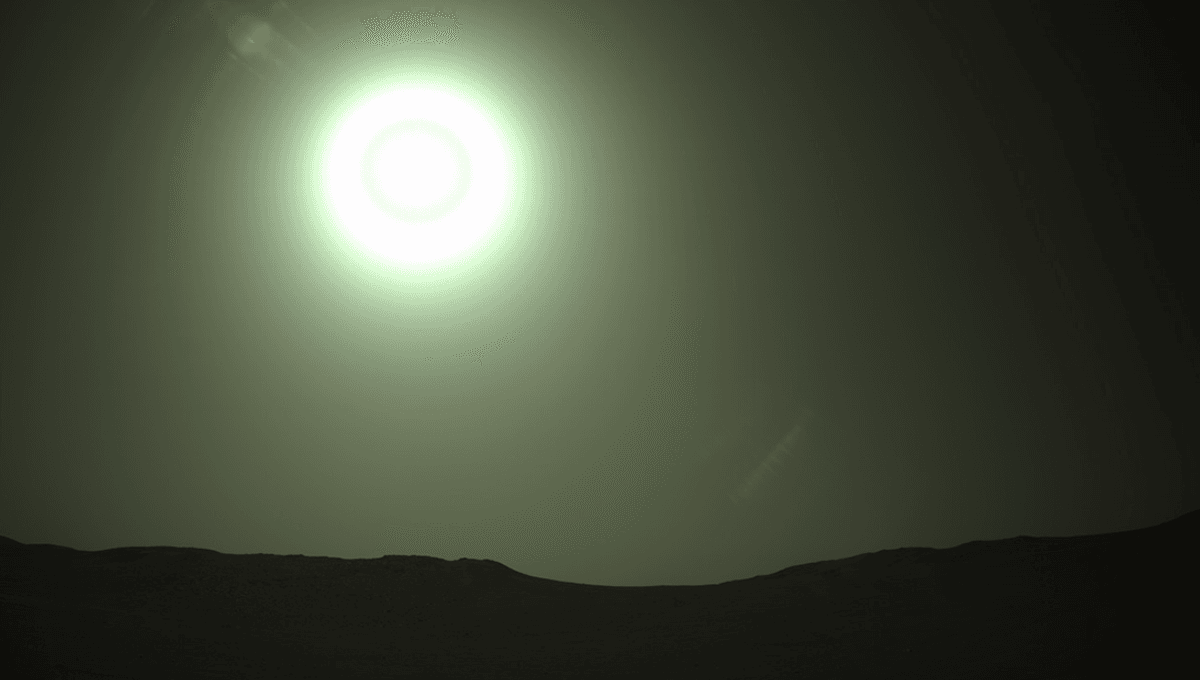
NASA has released a short timelapse video of Perseverance’s record-breaking drive on Mars, as engineers determine the rover should be operational until at least 2031.
In July 2020, the Perseverance rover was launched, landing in the Jezero Crater on Mars on February 18, 2021. The rover’s primary objective is to search for signs of ancient microbial life, collecting samples for (eventual) return to Earth by the Mars Sample Return mission. Whilst on the Red Planet, the rover has achieved a number of milestones, from producing enough oxygen to keep a small dog alive, to finding Martian mudstone with features that may be biosignatures.
While NASA engineers at the Jet Propulsion Laboratory (JPL) plot a course for the rover each day and its scientific activities, once it starts driving it is on its own and relies on its autonomous systems to navigate unexpected obstacles along its path, known as ENav. Previous rovers could do this to a certain extent, but were unable to do so as far in advance as Perseverance. They would often have to slow down to a crawl in order to navigate around rocks, sand pits, and when near ledges.
“More than 90 percent of Perseverance’s journey has relied on autonomous driving, making it possible to quickly collect a diverse range of samples,” JPL autonomy researcher Hiro Ono explained in a statement. “As humans go to the Moon and even Mars in the future, long-range autonomous driving will become more critical to exploring these worlds.”
NASA has now released a short video of the rover’s new record drive. On the rover’s 1,540th sol (or Martian day) on Mars, it traveled a record-breaking distance, beating the ground it covered just a few years ago.
“Perseverance rover was traveling northbound and covered 1,350.7 feet (411.7 meters) on that sol, over the course of about 4 hours and 24 minutes,” NASA JPL explained on YouTube. “This distance eclipsed its previous record of distance traveled in a single sol: 1,140.7 feet (347.7 meters), which was achieved on April 3, 2023 (Sol 753).”
In the video, you can see the rover react to the terrain in front of it. You may notice that during the timelapse, created by stitching together 300 image pairs from the rover’s navigation cameras, the rover sees several tracks in the Martian soil. Before you post your theory to Reddit, these are not signs of little alien clown cars driving around, nor marks left by any of the previous rovers, but Perseverance’s own tracks from May 18 and 19, 2025 (sols 1,509 and 1,510), as the rover traveled southbound.
“ENav provides robustness against slip by expanding the bounding boxes for wheels used by the collision check. These new features, together with FPGA-accelerated vision processing, enabled Perseverance to autonomously drive on substantially more rock-dense terrains and increased the average daily driving distance by an order of magnitude compared to its predecessors, the Curiosity, Spirit, and Opportunity rovers,” a recent paper on the autonomous system explains.
“Perseverance has set several new records for autonomous driving on Mars, breaking those previously held by the Opportunity rover. As of the 1,312th Martian day since landing, or 28 October 2024 on the Earth calendar, ∼90 percent of the 32.1 kilometers of driving has used ENav to evaluate the terrain.”
Over the summer, NASA engineers have performed remote tests on the rover’s wheels, confirming that they should perform as intended for at least another 60 kilometers (37 miles). As well as this, the vehicle’s subsystems continue to perform well, and should be operational until at least 2031.
“These tests show the rover is in excellent shape,” Perseverance’s deputy project manager, Steve Lee of JPL, added. “All the systems are fully capable of supporting a very long-term mission to extensively explore this fascinating region of Mars.”

Source Link: Sol 1,540: NASA Releases Video Of Perseverance Rover's Record-Breaking Drive On Mars
