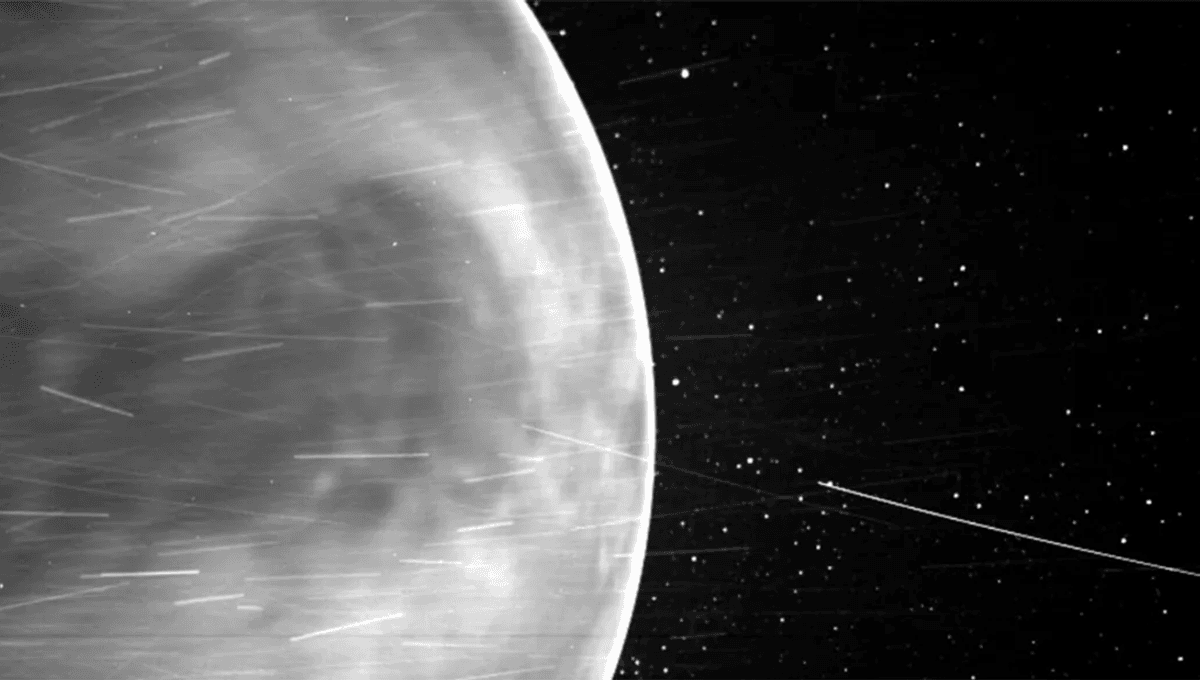
Twenty years after its discovery, asteroid and quasi-moon 2002 VE 68 has been officially renamed “Zoozve” after a strange label on his 2-year-old child’s poster of the Solar System led Radiolab host Latif Nasser to investigate further.
In a widely-shared X (Twitter) thread, Nasser explained that he found a mystery moon on his child’s astronomy poster labeled “Zoozve” near Venus. This is odd, as Venus has no moons, prompting Nasser to investigate.
Google found no references to any “Zoozve”, and a friend at NASA had no idea what it was referring to either. Nasser called the poster’s illustrator, who swore that he took the name from a list of moons of the Solar System.
To cut a long (but enjoyable!) story short, Nasser’s NASA friend Liz Landau realized what had happened. The moon was not “Zoozve”, but object 2002 VE 68. When space objects are first seen, they are given a provisional name based on when they were discovered. The first number part, as you might have guessed, relates to the year, while the letters relate to when it was discovered in the year.
The quasi-satellite is a lot more interesting than your standard space rocks, being as it was the first of its kind ever discovered, due to its unusual orbit.
“Like all asteroids, its orbit takes it around the Sun, with asteroids closer to the Sun circling more rapidly and completing a ‘year’ in a shorter time. The ‘year’ for VE68 is shorter than the Earth year, clocking in at a little under 225 days,” Zoozve’s discoverers, led by Seppo Mikkala of Tuorla Observatory, explained back in 2004.
“This is almost exactly the same as the ‘year’ of the planet Venus – and it turns out that like synchronised divers in the Olympic Games, both VE68 and Venus are travelling around the Sun nearly in lock-step.”
Tracking the orbit of 2002 VE, the team discovered the first quasi-moon, or quasi-satellites, in the Solar System. Quasi-moons, as the name suggests, are not quite moons. They orbit the Sun but are also influenced by the planets along their path.
Following the Radiolab investigation, the first quasi-moon in the Solar System around a major planet has officially been renamed Zoozve.
“This object is the first-identified quasi-satellite of a major planet (Venus),” the Working Group of the International Astronomical Union (WGSBN) announced in a bulletin. “When artist Alex Foster drew this object on a Solar System poster for children, he mistook the initial characters of the provisional designation as letters, thus coining an odd and memorable moniker.”
2002 VE has been orbiting the Sun and encountering Venus for quite a while, but the team who first described its orbit thinks it may have come from elsewhere.
“Our computations show that it has been in its present orbital state for about seven millennia and will stay there for five more centuries to come,” the team wrote in their 2004 paper.
“Very close approaches with Venus and Mercury are excluded within the interval of time of reliable numerical computation of the orbit, but repeated encounters with the Earth do occur. From the evolution of the orbit of this object, we conclude that it may have been a near-Earth asteroid, which, some 7,000 yr ago, was injected into its present orbit by the action of the Earth.”
[H/T: Radiolab]

Source Link: Solar System's First Quasi-Moon Officially Named "Zoozve" After Error On Child's Poster
