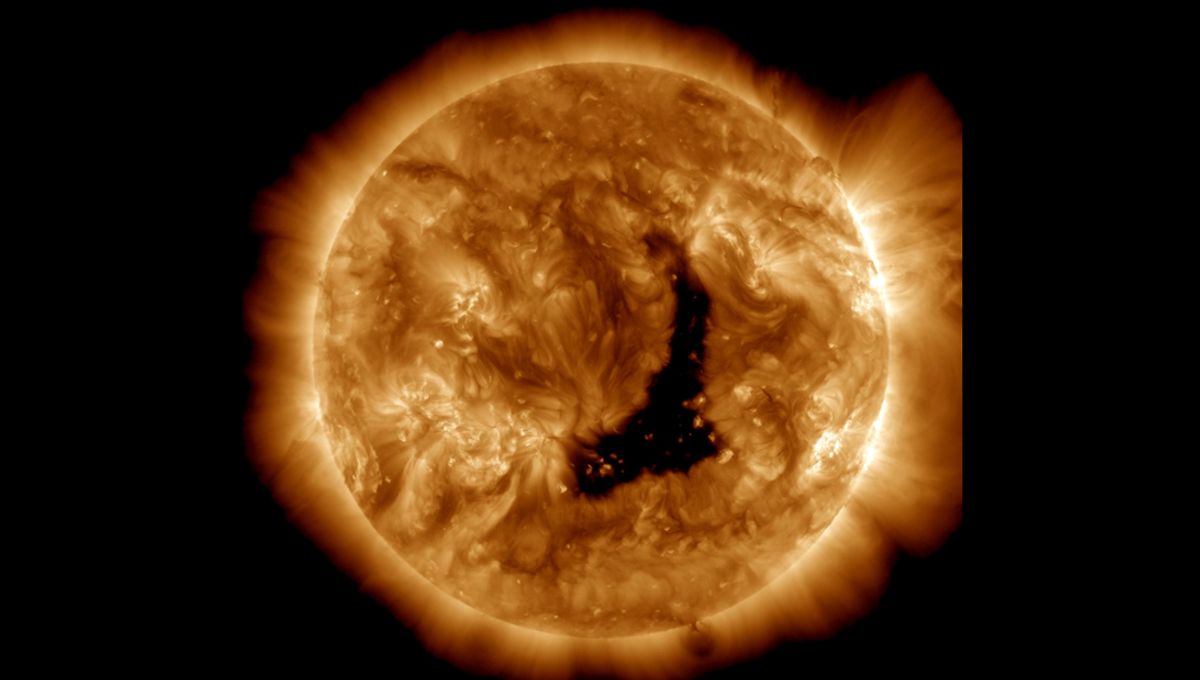
You’ve got to love a scientific paper that includes the line, “The Sun is formidable and destroying it is generally considered to be a difficult problem.” Rather than a primer for a Bond villain, the study in question instead explores the possibility the Sun could be hiding a black hole inside, and whether doing so would have destroyed the Sun by now.
Now and then, scientists acknowledge science fiction writers as the originators of ideas subsequently shown to have scientific merit. Inspiration from music, even major hits of the 90s, is rarer. Yet it was Soundgarden’s song Black Hole Sun that inspired Dr Earl Bellinger of the Max Planck Institute for Astrophysics to start thinking about whether such things could exist.
Stellar black holes are created by the collapse of stars with masses of more than 25 times the Sun in supernova explosions. It would have been easy enough for Bellinger to simply add a word to the title and conclude that “Black hole, (former) Sun” was scientifically correct. Instead, he enlisted eight colleagues in the quest to discover if it was possible for an apparently ordinary star to have a black hole inside it.
Surprisingly, they think the answer is yes.
Black holes famously have such strong gravity even light cannot escape them, so it might seem illogical to think that objects whose most obvious characteristic is that they shine could be overcoming that force to light the universe. However, quasars are brighter still, and they are powered by supermassive black holes at their cores.
Indeed, even Stephen Hawking suggested there might be a primordial black hole at the center of the Sun. The idea never took off, but Bellinger and colleagues have explored how stars would evolve if it were true.
The background to the study is the idea that in the first second after the Big Bang many smallish black holes were formed, with masses similar to the Moon or smaller. The smallest black holes would evaporate, but those the size of a large asteroid would still be in existence, drifting around the universe, a thought that is absolutely not terrifying in any way.
Potentially these primordial black holes might be abundant enough that they could explain at least some of the missing dark matter in the universe. Most of the holes would be drifting between the stars, camouflaged enough we have yet to identify one, but if one ventured into the gas cloud in which a star is forming it might end up in the star’s core.
The project was to work out what would happen if this were real, and if so whether the effects would be something we could detect.
Black holes less massive than the asteroid Psyche, the study concluded, would have no externally noticeable effects. Although they would consume surrounding areas of the star, the affected area would be so small that an outside observer could never distinguish stars with and without such black holes,
However, at the larger end of the mass range the authors deem credible, things would be different. Slowly the black hole would consume the star from the inside like some sort of terrible parasite, shutting down the fusion reactions that produce the star’s energy. This would cause the star to dim when counterparts of similar age and mass would be growing (slightly) brighter.
If the Sun had a Black Hole whose mass had now reached a millionth of that of the Sun’s (about three times the mass of Mars), it would lose about half its brightness over a period of 100 million years. Then, however, the star would brighten, as black hole accretion replaced nuclear fusion as its main source of energy. The star would puff up to become a red giant prematurely, and would show some differences that would reveal its true nature.
For one thing, it would have more helium at the surface than other red giants, and would never get quite as large – in the Sun’s case expanding only to the orbit of Mercury, not almost to that of Earth.
The class of stars known as red stragglers (brighter than subgiants but with colors also as red as red giants) are candidates for stars of this nature, the authors propose. If so, they should vibrate differently from stars without an internal secret, something future projects could study. Eventually, such a star will become consumed, ending up as a naked black hole with a mass larger than what it started with, but somewhat smaller than those left behind by supernova explosions.
The exact details depend on the masses of both the initial black hole and the star around it, and the quantity of heavier elements (metals to stellar astronomers) in the star. The paper considers various scenarios, but there are far too many possibilities to cover them all.
Besides checking stars for the distinguishing features the authors predict, we could determine the likelihood of such black hole stars existing by looking for evidence of primordial black holes elsewhere. Four of the black hole mergers we have detected so far involved one component that was low mass enough it might be from the early universe, but none are clear clear-cut cases.
We’ve also seen many low-mass microlensing events from objects of the appropriate mass, but there is currently no way to distinguish most from free-floating planets.
The study is published open access in The Astrophysical Journal.
[H/T: Science]

Source Link: Some Stars May Have Tiny Black Holes Hiding In Their Cores
