• Email Us: [email protected]
  • Contact Us: +1 718 874 1545
  • Skip to main content
  • Skip to primary sidebar

Medical Market Report

  • Home
  • All Reports
  • About Us
  • Contact Us

“Something Undeniably Special”: The Chi Cygnids, A New Five-Yearly Meteor Shower, Peak This Month

September 10, 2025 by Deborah Bloomfield

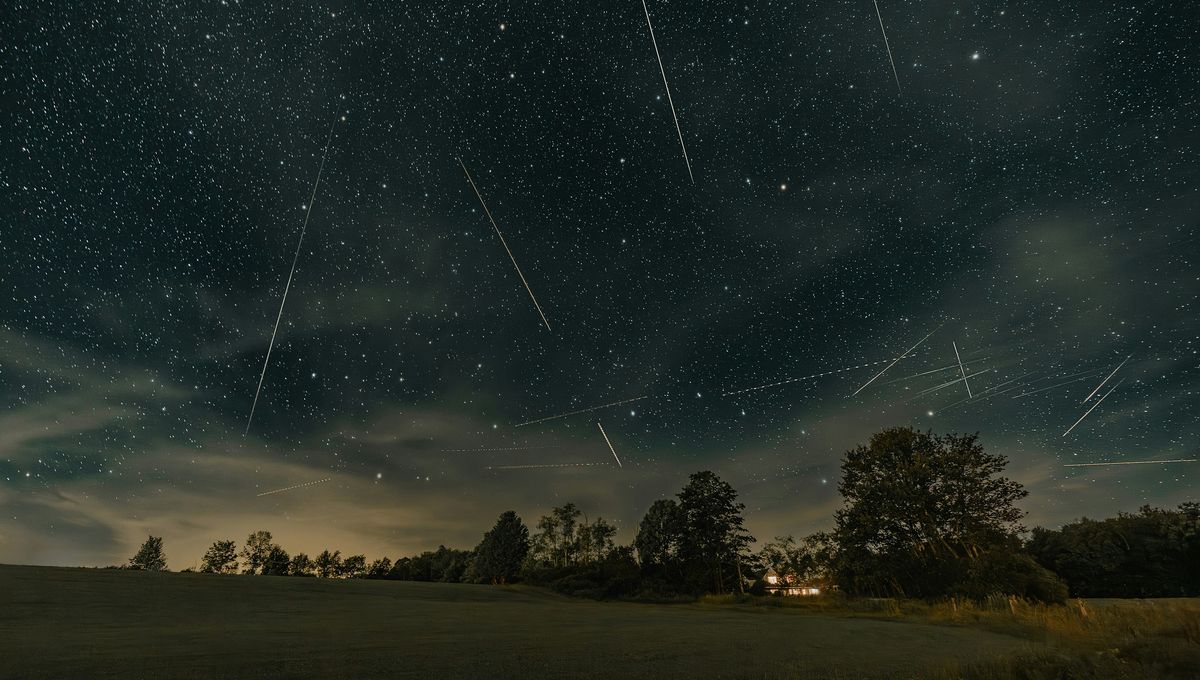
A recently discovered meteor shower that peaks just once every five years is expected to reach its crescendo this week. Known as the chi Cygnids, the rare shower has been slowly increasing in intensity since late August, leading to predictions that it could light up the sky between September 13 and 15.

The rest of this article is behind a paywall. Please sign in or subscribe to access the full content.

Actually, that’s probably a bit of an exaggeration, as this celestial debris field is far less dazzling than other famous meteor showers like the Perseids. As well as being fairly faint, the chi Cygnids are also somewhat few and far between, with just one or two appearing per hour during the peak of activity.


Still, there’s something undeniably special about catching a glimpse of a cosmic event that we didn’t even know existed until a decade ago. First observed by SETI Institute and NASA astronomer Peter Jenniskens in 2015, the chi Cygnids were then spotted again in 2020, while retrospective data showed that they also appeared in 2010.

A recent announcement from the SETI Institute documenting the detection of an uptick in chi Cygnid activity on September 3 would therefore appear to confirm the shower’s five-year periodicity – assuming the predicted peak later this month actually materializes.

And while all the signs suggest that this will indeed be the case, the fact that we still know so little about this rare spectacle introduces an element of doubt. For instance, we still haven’t figured out which comet is responsible for producing the debris that gives rise to the meteor shower whenever the Earth crosses its path.

According to Jenniskens, a possible candidate is an asteroid called 2020RF, which moves in sync with Jupiter and completes three orbits of the Sun for every seven completed by the gas giant. This means the comet circumnavigates the Sun once every 5.08 years, which ties in nicely with the periodicity of the chi Cygnids.

Should the meteor shower peak as expected, shooting stars will be seen to radiate from the star Chi Cygni in the constellation of Cygnus, the “Swan”. At this time of year, Cygnus appears high in the sky shortly after dark, which means the shower will be most visible in the evening rather than in the early hours of the morning – as is the case with the Perseids, the Geminids, and many other annual meteor showers.

Luckily, the Moon isn’t due to rise until around midnight on the nights of September 13 and 14, so anyone who’s able to get to a dark sky location should have a good chance of spotting this unusual cosmic event.

Deborah Bloomfield
Deborah Bloomfield

Related posts:

  1. GrubMarket gobbles up $120M at a $1B+ pre-money valuation to take on the grocery supply chain
  2. Japanese octogenarian skateboarder learns new tricks
  3. Cyborgs V “Holdout Humans”: What The World Might Be Like If Our Species Survives For A Million Years
  4. Atlas V Carrying Final National Security Mission Launches Today – Watch Here

Source Link: “Something Undeniably Special”: The Chi Cygnids, A New Five-Yearly Meteor Shower, Peak This Month

Filed Under: News

Primary Sidebar

  • US Just Killed NASA’s Mars Sample Return Mission – So What Happens Now?
  • Art Sleuths May Have Recovered Traces Of Da Vinci’s DNA From One Of His Drawings
  • Countries With The Most Narcissists Identified By 45,000-Person Study, And The Results Might Surprise You
  • World’s Oldest Poison Arrows Were Used By Hunters 60,000 Years Ago
  • The Real Reason You Shouldn’t Eat (Most) Raw Cookie Dough
  • Antarctic Scientists Have Just Moved The South Pole – Literally
  • “What We Have Is A Very Good Candidate”: Has The Ancestor Of Homo Sapiens Finally Been Found In Africa?
  • Europe’s Missing Ceratopsian Dinosaurs Have Been Found And They’re Quite Diverse
  • Why Don’t Snorers Wake Themselves Up?
  • Endangered “Northern Native Cat” Captured On Camera For The First Time In 80 Years At Australian Sanctuary
  • Watch 25 Years Of A Supernova Expanding Into Space Squeezed Into This 40-Second NASA Video
  • “Diet Stacking” Trend Could Be Seriously Bad For Your Health
  • Meet The Psychedelic Earth Tiger, A Funky Addition To “10 Species To Watch” In 2026
  • The Weird Mystery Of The “Einstein Desert” In The Hunt For Rogue Planets
  • NASA Astronaut Charles Duke Left A Touching Photograph And Message On The Moon In 1972
  • How Multilingual Are You? This New Language Calculator Lets You Find Out In A Minute
  • Europa’s Seabed Might Be Too Quiet For Life: “The Energy Just Doesn’t Seem To Be There”
  • Amoebae: The Microscopic Health Threat Lurking In Our Water Supplies. Are We Taking Them Seriously?
  • The Last Dogs In Antarctica Were Kicked Out In April 1994 By An International Treaty
  • Interstellar Comet 3I/ATLAS Snapped By NASA’s Europa Mission: “We’re Still Scratching Our Heads About Some Of The Things We’re Seeing”
  • Business
  • Health
  • News
  • Science
  • Technology
  • +1 718 874 1545
  • +91 78878 22626
  • [email protected]
Office Address
Prudour Pvt. Ltd. 420 Lexington Avenue Suite 300 New York City, NY 10170.

Powered by Prudour Network

Copyrights © 2026 · Medical Market Report. All Rights Reserved.

Go to mobile version