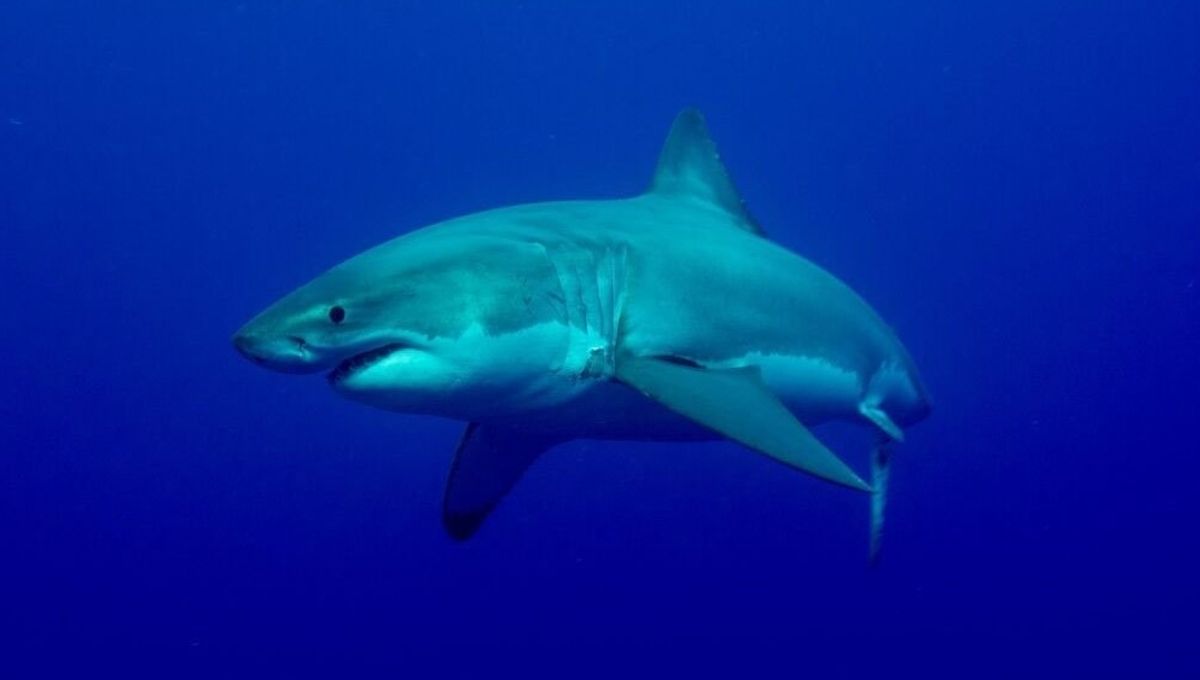
In more than 30 years of monitoring, Canadian wildlife agencies never found a single dead great white shark. Then, in the course of a year, five washed up – and nobody knows why.
ADVERTISEMENT GO AD FREE
The Canadian sharks join four previously found dead in US waters – all under similarly perplexing circumstances. There were no signs of starvation; no injuries that would have killed them. But microscopic testing eventually revealed the culprit: meningoencephalitis, an inflammation of the brain tissue and surrounding membranes that can eventually impact cognitive function. In a shark, that could translate to an inability to feed or swim properly, causing them to get beached more easily.
But meningoencephalitis is a symptom, not a disease – and what caused the inflammation, experts don’t know. That has them worried.
“Three of these five seem to have the same potentially infectious disease affecting their brain,” Megan Jones, a veterinary pathologist at the Atlantic Veterinary College and regional director of the Canadian Wildlife Health Cooperative, or CWHC, told the New York Times. “We need to know more about what that is.”
It’s bad news for a species that’s already in danger – and especially for this particular population, which has only just begun to recover from the consequences of overhunting and fishing in the area.
“Overall, sharks are not doing great,” shark conservation scientist David Shiffman told IFLScience. “They are one of the most threatened groups of vertebrates in the world.”
“About a third of all known species of sharks and their relatives, which are the skates, the rays, and the chimeras, are assessed as threatened with extinction by the IUCN Red List,” Shiffman pointed out. But “the United States, at least for now, is one of the bright spots of shark conservation,” he added, thanks in a large part to the rise of science-based conservation and management planning.
ADVERTISEMENT GO AD FREE
It’s for that reason, he explained, that North Atlantic great white sharks are something of an enigma – at least in comparison with other populations of the species. “They’re relatively not that well studied,” he told IFLScience, but it’s because “they have only recently, relatively recently, returned to these areas.”
A mysterious and fatal disease spreading through the local population is, therefore, a worrying proposition – even if it has, so far, only been found in a handful of individuals.
“I feel very strongly that there’s something significant going on,” Alisa (Harley) Newton, the chief veterinarian for shark research organization OCEARCH – the people behind Shark Tracker – told the New York Times. She was the first to notice meningoencephalitis in a great white, having identified it back in 2022 in a sample of brain tissue taken from a shark that washed up in Long Island, New York.
Other samples, from shark carcasses found as far apart as Prince Edward Island, Canada, and South Carolina, USA, have revealed the same mysterious inflammation – but as of yet, the cause is still unknown. Hopefully, some clues may soon be discovered: Newton has submitted brain tissue from the shark found in South Carolina to the Washington Animal Disease Diagnostic Laboratory for genetic sequencing, which may reveal any virus or bacteria that could be behind the meningoencephalitis.
ADVERTISEMENT GO AD FREE
Until the results come back, however, the puzzle remains unsolved. The North Atlantic great white sharks stay in their precarious situation – and so too, therefore, does the entire ecosystem.
“They’re an iconic species. They’re really important to the ecosystem,” Shiffman told IFLScience. “Generally speaking, predators help keep the food chain in balance.”
“If you want a healthy ecosystem, you want a healthy food chain,” he said, “and that means you need a healthy top of the food chain.”

Source Link: Something Weird Is Killing Great White Sharks In The North Atlantic
