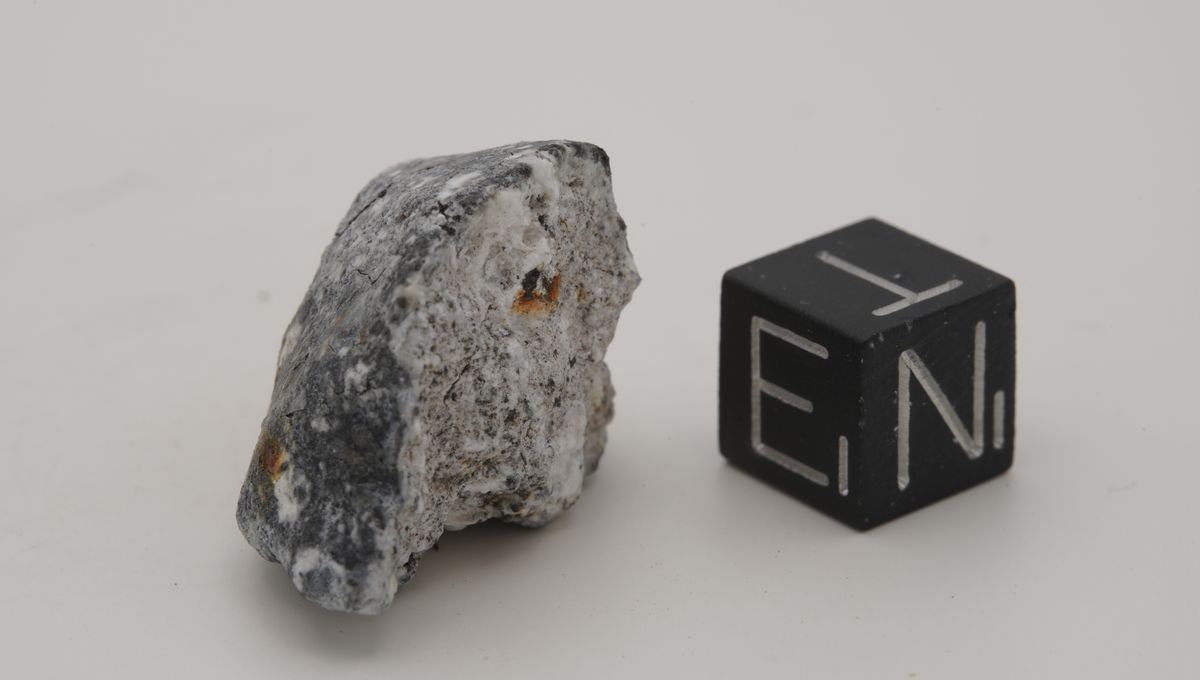
In the early hours of January 21, asteroid 2024 BX1 flew through the atmosphere over Germany, burning up and breaking apart about 100 kilometers (62 miles) west of Berlin. It was only the eighth asteroid ever predicted to collide with Earth before it hit the planet, giving us a rare 95-minute warning. This led to a scientific hunt for possible meteorites and quickly one was found – which has turned out to be a very rare find.
Researchers from the Museum für Naturkunde Berlin as well as colleagues from the Freie Universität Berlin and the German Aerospace Center initially recovered the walnut-sized meteorite from a field in the town of Ribbeck, about 80 kilometers north-west of Berlin. Analysis of the rock suggests that it is in the rare group of achondrites known as aubrites. There are only 87 known samples of this type of space rock from just 17 sites globally.
“Based on a comparison against the Aubrés fall, we were able to make a rough classification of the Ribbeck meteorites relatively quickly,” Dr Ansgar Greshake, scientific head of the museum’s Meteorite Collection, said in a statement. “This underlines the immense importance of scientific collections for research. So far, there is only material from eleven observed aubrite falls in collections worldwide.”
Aubrites look very different from other meteorites. They are typically light-colored and if they have a fusion crust then they are brownish, a difference that stems from their peculiar composition. The team has now found 20 meteorite samples, the analysis of which is ongoing. Electron microprobes of the first revealed the kinship to aubrites.
“Aubrites look more like a grayish granite and consist mainly of the magnesium silicates enstatite and forsterite,” explained Dr Christopher Hamann, who was involved in the meteorite’s initial classification and is with the museum’s Solar System, Impacts and Meteorites department.
“It contains hardly any iron and the fusion crust, a thin, tell-tale layer of quenched melt coating meteorites and which typically allows identifying them as such in the field, looks completely different than that of most other meteorites. Aubrites are therefore difficult to detect in the field.”
The peculiar mineralogical structures seen in aubrites suggest that their parent body must have had a violent history. Not that their parent body is known. One hypothesis is that the parent belongs to the E-type asteroids in the Solar System’s inner Asteroid Belt that are thought to have achondrite surfaces. Or maybe they were broken off from a near-Earth object, 3103 Eger, which is also an E-type but gets very close to Earth. Another suggestion is that they are pieces of another planet: Mercury.
The samples were submitted to the Nomenclature Committee of the Meteoritical Society on February 2 for examination and confirmation. Hopefully, we might find out more about these rare types of meteorites.

Source Link: Space Rock That Exploded Over Germany Turns Out To Be Very Rare Meteorite
